As the Trump administration weighs a potential military strike against Iran, Pentagon planners are grappling with a diminished supply of missile interceptors needed to protect U.S. troops and allies from the counterattack that Tehran has promised to unleash in response.
Defending U.S. forces as well as Israel after America’s June attack on Iranian nuclear sites has “severely affected” the Pentagon’s stockpiles of these weapons, analysts say. So, too, has the war in Ukraine. All of this comes in the same week that a key nuclear arms control treaty with Russia is expiring.
Matters of missile defense gained more urgency with reports Wednesday that talks scheduled for Friday in Oman between the United States and Iran were being scrapped. They are back on, but the precarious nature of the negotiations set off more speculation about an impending U.S. military action.
Why We Wrote This
The Pentagon is burning through its missile interceptors at an unsustainable rate, leaving stockpiles low. An Iranian counterattack would deepen the dent. With no quick fix, the United States is working to resupply weapons.
“These are scarce resources,” Tom Karako, director of the Missile Defense Project at the Center for Strategic and International Studies (CSIS) think tank, said during a briefing last month. The U.S. has been firing “a lot of missile defense interceptors lately,” he added, raising questions: “Are we running out? And what are we going to do to produce more of them?”
If the U.S. supply of defense weapons is being depleted, so is Iran’s missile arsenal. But Tehran still has thousands of weapons capable of reaching U.S. ships and bases in the region, analysts say. Militias sympathetic to the regime have pledged to join in any counterattack.
And while Tehran has been careful not to escalate in the past – Iran’s counterstrike on U.S. forces at Al Udeid base in Qatar last summer came with advance warning – a potential U.S. military operation this time could spark the regime to launch an all-or-nothing bid to retain its grip on power.

Mass Communication Specialist Seaman Daniel Kimmelman/U.S. Navy/AP
In what some observers say is a turning point in its willingness to abandon any pretense of peace or reform in favor of survival, Tehran last month violently suppressed one of the most serious waves of domestic unrest it has faced since the regime’s founding in 1979, killing thousands of people.
“The message is they’ve got to show humanity,” President Donald Trump said of the regime on Jan. 13 as the crackdown began.
U.S. officials are also demanding nuclear concessions from Iran, a nation with which it has had no formal diplomatic ties since 1980. Mr. Trump has cited nuclear weapons proliferation as a top concern – one brought into sharp relief this week as America’s landmark nuclear arms control agreement with Russia, the New Strategic Arms Reduction Treaty (START), expires Thursday.
Rattling sabers, limiting policy possibilities
The recent arrival of the USS Abraham Lincoln aircraft carrier strike group in the Middle East is ratcheting up pressure on Tehran and raising the potential for escalation. A U.S. fighter jet shot down an Iranian drone Tuesday when it “unnecessarily maneuvered” in the ship’s direction, a statement from U.S. Central Command said.
“Any unsafe and unprofessional behavior near U.S. forces, regional partners, or commercial vessels increases risks of collision, escalation, and destabilization,” the command warned.
The aircraft carrier and other U.S. assets in the region provide the Trump administration with options for military force. The three U.S. Navy guided-missile destroyers accompanying the USS Abraham Lincoln also carry air defenses and dozens of missiles.
Yet as U.S. officials make diplomatic moves in the days to come, “They will have to consider the constraints and limits on the number of [U.S.] interceptors and air and missile defense assets,” says Wes Rumbaugh, a fellow with CSIS’ Missile Defense Project.
As it stands now, he adds, those calculations amount to a “meaningful constraint on their ability to achieve foreign policy goals.”
Taking stock of diminished stocks
When Iran fired more than 180 ballistic missiles at Israel in October 2024, some defense analysts estimated that in helping defend its ally against the barrage, the U.S. military used a one-year supply of its missile defense interceptors in a single day.

U.S. officials began warning that supplies were running low.
Shortly after taking office, the Trump administration reportedly reviewed the nation’s depleted stocks of Patriot missiles with an eye toward increasing production.
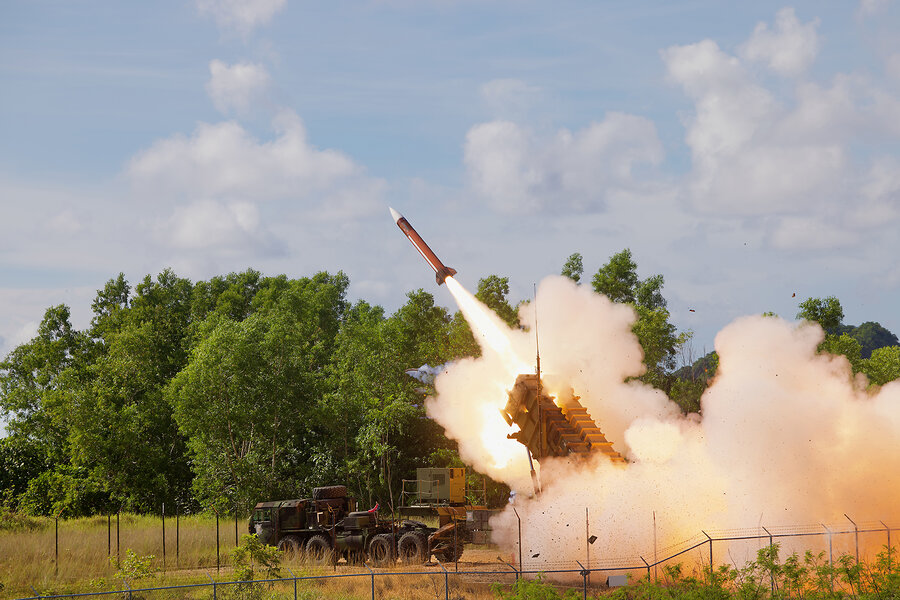
Then last June, the U.S. military fired some 150 interceptor missiles from its Terminal High Altitude Area Defense, or THAAD, systems, during Israel’s 12-day war with Tehran. This single operation depleted roughly 25% of the U.S. military’s total THAAD interceptor stockpile, analysts say.
THAAD systems are a precious resource for the Pentagon – the Army operates only eight THAAD batteries in its arsenal. Each battery includes truck-mounted launchers to intercept incoming missiles at high altitudes and specializes in taking out short- and medium-range ballistic missiles. The challenge of replacing these interceptors is significant, as production has averaged only a dozen new missiles a year.
Just days after the U.S. used 30 Patriot missiles to intercept Iranian missiles shot at Al Udeid base in Qatar, President Trump, speaking at a NATO summit, noted that while he was aware that Ukraine wanted “antimissile missiles,” as he called them, “they’re very hard to get. We need them, too.”
The Trump administration then briefly froze shipments of Patriot weapons to Ukraine. There were concerns that the U.S. was running low on supplies, officials said, with only a quarter of the needed Patriot missile interceptors in its stockpile.
By some estimates, Europe has only about 5% of the air defense systems it needs to protect its eastern border from a war with Moscow. This gap in defenses was laid bare in September, analysts say, when Russian drones passed more than 100 miles into Polish airspace. Europe currently owns about 30 U.S.-made Patriot weapons.
How to rebuild defense stockpiles
In response to concerns that current U.S. stockpiles are low, efforts are now underway to accelerate America’s production of missile defense interceptors.
The Army’s 2025 budget request included a 77% increase in air and missile defense capabilities compared with the previous year.
The Pentagon also created a new Munitions Acceleration Council last year to help eliminate bottlenecks in U.S. weapons production. That council is being spearheaded by Deputy Secretary of Defense Steve Feinberg, who is reportedly holding weekly calls with defense contractors to push for increased capacity.
To this end, last month, the Defense Department announced two big deals with defense contractor Lockheed Martin to more than triple production of Patriot missile interceptors from some 600 to 2,000 per year and grow THAAD interceptor production from 96 to 400 missiles annually.
“The Trump administration has obviously made ramping up munitions production, missile defense munitions production a pretty high priority,” Mr. Rumbaugh of CSIS says.
For now, Gen. James Mingus, the vice chief of staff of the Army, pointed out in a discussion last July that the number of Patriot air defense battalions deployed to the Middle East was modest.
That number is one. And the lone defense system has been deployed there “for close to 500 days,” said General Mingus, the second-highest-ranking officer in the U.S. Army.
It is the element within the military force, he added, that remains “our most stressed.”