Fifty years ago, then-Attorney General Edward Levi issued a warning about the perils of political interference in law enforcement.
“Popular governments are prone to cycles,” he said in 1976. “We are in such a period of cyclical reaction today, justifying what we do now as a kind of getting even with the events of prior years.”
Levi was speaking from experience. He became the attorney general in the aftermath of Watergate, when public trust in government had cratered, and he is often credited with having restored the Justice Department’s credibility as a nonpartisan law enforcement agency.
Why We Wrote This
Reforms following Watergate strengthened the Justice Department’s independence and restored public confidence. Now, amid the Trump administration’s pressure on DOJ norms, polls show that half of Americans doubt that federal law enforcement is fair and impartial.
Now, the DOJ appears to be experiencing another “cyclical reaction.”
The agency has prosecuted two of President Donald Trump’s political adversaries: the New York attorney general and a former FBI director. As Mr. Trump has pressured the Federal Reserve to lower interest rates, the Justice Department has launched investigations into the Fed chair and another governor at the central bank. One of Mr. Trump’s first acts upon taking office last year was to pardon those convicted in connection with the Jan. 6, 2021, Capitol riot, whom he called political prisoners. His administration subsequently purged the DOJ and the FBI of career employees who had worked on those prosecutions.
Between his first and second terms, Mr. Trump faced four separate criminal prosecutions, including two initiated by the Biden administration’s Justice Department. Many Republicans criticized those prosecutions as politically motivated. When he returned to the White House, Mr. Trump issued an executive order that denounced the Biden administration for engaging in “a systematic campaign against its perceived political opponents.”
Ever since, however, his administration has appeared to be carrying out its own campaign of weaponized justice that’s ramped up notably in recent months, according to interviews with former Justice Department prosecutors and legal scholars.
One result: Polls show half the country doubts whether federal law enforcement is fair and impartial.
“The Justice Department has always been a standard bearer for professionalism and integrity and ethics,” says Kami Chavis, a former federal prosecutor who now teaches at William & Mary Law School. “We have really held those attorneys in the highest esteem, and now that is all being thrown into question.”

Testing the traditional firewall
Every president enters office with the prerogative to set new priorities for the Justice Department. Mr. Trump campaigned to do just that, promising to focus on stricter immigration enforcement and crack down on fentanyl trafficking, among other things. But he promised more: to turn the political “lawfare” he claims Democrats had waged against him and his supporters back against those aggressors.
“I am your retribution,” he pledged in a 2023 speech at the Conservative Political Action Conference, held just outside Washington.
While the DOJ is equipped to shift enforcement priorities from administration to administration, it is designed to resist political influence. The department’s key leaders – such as the attorney general and the U.S. attorneys leading regional offices – are nominated by the president and confirmed by the Senate. Yet those leaders oversee more than 10,000 career prosecutors and civil lawyers who expect to work under presidents from both parties.
There are no laws or constitutional requirements that the Justice Department operate independently from the rest of the executive branch. Instead, the firewall between the White House and Justice has been held together by intangibles such as norms, policies, and legal ethics.
This Trump administration has tested that firewall in unprecedented ways.
Even before Mr. Trump returned to office, some of his allies were laying plans for reforms to the Justice Department. Project 2025, the conservative policymaking blueprint for the administration, stated that failing to reform the agency – including weeding out “radical Left” employees and ending “viewpoint-based enforcement” – would “guarantee the failure of that conservative Administration’s agenda.”
But reform efforts have clashed with long-standing DOJ norms and policies, fueling perceptions that the department is still being used as a political weapon.
Reports suggest that dozens of federal prosecutors have either resigned or been fired for refusing to file charges that aren’t supported by probable cause, a violation of professional conduct rules. Other reports suggest that White House officials – including Mr. Trump himself – have directly discussed investigations with DOJ employees, a violation of the department’s contacts policy.
Polling from the past year shows a decline in public confidence in the Justice Department. While Republicans currently have more trust in the agency – a 180-degree reversal from the Biden years – that support is also starting to waver.
An August survey from the Pew Research Center found that fewer than 4 in 10 Americans had a favorable view of the department, compared with 51% of Republicans. Another Pew poll, conducted last month, found that only 42% of Republicans say they are confident Mr. Trump is acting ethically in office, a 13-point decline from the start of his term a year ago.

“A chain of command”
Chad Mizelle, a close ally of Trump officials who has worked in both Trump administrations, posted a hiring announcement on X last weekend. The Justice Department, he wrote, is interested in hiring “good prosecutors” who “support President Trump and [his] anti-crime agenda.”
The post quickly drew attention, including from Ed Whelan, a conservative lawyer with experience at the department, who commented that “it would be good to know if DOJ is taking the position that support for the president is a lawful criterion in hiring [assistant U.S. attorneys].”
Yet this job post is consistent with how Mr. Trump’s Justice Department appointees believe the department should operate: as an agency subject to direct presidential control like any other part of the executive branch.
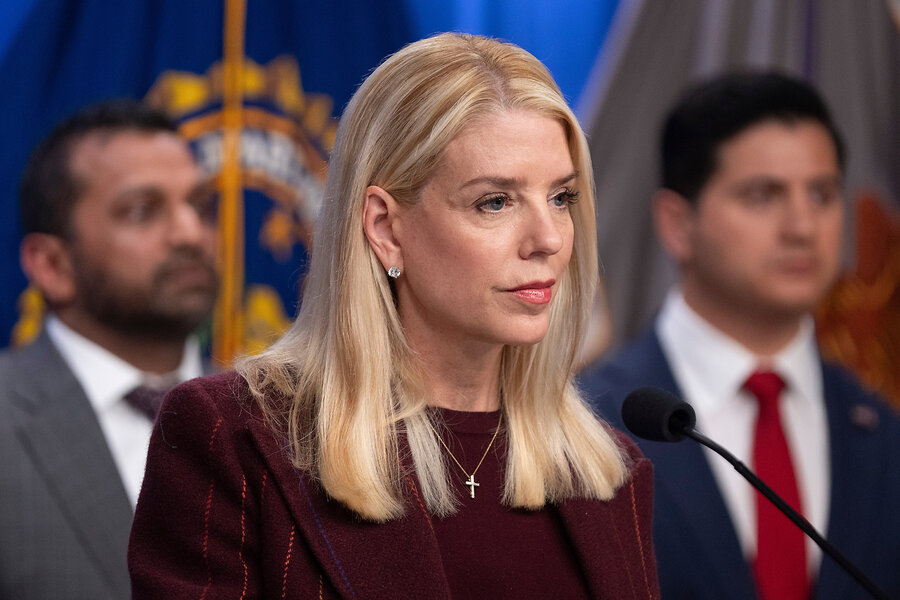
In a memo issued shortly after taking office, Attorney General Pam Bondi wrote that DOJ attorneys must “zealously defend the interests of the United States.” Those interests, she added, “are set by the Nation’s Chief Executive.”
Federal prosecutors “are not independent, they don’t work for themselves,” says Mike Davis, founder of the Article III Project, a group that advocates confirming conservative judges to the federal courts. “They work in a chain of command that reports to the president, who is elected by Americans.”
But that kind of apparent loyalty test for an agency whose job is to protect all Americans’ constitutional freedoms could set the country “down a very dangerous path,” says Jeffrey Cohen, a former Justice Department prosecutor who now teaches at Boston College Law School.
The incentives to file trumped-up charges to please the president would be rife in such a scenario.
If the president “can tell the attorney general the people he or she wants prosecuted … that seems very different from the president setting priorities,” Mr. Cohen adds.
Political prosecutions, unusual contacts
There are suggestions that the Justice Department has already been trying to carry out the president’s personal wishes.
Former FBI Director James Comey and New York Attorney General Letitia James – both longtime Trump adversaries – faced criminal charges. Both had their cases dismissed last year after a judge ruled that the interim U.S. attorney who filed the charges, Lindsey Halligan, had been appointed unlawfully.
Lisa Cook, a member of the Federal Reserve board of governors, is under criminal investigation for mortgage fraud. She has yet to be formally charged. Jerome Powell, the Fed chair, announced on Jan. 11 that he is now under DOJ investigation for cost overruns on renovations to historic Fed buildings.

It’s unclear whether Mr. Trump personally pressured the Justice Department to pursue these cases behind the scenes. But the president’s public statements alone can be seen as exerting unusual influence. He has been highly critical of Mr. Powell for months, while publicly pushing for the central bank to lower interest rates more aggressively to help stimulate the economy.
In the cases of Mr. Comey and Ms. James, Mr. Trump mentioned them by name in a social media post last fall. “We can’t delay any longer,” he wrote. “JUSTICE MUST BE SERVED, NOW!” The post, which began with “Pam,” might have been intended as a private message to Ms. Bondi.
Two other foes – John Bolton, a former Trump national security adviser, and John Brennan, a former CIA director – are also in the Justice Department’s crosshairs. Mr. Bolton is under indictment for mishandling classified documents, while Mr. Brennan is being investigated for making false statements to Congress.
Mass resignations
Waves of mass resignations have also marked a year of turbulence at the DOJ.
Seven prosecutors in the department’s vaunted Manhattan office and in its Public Integrity Unit quit instead of signing on to the motion to dismiss bribery and fraud charges against Eric Adams, then the mayor of New York City. The dismissal came as the Trump administration sought the city’s cooperation with its immigration enforcement campaign.
“Our laws and traditions do not allow using the prosecutorial power to influence other citizens, much less elected officials, in this way,” wrote one prosecutor in his resignation letter.
Between January and June last year, nine DOJ civil rights lawyers resigned after working on investigations into antisemitism on University of California campuses. Senior department officials, they claimed, pressured them to bring charges despite having insufficient evidence.
Ms. Halligan ended up leading the Comey and James cases because the man she replaced, Erik Siebert, the interim U.S. Attorney for the Eastern District of Virginia, had resigned under pressure after going months without filing charges against Ms. James.
And in recent weeks, at least 14 federal prosecutors in Minnesota have reportedly resigned amid investigations into the fatal shootings of Renee Good and Alex Pretti by federal immigration agents in Minneapolis. Some of the prosecutors resigned in protest of a DOJ directive to investigate Ms. Good’s partner. (When asked to comment on the resignations, a department spokesperson referred to Ms. Bondi’s “zealous advocacy” memo.)
Credibility and weaponization
Some Republicans in Congress have begun raising concerns about the Justice Department’s conduct. The Powell investigation, specifically, has drawn condemnation.
“It is now the independence and credibility of the Department of Justice that are in question,” said Sen. Thom Tillis of North Carolina, in a Jan. 11 statement.
“If the Department of Justice believes an investigation into Chair Powell is warranted based on project cost overruns – which are not unusual – then Congress needs to investigate the Department of Justice,” said Sen. Lisa Murkowski of Alaska on Jan. 12.
The Trump administration, however, is reportedly looking to increase the workload of the Weaponization Working Group, which Ms. Bondi formed last year to investigate alleged political prosecutions carried out by the DOJ during the Biden administration. The department recently removed Ed Martin – a Trump ally and former interim U.S. attorney for the District of Columbia – from leading the working group, in part because an investigation found he had leaked grand jury materials related to a mortgage fraud prosecution of another Trump foe, Democratic Sen. Adam Schiff of California.
The working group has not been involved in most cases against Mr. Trump’s adversaries. Still, the Justice Department’s work so far is illustrating just how fragile the agency’s independence from politics has always been, says Paul Butler, a former federal prosecutor who now teaches at Georgetown University Law Center.
“There’s nothing per se that’s illegal about Trump ordering criminal investigations or prosecutions of people he doesn’t like,” he adds. “That’s only been the norm; it hasn’t been a formal law.”