This article is taken from the February 2026 issue of The Critic. To get the full magazine why not subscribe? Get five issues for just £25.
One of the many complaints about today’s culture is that it has somehow become “stuck”. According to this view, artists are unable to give rise to new forms that would take hold in the popular imagination. This may be because legacy cultural institutions resist new ideas, preferring to cling to safe but failing paradigms. It could also be because artists themselves are unwilling, or lack the vision necessary, to compete with runaway aesthetic development in fields like AI.
To anyone dividing their attention between gallery programmes and social media feeds, both explanations make sense. On the one hand, culture feels stuck despite, if not because of, the culture wars animating mainstream institutions of late. Controversies like the boycott that closed Glasgow’s Centre for Contemporary Art for weeks reveal that turning artefacts into proxies for political positions is now the norm.
On the other hand, even bold attempts to overcome such limitations foreground organisational forms rather than ideas. For example, a recent funding call for “New Aesthetics”, underwritten by progressive-optimist technologists and thinkers, rooted its search for a new art in the historical success of the Bauhaus.
The proposal noted that today, “futuristic aesthetics often mean retro-futuristic aesthetics”. It thus unwittingly spurned repeated reflections on Italian Futurism, a movement whose much-discussed potential for unsticking 21st century art remains unrealised.
The problem thus lies in how we relate our present to the near but unknown future. Could it be that the proximity of the obstacle and the distance from a proven method of overcoming it mean that we are unable to see the trees for the wood?
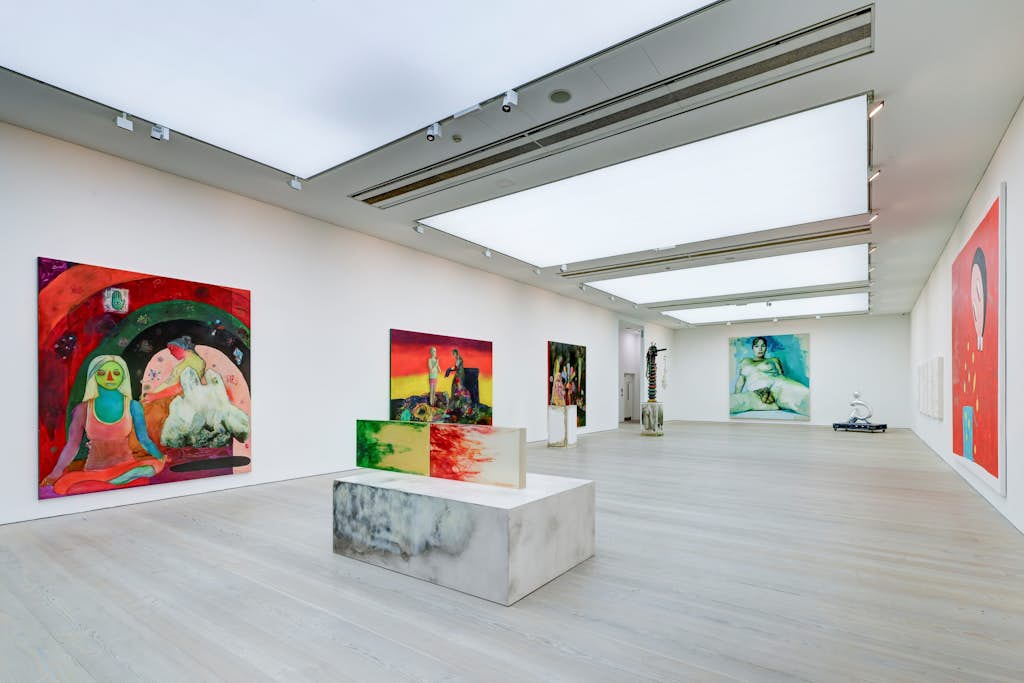
The Long Now, an exhibition marking the fortieth anniversary of the once pioneering Saatchi Gallery, offers an opportunity for reconsidering some of the turning points of visual culture’s projections.
The programmatically ahistorical nature of the show suggests that Saatchi Gallery’s trajectory from art historical centrality to near irrelevance is hard to reconcile even for the retrospective’s curator. The sprawling display basks not so much in the collection’s highlights as in the ideas that they gave rise to. The exhibition is thus a catalogue of four decades of novel artistic ideas, brought together as if they had all caught on.
The ad man Charles Saatchi’s private collection, which opened in a disused paint factory in 1985, was instrumental in introducing the mode of artistic production now known as “contemporary art” to Britain. Saatchi began by collecting American art. His former fondness for artists like Donald Judd echoes in The Long Now in the 2009 dyed urethane blocks of Sterling Ruby, whose garish colours are an overt critique of Minimalism.
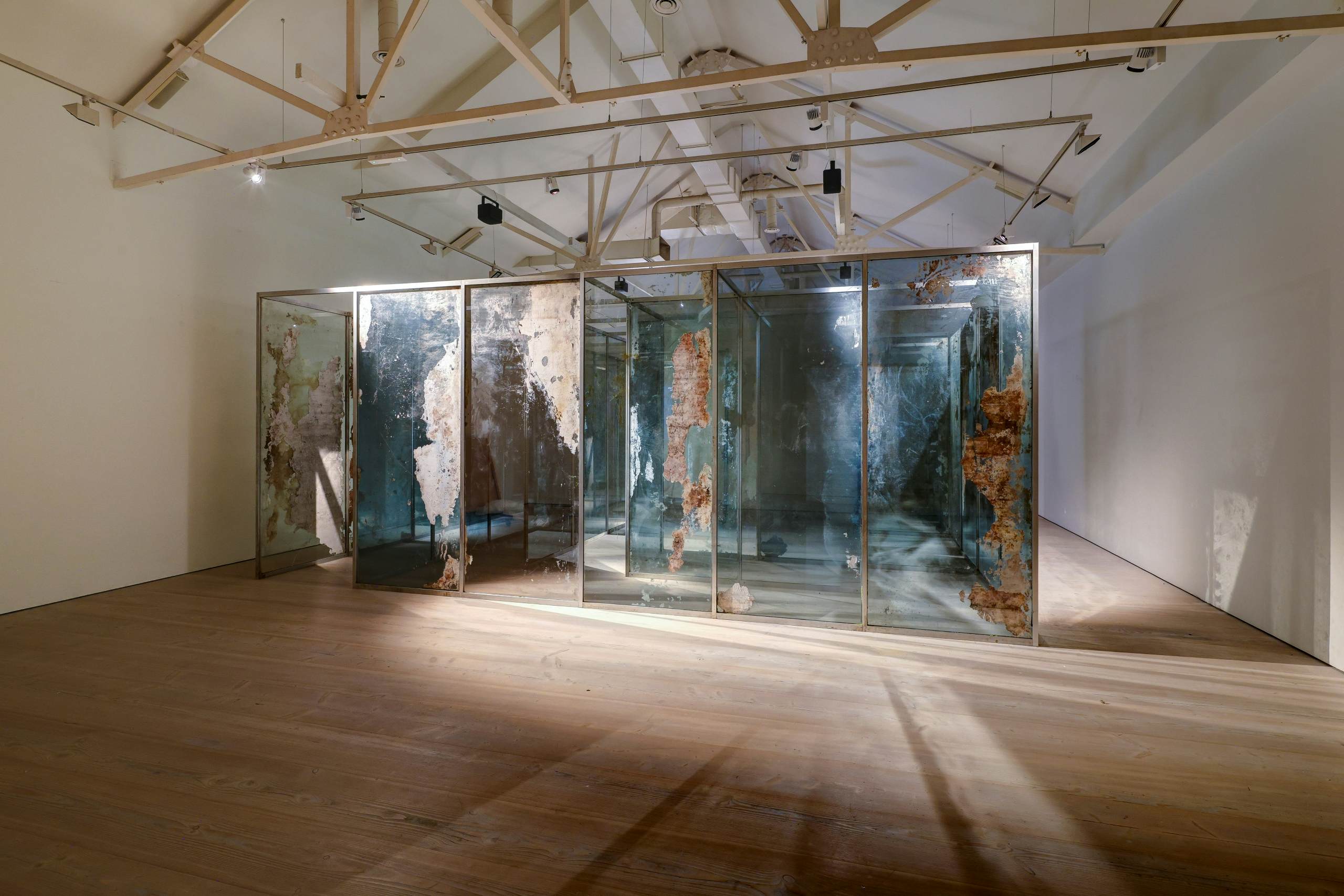
Saatchi changed his strategy often and without warning. His support contributed to the rise in the early 1990s of the generation of Young British Artists as much, if not more than, their bold aesthetic moves. Both have been the subject of critique, but Gavin Turk’s Bardo — an eerie reconstruction of his 2004 maze made from semi-translucent mirrors — proves that even the movement’s one-liners may have lasting value.
The 2000s saw a change in Saatchi’s fortunes as the London art world also learned how to tug at aesthetic and financial strings. The gallery’s short stint in County Hall was full of attention-grabbing spats with artists (including, infamously, Damien Hirst), but also The Triumph of Painting series of exhibitions, which established a generation of European painters, such as Marlene Dumas, on the UK scene.
Twenty years on, a section of The Long Now filled with painterly references to water brings together a bunch of middle-aged artists whose trajectories are incomparable to those of the earlier generation championed by Saatchi. Ryan Mosley’s Ballad, for example, shares some references with Peter Doig (who was part of Triumph), and Henry Hudson’s scagliola forces reflection of a much longer history of the medium.
Does this abrupt re-historicisation signal the lack of confidence in contemporary painting, or is the show’s uneven presentation of timelines, narratives and genres an extension of Saatchi’s self-sustaining belief in his taste? Since the gallery moved to the King’s Road in 2008, many of its projects have suffered, but also benefited, from this ambiguity (even though Saatchi hasn’t been involved in the programme since 2019).
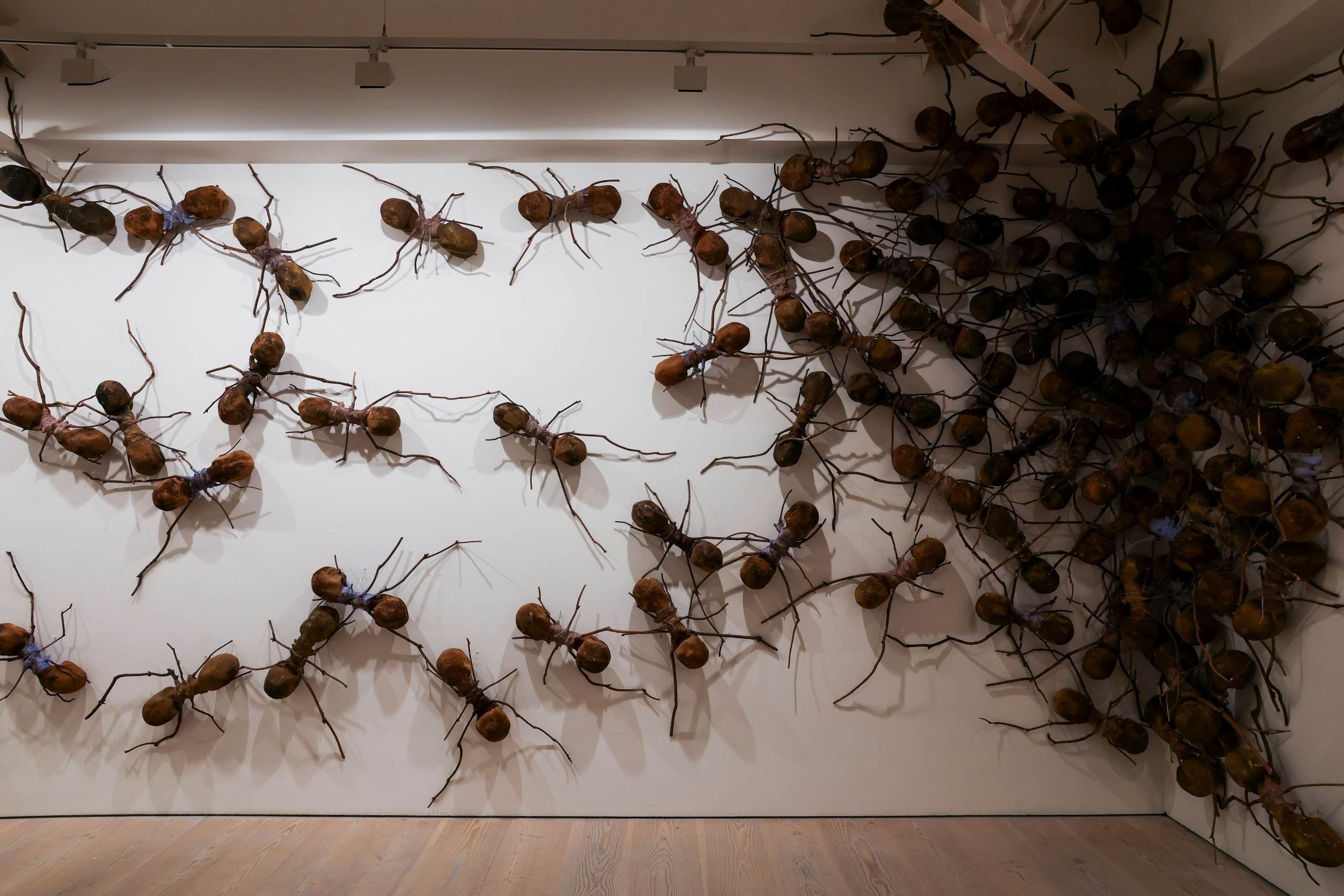
This is how the exhibition can include Allan Kaprow’s 1961 tyre pile Yard and a 2013 wall of Rafael Gómezbarros’s giant ants as if they addressed the same new present — and get away with it, just. Yet the now of Saatchi has long parted ways with the contemporary of the mainstream art world.
Did they ever coincide? Saatchi understood that art fostered ideas through mass exposure, and his role was to encourage a reckless, speculative productivism — without, however, giving up the possibility of rejecting its outcomes. The contemporary, by contrast, embraced heterogeneity, insisting that all art should be oriented towards an unspecified, yet better future.
Despite the near synonymity of the terms used to describe these approaches to artistic production, the attitudes give rise to a drastically different understanding of art’s role in shaping what comes next. Not a lot of The Long Now is lastingly good art — but could something like Saatchi’s obsession with the present help to propel our stuck culture more readily than the version of contemporaneity we have accepted as the default?
The Long Now is at the Saatchi Gallery until 1 March.