A watched kettle never boils, eh?
For years, Ozzie commentators, posters, politicians, and punters watched the wave of populism sweeping across Britain, Europe and America and wondered, “Where’s ours?” Somewhat embarrassingly, this author and many others (but I was first) had been promising (or rather, threatening) a populist backlash in Australia. Any day now! But it never came.
Trump won the White House three times before Australia even saw a hint of a similar anti-elite backlash here. Farage went from a fisherman to a parliamentarian. Le Pen stood aside for Bardella. Sweden and Denmark started politely sending migrants back. And yet, down under, there was nada: No populist movement, no backlash, nothing.
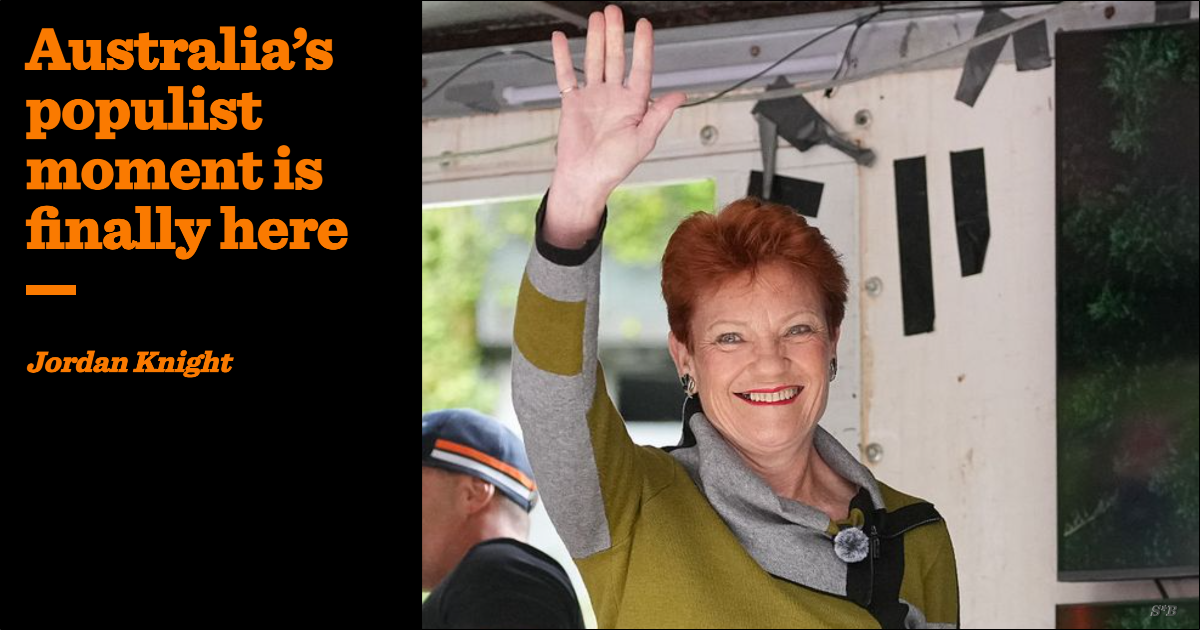
Until, finally, it happened all at once. Seemingly overnight, One Nation, headed by Pauline Hanson, a former fish and chip shop owner, began polling higher than Australia’s legacy centre-right party, the Liberal Party. This is unheard of. For years, Hanson’s One Nation was considered as good as dead, hovering around 5% in the polls, maintaining a meagre two senators in federal parliament whilst struggling to retain councillors, state MPs and staff.
That was until the Labor government opened the borders and brought in 1.3 million migrants in three years.
And then, one day, for no reason at all, everybody started supporting One Nation.
Polls showed that Australians were fairly ambivalent about immigration at the time that borders were reopening after COVID. That quickly changed. In 2023, the government brought in an astonishing 737,000 migrants. One in 36 people in Australia arrived in that year alone. Close to one million international students reside in the country. 12% of New Zealand’s population lives here. 1.5% of Bhutan’s population moved to Australia in one year. Indians replaced Brits as the top migrant group. I could go on (and I do, follow me on X).
Surprisingly, house prices and rental prices went through the roof. Real wages went backwards. Many people went homeless. After a traumatising two years, suffering some of the worst lockdowns in the world, Australians were then immediately subjected to one of the worst immigration programs in the world. Today, polls show that a majority of Australians want a pause in immigration. Even the most clear-eyed political analyst would have struggled to see that coming.
The similarities between Australia and Britain’s populist push are impossible to ignore. Our centre-right Coalition was in power for over a decade and was largely responsible for the mass immigration catastrophe we now enjoy. Even today, some within the party refuse even to use the term “mass immigration”. Like the Conservatives, the Liberal Party are becoming widely hated and increasingly irrelevant.
Online, calls for “Total Liberal Party Death” echo the anger that created the “Zero seats” meme. It’s not enough that Reform should win. The Conservative Party should suffer electoral humiliation. So too with the Liberal Party. Australia’s “online right” wants to salt the earth.
One Nation, like Reform, has also seen significant defections to its side. Barnaby Joyce was a former Deputy Prime Minister and leader of the National Party. He has now jumped ship to join One Nation, bringing enormous legitimacy to the party; others are tipped to follow.
We even have our own Robert Jenrick. Andrew Hastie, a former SAS soldier and Liberal Party MP from Western Australia — who many tipped to be the future leader and possible Prime Minister — saw the writing on the wall and tried to take the Liberals in a more populist direction. His leadership ambitions were cut short, the party remains led by its moderate faction, and nobody can say what it stands for.
Like Farage, Hanson has been a fixture of Australian politics since the 1990s. Like Farage, she and her party have seen a rollercoaster ride. Like Farage, she was attacked by the political class that she is now replacing for decades. Like Farage, she has been consistent on immigration for years. One Nation is a party whose time has come once again.
There were other signs of an oncoming populist backlash. In August last year, tens of thousands of Australians filled city streets calling for an end to mass migration. Being of Anglo origin Australians are not really the protesting type, so something was obviously afoot.
The question now is whether One Nation can last the distance and become the new opposition, let alone a party fit for government. Doing so would require professionalisation, new talent, and avoiding damaging scandals. Right now, it is succeeding on all three fronts.
But they do not have as long as their European counterparts to figure this out. Australia’s next election will probably take place in 2028, likely before the UK general election. Late to the party, Australia will find out first if populist politics can win beyond America. We’ll wait and see.