Jesy Nelson has been incredibly open about her twin babies’ SMA type one diagnosis in the hope of spreading awareness about the condition.
And the singer, 34, has addressed the tragic prognosis that Ocean Jade and Story Monroe, aged nine months, may not live beyond the age of two.
Genetic neuromuscular disease SMA1 causes progressive muscle weakness and wasting due to motor neuron loss.
Speaking to Jamie Laing on his Great Company podcast, Jesy, who recently split from the children’s father Zion Foster, 26, said she is hopeful that her babies will defy the odds now that they are receiving treatment and go on to have a longer life expectancy.
Jesy said: ‘So spinal muscular atrophy is a muscular wasting disease, so they don’t have a gene that we all have in our body.

Jesy Nelson has addressed the tragic prognosis that her twins Ocean and Story, nine months, may not live beyond the age of two following their SMA type one diagnosis
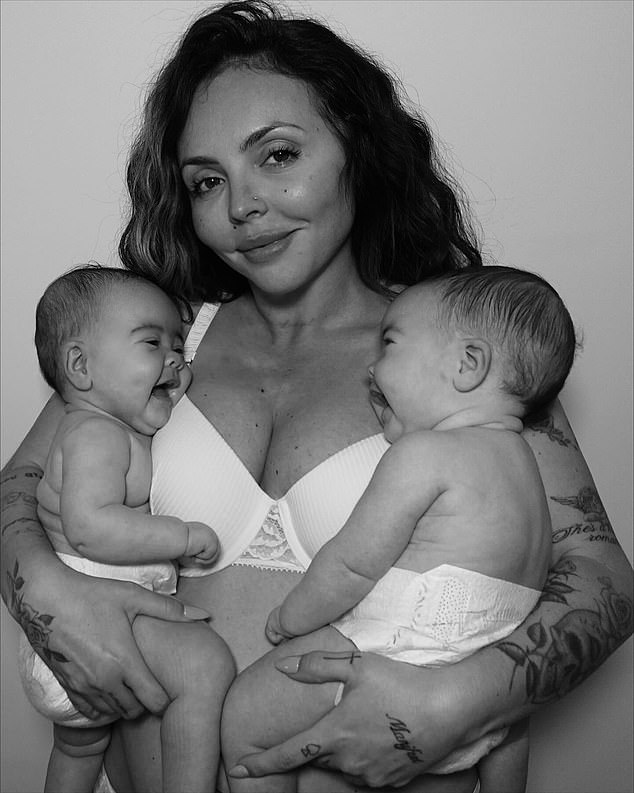
Speaking to Jamie Laing on his Great Company podcast, Jesy, who recently split from the children’s father Zion Foster, 26, said she is hopeful that her babies will defy the odds now that they are receiving treatment and go on to have a longer life expectancy
‘Their muscles are now deteriorating and wasting away, and if you don’t get them treatment in time, eventually the muscles will all just die, which then affects the breathing, the swallowing, everything. And they will die before the age of two.
‘It’s not okay, but it is what it is, and I just have to accept it, and now just try and make the best out of this situation… And my girls are the strongest, most resilient babies and I really believe that they are going to defy all the odds.’
Former Little Mix singer Jesy has demanded the NHS expand the standard heel prick to check for spinal muscular atrophy.
Tests cost around £1 each and the twins ‘could have saved their legs’ with early treatment.
Moreover, Jesy’s twins had TTTS [Twin-to-twin transfusion syndrome] while in the womb and were born prematurely at 31 weeks.
She said: ‘They had TTTS which affects a rare percentage of identical twins, and that means, if you it’s when there’s only one placenta that both the babies feed off of, and it’s cr*p for both of them, because one will get more of the nutrients and one won’t.
‘But either way, doesn’t matter. Even the baby that’s getting too many nutrients, it still affects them. It’s not good. And so if you don’t get treatment for that, they will die. It’s like, 95 per cent, that they won’t survive.’
Since becoming a mother, Jesy said she found a strength within herself that she didn’t have before.

Genetic neuromuscular disease SMA1 causes progressive muscle weakness and wasting due to motor neuron loss (pictured: Ocean and Story, nine months)


Jesy said: ‘So spinal muscular atrophy is a muscular wasting disease, so they don’t have a gene that we all have in our body’

Jesy said: ‘Their muscles are now deteriorating and wasting away, and if you don’t get them treatment in time, eventually the muscles will all just die, which then affects the breathing, the swallowing, everything. And they will die before the age of two’
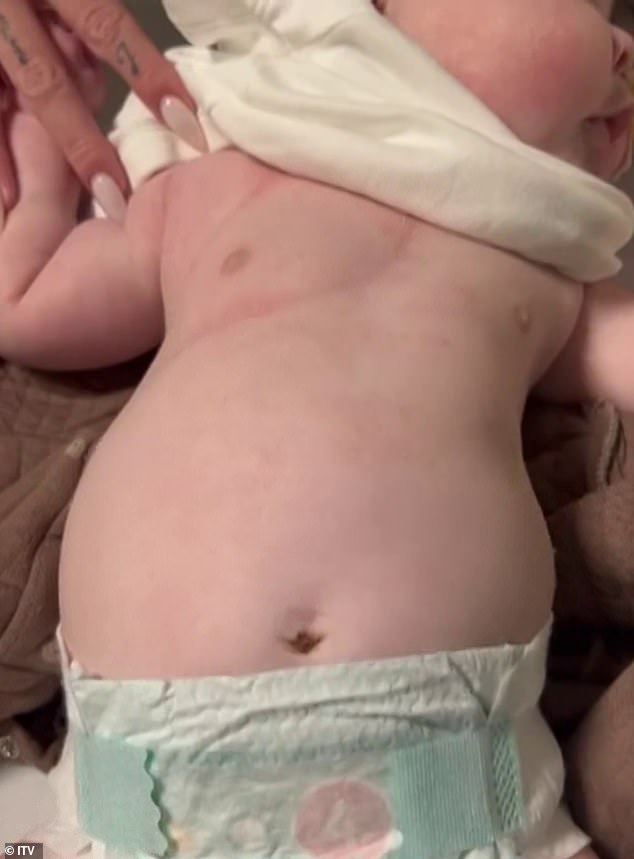
Former Little Mix singer Jesy has demanded the NHS expand the standard heel prick to check for spinal muscular atrophy. Tests cost around £1 each and doctors ‘could have saved their legs’ with early treatment

Jesy never wanted children and ‘did not have one maternal bone in her body’, so she was surprised to discover she was pregnant with twins
She said: ‘I feel like I don’t really matter anymore, like they are, like my whole heart and soul, and like I have to just get on with it.
‘Before, things that seem now seem so just ridiculous to me that I used to worry about I’d sit in bed and I’d cry and I’d feel sorry for myself, and I’d have days where I just wouldn’t even get out of bed.
‘And now, I don’t have a choice to do that, because I have to just get on with it. It’s s**t. It’s really f***ing s**t. But at the same time, I’m just still so blessed because my girls are, they are literally superhuman, honestly, like I look at them and every day they are happy, and I’m like, What have I created?
‘The s**t that they’ve had to go through, and they’re still happy and smiling, and I’m like, that almost thing gives me even more like strength to be like, Well, what gives me the reason to be sad?’
Jesy never wanted children and ‘did not have one maternal bone in her body’, so she was surprised to discover she was pregnant with twins, two years into her relationship with Zion and discovered she was ‘so happy’ about it.
She remained in hospital for three months before her babies were born due to TTTS, because she was told they could arrive at any point so she needed to be in hospital just in case. They were born ‘so tiny’, via C-section.
Jesy had to be put to sleep for the birth and so she felt like she had been robbed of the experience of giving birth on top of everything else.
She said: ‘I feel like, in my whole pregnancy, everything was taken from me. All the things you’re supposed to enjoy, they were all taken from me. I was so excited to see the birth of my children and I didn’t get that either.’
When Jesy woke up, Zion told her the babies were doing ‘amazingly’ but they weren’t there, because they were in the special care unit, so she couldn’t see them until the medical team deemed her fit to do so.
Her first sighting of her babies was through a plastic box with tubes and they had masks on.

Jesy said of the situation: ‘It’s not okay, but it is what it is, and I just have to accept it and just try and make the best out of this situation. My girls are the strongest, most resilient babies, and I really believe that they are going to defy all the odds’ (pictured with their dad Zion)
Jesy said she couldn’t even pick them up for another day, which felt unnatural, particularly when she heard them crying.
The twins remained in hospital for a month and Jesy was sent back to a local hospital, so she was separated from them for the first week.
She said: ‘That is one of the hardest things I’ve ever had to go through. Every time I would come in, I would have to see another woman hold and look after my baby and it was just heartbreaking for me.
‘I felt like they don’t even know I’m their mum. They they’ve been taken from me, and now, every time they are picked up, they’re picked up by a different woman.
‘I’ll never forget when I walked in and one of the ladies was feeding them with a bottle for the first time, and I just felt like I just wanted to die because that’s my job. I can’t even tell you how painful that was.’
Jesy didn’t even want her own mother or sister holding the babies because she feared the more people that held them, the less likely it would be that they would recognise that she was their mother.
She was told not to compare her babies to other children of the same age because they will understandably reach their milestones at different times due to being premature.
Jesy said: ‘Even when I held them for the first time, their legs were like in this frog leg position. And I remember saying, “oh, their legs are so cute. Look at this little position that they’re laying on me in”. And then when I took them home, when I’d lay them down to change their nappy, their bellies were like a bell shape.
‘So SMA babies… their ribs will go in, and their bellies come out like this, and they breathe from their belly, they won’t breathe from their chest. And I just remember saying to my mom, like, “oh, and they got unusual little shaped bellies”. And she was like, “I know, because they’re premature”.’
‘I just saw all of the signs, but I just had no idea, because I was constantly told, “Don’t compare your baby”. So I just thought that was normal.’
Jesy and Zion decided to move to Cornwall so their babies could grow up in a peaceful setting – and moving six hours away from her mother meant she saw them less often.
So when they reunited, Jesy said her mother was able to see how much they had deteriorated since she had seen them last.
‘She was looking at them in their little rockers, and she said, “Jesy, they don’t move their legs very much. Have you noticed that?”‘
But understandably Jesy urged her mother to not compare them with full-term babies of the same age as she had been advised – and noted that her mother is a worrier.
A week later, Jesy was changing their nappy and noticed that the twins’ legs didn’t move at all so she went back to the hospital for tests.
The doctor said the twins were showing signs of hypertonia (poor muscle tone) and noted that one of the babies’ heads seemed large and ordered brain scans.
Jesy went home crying and decided to go private but in the meantime, started Googling the symptoms and said SMA kept coming up – and she learned that babies who don’t have treatment don’t live past the age of two.
The room started spinning like in the movies and Jesy just knew in her heart that her babies had SMA type one.
She and Zion took them to a private pediatrician in London, and the doctor ran similar tests and said: ‘Well this is really alarming. Your children are practically paralysed from the waist down. I believe this is really serious.’
Jesy was told they needed a blood test but you can’t get a blood test done privately on a baby and she was really noticing their legs deteriorating because it happens as quickly as that. There had been some movement and now there was nothing.
The doctor said he would write Jesy a letter to take to her local hospital to get a blood test and she was just worrying, thinking ‘this is days and days of wasting time’ because time was really of the essence.
She was told she would get the results of an EMG by the end of the day to give to the doctor and when she got them, she discovered the doctor had gone away on holiday.
The doctor asked them to join a Zoom call from his holiday, so she immediately knew it was serious.
She said: ‘He said, “I am, from the test results, 95 per cent sure that they’ve got SMA type one”.’
Jesy said she already knew in her heart of hearts and was just focused on getting them treatment because they were ‘deteriorating in front of her eyes…’
Jesy has put a petition in to try and get newborn babies screened from birth for SMA and is ‘determined and ready to fight’ to see it approved.
If SMA1 is treated pre-symptomatically (at or near birth), the disease can be largely prevented, and many children develop with minimal or no symptoms.
This interview continues in part two, set to be released on Friday.