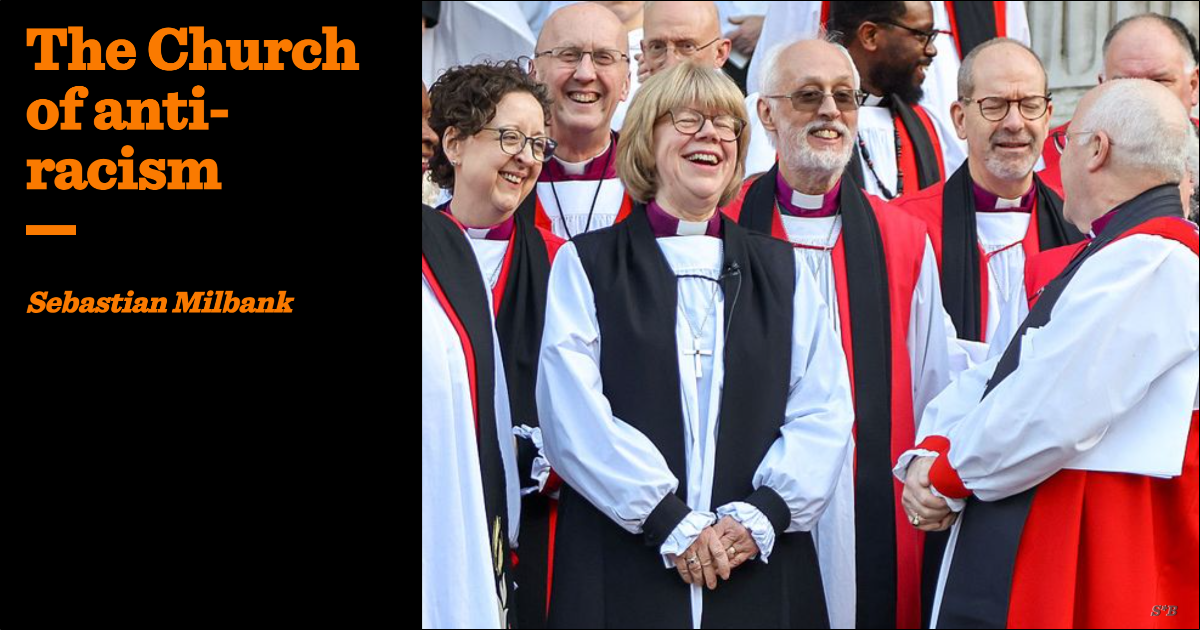
To be an Anglican today is not so different from being a British citizen — you feel yourself to be at the mercy of decisions made behind closed doors, by obscure committees, and using incomprehensible jargon. Perhaps there’s something curiously fitting for an established Church in this final Erastian convergence of church and state, in which a unifying progressive and proceduralist theology is inculcated in every classroom and corporate boardroom with Jesuitical zeal. The end of history is, after all, a millenarian event, and it would be sad to see the Church of England absent as the final trumpet of hegemonic liberalism sounds.
But, of course, the end of history is already over, and like all doomsday cults it has left thousands of deeply embarrassed worshippers behind, who must either shamefacedly try and slip back into normal life, or continue to assert that the end of the world is just around the corner, if only we believe hard enough. Appropriately, given that the CofE is always at least ten years out of date, it is still merrily carrying on as if a significant plurality of its own congregation weren’t preparing to vote Reform at the next election, with 38 per cent now rating their likelihood of voting for the party as high.
A growing number of ordinary Anglicans are desperately sick and tired of politically correct pieties displacing the language of Christian faith and theology. Many feel that their Christian identity, culture and heritage is under threat from the eroding forces of multiculturalism, political Islam and mass migration. Yet not only are such concerns unheard and unreflected by those who govern the church, they are actively inflamed and marginalised by a hostile hierarchy. Project Spire, a project that involves handing over £100 million in reparations for highly contested and indirect links with slavery, is going ahead despite a majority of worshippers strongly opposing the plans, and indicating that they would be less likely to donate to the Church if they proceed.
On any number of vital questions, ordinary Anglicans aren’t in the driving seat
The problem is not only that bishops sometimes do things that anger more conservative Anglicans, it’s that scepticism about progressive ideas, policies and values is entirely missing from the governing structures of the Church. Those who are justly sceptical of a mode of politics that has helped fuel populism and leave Western countries confused and divided are treated with naked contempt. Decisions, despite the language of “inclusion”, are made in a totally autocratic manner by bishops who do not make themselves available to the press or parishioners.
On any number of vital questions, ordinary Anglicans aren’t in the driving seat, and bluntly, neither is anything resembling Christian ethics or political theology. Instead, report after report repeats progressive pieties, whilst vilifying the institution that bishops are supposed to represent and steward.
One such report, entitled “From Lament to Action”, described the Church of England as “institutionally racist”, echoing remarks made by the now disgraced former Archbishop Justin Welby. The sentiment was bad enough, but worse was the requirement, at a time when the Church is struggling with clergy numbers and vocations, to institute racial quotas and devote scarce diocesan resources to hiring diversity officers. The report was, of course, conceived in the fevered days of 2020 and BLM, and its authors never met in person.
The culture has moved on since then, but institutions have not, and many, like the Church of England, have chosen to double down. The report and its recommendations have become commitments, and the spirit of hysterical “anti-racism” shambles on through the collapsing structures of our national Church.
And where better for a zombie to shamble, 28 Days Later-style, than here in London? You might have thought that a part of the Church in which a rainbow coalition of congregants from across the world meet, worship and chat over coffee every week was a success story for antiracism. For the parishes struggling to repair the roof, or doing firefighting in the war on poverty, family breakdown and mental ill health, a cash injection would be very welcome. But the £730,000 going to the Diocese of London won’t be buying your parish a new boiler or helping a single parent household. Instead “RJP [Racial Justice Priority] funding will be used to support educational initiatives, in churches and C of E schools, about church buildings’ links to transatlantic slavery.”
“Churches will also be funded to support refugees and asylum seekers, and be expected to promote diversity in leadership, while unconscious bias training for parochial parish councils will be ‘theologically informed’, Lisa Adjei, the head of RJP for the diocese, said.”
To quote a great civil rights activist, those of us in the pews are sick and tired of being sick and tired. It isn’t just the progressive pablum, it’s the managerialism that induces the collective vomit response. Why are the heirs to the apostles speaking to us like they’re working in HR? Why can’t they speak in the language of the Bible, or the language of everyday life? Why are we constantly being condescended and dedicated to, and since when did Christians believe that the sins of the father should be paid by the child?
Well we could “lament” in this vein for sometime, but the real sorrow is how poor this sort of thing is as “action”. Racism and tribalism are a terrible evil, but they’re being incontrovertibly worsened by mass migration, and the loss of a democratic say over migration policy. The Church is repeating these errors in its own structures, fuelling divisions and resentments and bulldozing anyone who objects out of the way.
The tragedy in all this is the great opportunity that the Church is squandering to be an alternative to secular spaces dominated by the culture war. In a city where there are many racial divides and injustices, the CofE, along with other parish-centred Christian churches, is one of the few institutions consistently bridging divides of class and ethnicity alike. Local parishes not only bring us together within a universal church, they also root people in a particular place, and make them part of a sacramental, embodied community by adoption.
Instead of taking a divisive stance on asylum or border policy, or demonising itself in an orgy of self-flagellation, the Church of England should be proudly championing the integration in which the beauty of the English language, choral tradition and liturgy are shared as a gift with all who wish to share in it. Instead of politicising preaching and sacramental ministry, we should be celebrating the power of the rituals of baptism, marriage and the eucharist to bind communities together in bonds of affection and civic friendship.
As someone who regularly crusades his way into the culture war, one thing I love about my own parish church is that it isn’t about politics, policy or polarisation. It’s somewhere where I can just be an ordinary person and a Christian, standing before God side by side with Christians of every colour, united by a single creed. It’s a place where the secular world is left aside, and where I contemplate eternity. I sometimes have lively discussions after the service, but I know that I’m talking with people for whom there are bigger things than ideology, and that I’m not about to get cancelled.
What I and many people would like to see is lively debate in the Church, not progressive ideology substituting for dogma
Interventions into politics from the pulpit are risky and generally ill-advised, but none of this is to say that priests or bishops should be silent on political questions. Rather, such interventions should be rooted in theology, not secular ideology, and they should not be only from one partisan standpoint. Populists, post-liberals and conservatives are mysteriously unrepresented in the upper echelons of the Church, and seem to have to keep pretty quiet when they do make it there. What I and many people would like to see is lively debate in the Church, not progressive ideology substituting for dogma.
When that doesn’t happen, we see opposition to migration cynically framed as “racial sin” rather than a valid political standpoint. Bishop Jeremiah, the “racial justice lead” for the Diocese of London, sees the purpose of RJP as countering “the far-right narrative”. Yet there is nothing Christian or moral about allowing the abuse of young girls — something that has been the direct result of the failure to deport illegal migrants. In one recent case a Kurdish man who raped an teenage girl in a park claimed his “history of complex trauma” and asylum status as mitigating circumstances, as if illegally entering another country, breaking its laws and abusing the local girls were points in his favour.
There is a reasonable argument about actively taking on actual refugees — as Britain has done in the case of Ukraine. But when it is considered morally suspect to question whether we should harbour young men who sneak into the country (from France) in search of work, welfare or women, you have left the bounds of reason, nevermind Christian ethics. The ability of the Church to persuasively champion the cause of genuine asylum seekers (who are more often children, women and the elderly, not virile young men) is undermined by this sort of weaponised naivete.
In a similar fashion, the Church is undermining its genuine strength as a positive post-racial institution, not just through diversity quotas, but through a damaging and untrue narrative of guilt around racism and slavery. Whilst the abuse of Christian theology to justify chattel slavery and racism should be addressed, it is actively misleading to ignore and decentre the role of Anglicans in leading the charge on abolitionism and anti-racism, a fact that reflects the wider truth that ordinary British people have persistently mobilised against slavery and racism, and have given their lives doing so.
This positive and optimistic story far better serves the needs of actual ethnic minority communities, and the cause of building a cohesive national culture. It is a quest worthy of our national church — but it’s one only possible when our bishops stop being progressive bureaucrats.