Official data says Britain is safer, but everyday encounters with disorder are eroding public confidence
Dinner party conversations have remained largely the same throughout the years. The same familiar topics recur: polite small talk, life updates, job bashing, and the occasional distant tragedy. “Did you know earthquakes in California are disrupting Super Bowl week?” One recent addition to this formula is personal anecdotes on crime in the UK. “Did you see that store in Richmond getting its windows smashed by looters?”
Nearly everyone knows someone who can recount a personal experience of being a victim or witness of a crime. If not directly, then through a friend of a friend, a colleague or a neighbour. Phones snatched from men on bikes, supermarket bandits looting right next to you, bags stolen from the pub — these are all stories I’ve heard in the last 3 months. Hearing these accounts shapes how people move through public space, how tightly they hold their belongings, and how much trust they place in the police.
And yet, as these conversations multiply, the official statistics paint a different picture.
According to the ONS, crime in England and Wales is falling. The Crime Survey for England and Wales, long considered the gold standard, suggests that crime peaked in the mid-1990s and has been on a broadly downward trajectory ever since. Violent crime in particular has fallen. Even when fraud and computer misuse are included, the ONS estimates around 11.2 million crimes last year, far fewer than the estimated 20 million in 1995 and levels recorded in 2027.
So if the UK is technically safer than ever before, why do so many feel less safe?
When polled, 69% of people said they thought crime was rising. Just 6% believed it was falling. It is difficult to argue against the familiar “broken Britain” narrative when everyday experience appears to corroborate it. At the end of the day crime, whether categorised as severe or dismissed as low-level, is still crime — and it is the accumulation of these smaller encounters that most powerfully shapes public confidence.
The difficulty lies not in the statistics themselves, but in what they are designed to capture. The Crime Survey for England and Wales is a victim-based household survey. By definition, it excludes large swathes of petty crimes. Crimes against businesses and institutional settings like care homes, student halls and hostels are not included. Drug offences without a victim are absent. Sexual assault, stalking and harassment sit awkwardly outside the headline totals despite their prevalence — and recent increases.
What remains is a statistical portrait that is methodologically outmoded and increasingly detached from how crime is encountered in modern Britain.
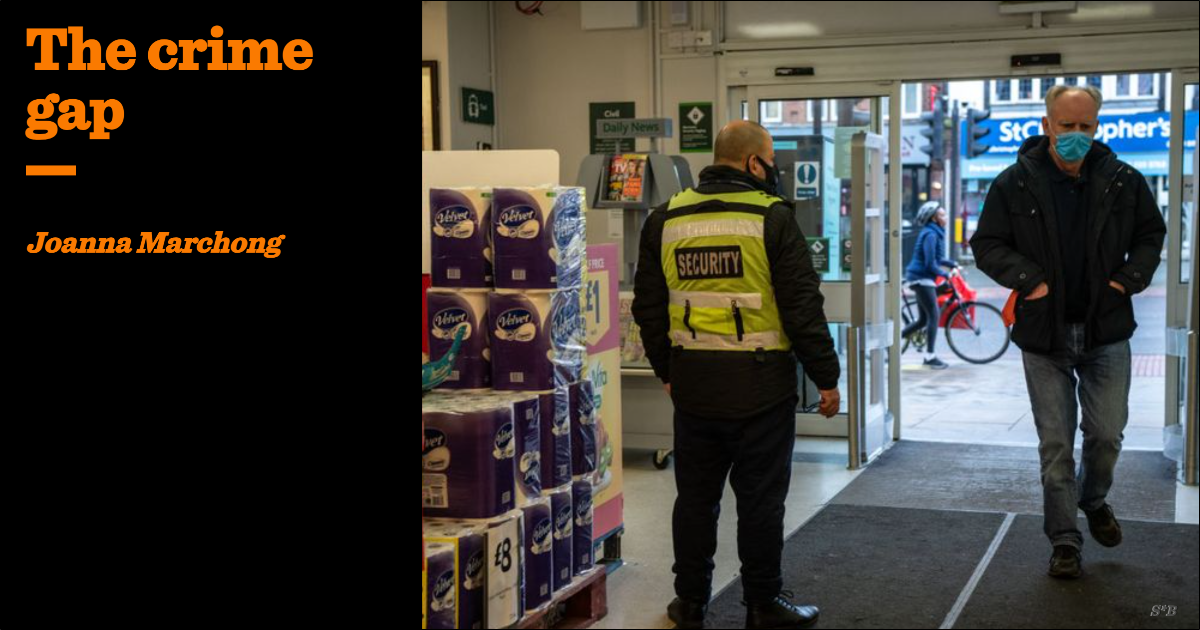
Serious violent crime may have fallen over the long term, but highly visible, low-level offences has become harder to ignore. Shoplifting is obvious, not discreet. Phone theft is happening in broad daylight. Supermarkets are locking up everyday items like toothpaste and wax strips behind glass cabinets. These cues matter.
The official response to this unease often defaults to the language of perception. People feel unsafe, we are told, because they watch too many videos and scroll too much on social media. Anxiety is framed as a cultural problem rather than a material one. It is a convenient excuse, and the reality is that information merely reflects crime..
Even more detrimental is the outcome of reporting crime with little hope of a follow-up. While recorded crime has risen, the proportion of cases resulting in a charge has declined. What was once a process that at least gestured towards resolution now often ends with an automated reference number. Crime is increasingly reported but rarely punished or followed up on.
Political narratives fill this void. Take the arguments of Laila Cunningham, who recently declared “London is lawless”. Sadiq Khan often retorts that “homicides are at a record low”, but this misses the point entirely. The gap between statistics and lived experience is proof not just of policy failure, but of institutional dishonesty. We have two parties coming to starkly different results after seeing the same data.
The problem isn’t fabricating data, but a lack of adequate data. We have reduced serious violence while simultaneously allowing everyday disorder to proliferate. Looks good on paper, but public confidence is lost. When the response to this tension is to insist that the public is simply mistaken, the real problem is clearly being ignored
To be legitimate, crime data must have its limitations acknowledged. This is not a call to ignore the data or to hit the panic button, but it is an argument for recognising that safety is experienced locally every day. People do not measure their security against a mid-1990s baseline; they measure it against yesterday. Until that distinction is acknowledged, dinner party conversations will continue to be filled with stories that the statistics struggle to accommodate, and politics will continue to exploit the gap between the two.