This article is taken from the February 2026 issue of The Critic. To get the full magazine why not subscribe? Get five issues for just £25.
“Any attempt to co-opt Christianity to particular political agendas or ideologies should be viewed with deep suspicion,” said Arun Arora, the Bishop of Kirkstall and the Church of England’s co-lead bishop on racial justice. Hallelujah, I thought. No more co-option of Christianity to particular political agendas? Finally.
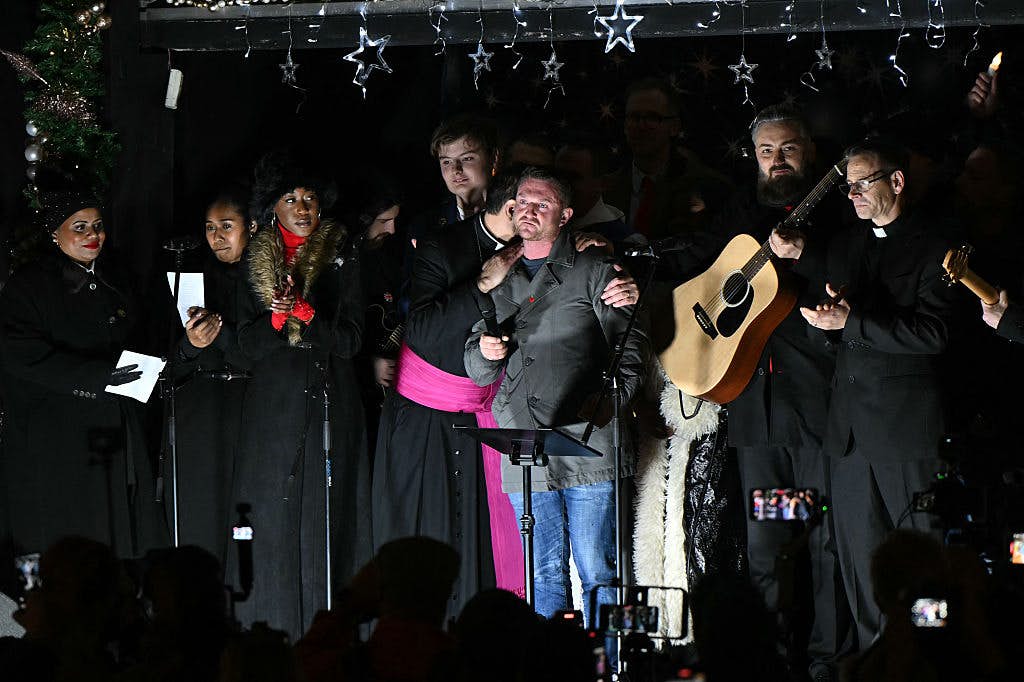
He was responding to the news that the far-right agitator and criminal Tommy Robinson was holding a carol service to launch a “Put Christ back into Christmas” campaign, which he described as a “shining light in the midst of our turmoil caused by unchecked immigration”.
Perhaps Robinson’s campaign had triggered a moment of self-reflection amongst our church leadership, and this Christmas we would hear sermons reflecting the old church campaign — “Christmas begins with Christ” — rather than the usual deluge of political speeches dressed up as sermons.
Alas, a survey of Christmas Day episcopal sermons revealed that co-opting Christianity is perfectly acceptable — providing the agenda is climate change, migration, Gaza or welfare.
This is a pity, because if we want to avoid the dangers of Christian Nationalism, where our faith is hijacked to push a narrow ethnically-defined English political and cultural identity, then we need a robust national church where young people from across the political spectrum (but for this purpose especially on the right) can find a home that doesn’t dangerously conflate Christianity with a particular race or ideology.
There is a crisis right now of which Tommy Robinson’s carol service/political rally is a reflection. Over the last generation, Britain has suffered a collapse of confidence in itself, its history and its Christian inheritance. Simultaneously, we have seen a decline in church attendance and belief.
These are not the same phenomenon, but they do overlap. More recently we have seen three new trends. Like those that came before, they overlap whilst not being the same.
The first is a growing public sense that the “elites” of our country, especially those with custody of our nation’s institutions, have come to despise its past. This has led to a reaction on the right — according to pollsters amongst young men in particular — who point out that there is a great deal of our history (and history of our nation’s faith) we can be proud of.
The second is that pollsters have also started to pick up a growth in church attendance amongst those under 35. Like the first trend, this is happening primarily amongst young men.
The third is that there has undeniably been an uptick in political positions that are masquerading as “conservative”, but are in fact just racist (although, as the rise of antisemitism shows, this is also taking place on the left).
The church must navigate this with care. Of course, we must unequivocally reject the racism of the third trend. But we mustn’t conflate it with the other two or let it blind us to our duty to respond to them.
C. S. Lewis said that a political sermon tells us no more than which newspapers are taken at the rectory
Bishop Arora was spot on: rejecting the temptation to co-opt our Christianity to our own political agendas is the only way of ensuring that we have a National Church fit to serve a divided nation.
C.S. Lewis said that a political sermon tells us nothing more than which newspapers are taken at the rectory. If we are to be a national church, we must be a place where all can feel welcome. So drop the politics. And, yes, that means those pet causes we all have decided, in our different ways, are gospel priorities.
The glorious thing is that if we stop preaching about politics, we can preach about something far more exciting: Christ. People are thirsting for the Real Deal, the deep well of theology with which to make sense of a fracturing and frightening world. If we can present a deeply-resourced, Anglican vision of what being a Christian is, then we can offer young minds a church that is proper to grow wise in.
The Church of England has been a part of every major national event; its bible and prayer book are the cornerstone of our language; its art and music are central to our cultural tradition. Its buildings sit at the heart of our communities. The institution sits at the heart of the constitution.
With £55 billion of social activities, the Church is a real and necessary presence across the country caring for the sick and those most in need. Being part of a worldwide communion means it has given a home to hundreds of thousands from that communion who have come to England, giving new life to parishes. In short, it embodies the history and culture of England — but offers it to all, regardless of their heritage or race.
To keep this alive, the Church must stop rejecting its cultural and literary heritage, and lean into our national responsibilities as we do on Remembrance Sunday. After all, if we reject our Anglican inheritance, why should anyone else give it a try?
We have a glorious opportunity to offer a church that weaves the newer strands of our cultural and national life into a tapestry going back to St Alban. We can hold in that tapestry congregations of the old and the young, of the right and the left, and minister to them all.