As the Trump administration forges ahead with its goal to “Make America Healthy Again,” officials are aiming to reach U.S. children through the country’s public schools, pushing through some already prickly resistance.
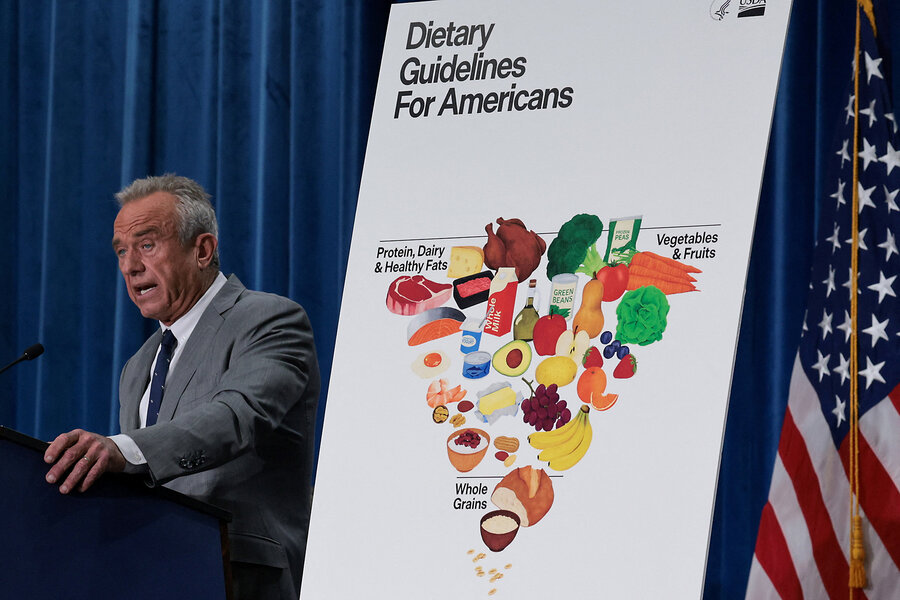
Last month, Secretary of Health and Human Services Robert F. Kennedy Jr. and Agriculture Secretary Brooke Rollins flipped the traditional U.S. food pyramid upside down, shifting the primary focus from whole grains and nutrient-rich foods to protein (including red meat) and full-fat dairy – a move sure to have significant ripple effects on school cafeterias. A week later, President Donald Trump signed the Whole Milk for Healthy Kids Act, offering schools more flexibility in meal choices, including whole milk.
And last summer, Mr. Trump also signed an executive order reinstating the Presidential Fitness Test for students, shifting from health-focused metrics back to a more competitive standard.
Why We Wrote This
The “Make America Healthy Again” movement has won some bipartisan support for trying to get processed foods out of schools. But it’s also facing pushback. A look at how schoolchildren may see food and fitness change.
The MAHA movement, framed as an effort to fight chronic disease, has won some bipartisan support for its focus on getting ultraprocessed foods – like chips and hot dogs – out of schools. But it’s also facing pushback. Some lawmakers and health experts say some guidelines are scientifically and nutritionally misguided. (This fall, 15 Democratic governors formed their own public health alliance to set independent standards on public health.) The fitness test also has its critics.
Still, even with headwinds, the Trump administration’s new rules are set to move forward, with schools beginning to consider ways to adapt.
The school lunches have taken center stage, as supporters argue that the nutritional benefits of more milk fat and protein intake – like eggs and butter – in a balanced diet outweigh concerns about saturated fat. That, they say, signals a shift toward healthier, less processed dietary habits.
“If you think about the fact that you’ve got 30 million kids a day eating school meals and that those meals are based on these dietary guidelines, that’s a tremendous opportunity to invest in the health and academic achievement of America’s youth,” says Diane Pratt-Heavener, director of media relations for the School Nutrition Association.

Supporters say the new legislation also increases school and parent choices.
For example, under the act Mr. Trump signed, schools can serve whole or 2% milk and allow parents to send a note if their child needs a dairy milk alternative, rather than requiring a doctor’s sign-off. Under the Obama administration, whole milk was phased out altogether in favor of lower-fat options.
President Trump has also created umbrellas under his MAHA movement, one of which is Make Our Children Healthy Again, or MOCHA. A MOCHA commission released its first study in September, which called for banning or limiting artificial, petroleum-based food dyes and increasing access to whole foods.
The report also said that the current School Breakfast Program and National School Lunch Program have contributed to children’s poor health by failing to limit ultraprocessed foods, and leading kids to eat more sugar, processed fats, carbohydrates, and sodium, such as in granola bars, packaged chips, and chicken nuggets.
Who defines “healthy food”?
Federal regulators are now stepping in to define “ultraprocessed foods,” aiming to create a unified standard that moves beyond varied state regulations. Secretary Kennedy’s guidelines call for reduced consumption of chips, candy, and other sugary foods. They also recommend reducing refined carbohydrates, such as white bread, flour tortillas, and crackers. Ultraprocessed foods have been linked to obesity, heart disease, and Type 2 diabetes.
But further clarity is needed, health experts say.
“If the USDA takes this recommendation to reduce highly processed foods and applies it to school meals, they will need to define what it is that schools have to limit,” says Ms. Pratt-Heavener, who welcomes the idea.
“If we have this patchwork of differing state laws, it’s going to be very difficult for food companies to develop products that can be sold in schools throughout the country.”
The new food pyramid has won endorsements from farmers in industries like beef and dairy, which have shown strong financial and political support for President Trump.
But it has also been driven by a continued public demand for better nutrition for students.
Despite their other objections to some of MAHA’s policies, for example, the American Medical Association, American Heart Association, and American Academy of Pediatrics have long-standing guidelines that align closely with MAHA’s emphasis on whole foods.

But moving from fried chicken nuggets to baked chicken cutlets, from congressional testimony to cafeteria lines, might not happen quickly. To apply guidelines and rules around school meals, the Department of Agriculture will have to issue a proposed rule, accept public comment, consider feedback, and then draft a final rule. After that, states and schools will begin making the necessary adjustments. But it will take time.
“The release of the 2025-2030 Dietary Guidelines for Americans is a pivotal step to Make America Healthy Again through real, nutrient-dense foods,” according to a statement from the USDA.
Incorporating those guidelines will be a multiyear effort, the statement said.
Bars out, butter in
Many school districts, still implementing Biden administration directives that limit the use of sugar, are only now selecting food vendors for the 2026-2027 school year. So the new pyramid guidelines are unlikely to impact lunch trays for months, if not longer.
But students might taste some differences sooner than that. Starting this fall, flavored milk can’t have more than 10 grams of added sugar per 8 ounces. By the end of the 2027-2028 school year, added sugar cannot make up more than 10% of calories a week in breakfast and lunch programs. And schools must reduce sodium by 15% in lunches and 10% in breakfasts beginning on July 1, 2027.
Mara Fleishman, CEO of the Chef Ann Foundation, a nonprofit focused on school food reform, says highlighting the importance of students eating less sugar and more whole foods is a good thing. But, she adds, the government needs to adequately fund its new MAHA program and overall school nutrition efforts.
In early 2025, as the Trump administration slashed government spending, the USDA cut $660 million from the Local Food for Schools program, which had traditionally helped state agencies buy fresh, local food for school lunch programs. But Ms. Fleishman contends that, for MAHA to be successful, the current average reimbursement of $4.50 per lunch served must be increased.
“Moving districts to serve less processed food is what we’re trying to do,” Ms. Fleishman says. “But it requires support. It requires the right equipment. It requires funding.”
Districts need to be shown how to create varied menus, identify where they can spend more on higher-quality ingredients, reassess labor costs, and acquire the proper equipment, she adds.
Not all nuggets are created equal
One school district already taking the lead on healthier eating is the Boulder Valley School District in Boulder County, Colorado, which runs a top-tier scratch kitchen. It serves 17,000 meals across 53 schools daily and operates a state-of-the-art, $14 million central kitchen, opened in 2020.

Courtesy of Boulder Valley School District
Among the items it serves are all-natural chicken nuggets, seasoned with spices; marinara sauce made with tomatoes from local farms; and Korean bulgogi. It prepares 80% of the meals in its central kitchen and has a fleet of trucks deliver them to schools, where staff finish cooking and preparing them. The Boulder Valley School District prepares its menus in three-week blocks.
“I wouldn’t go as far as to say that we agree with everything that’s in the new pyramid, but I do definitely agree with the spirit of whole, scratch-cooked foods,” says Carolyn Villa, the district’s director of food services. Schools should aim for protein as well as fresh fruits and vegetables, all of which have higher nutritional value than starches, sugars, and other prepared or processed foods, she says.
But cooking 10,000 meals or more every day, as well as training people to run a production schedule, operate equipment, and manage ingredient sourcing, is a big lift, Ms. Villa says.
“It takes several years of dedicated effort to build a capable workforce to do that.”
Focus on fitness
Last summer, President Trump reinstated the Presidential Fitness Test, moving from more general health metrics to a more competitive standard.
Started by President Dwight D. Eisenhower in the 1950s, the test is a series of physical tests, including a 1-mile run, pushups, situps, and a flexibility measure. The top 15% of performers received awards.
The Obama administration replaced the traditional test in 2012 with the Presidential Youth Fitness Program, which took a less competitive, more holistic view of student health. And some professionals in the youth fitness space don’t like the idea of the old test returning.
“For decades, health and physical educators have been trying to find a way to get kids to embrace physical activity,” says Judy LoBianco, CEO of HPE Solutions, which helps schools improve their physical education instruction.
Challenges like the old Presidential Fitness Test miss the mark, she says.
Still, Virginia, Mississippi, and Oklahoma are moving to reintroduce the traditional skills-based fitness test into schools, aligning with the executive order. Mississippi and Virginia will start with the “new-old test” next fall.