China has unveiled plans for a futuristic ‘Star Wars‘ space carrier than can deploy nearly 100 unmanned fighter jets and fly to the edge of Earth’s atmosphere.
The nation has claimed the Luanniao – slated to be 794ft-long, 2244ft-wide and have a takeoff weight of 120,000 tonnes – will be up in the air in the next 20 to 30 years.
The warship, set to be the biggest in the world if it is ever made, is being designed to carry up to 88 unmanned Xuan Nu fighter jets.
These planes, still in their conceptual stage, will be designed to be highly manoeuvrable stealth aircraft capable of launching hypersonic missiles.
Experts aren’t sure if the Luanniao could ever be feasibly made, with many claiming it was a publicity stunt that aimed to ‘inspire the Chinese public.’
But if it were completed, the new warship would ‘outclass pretty much everyone’, according to Peter Layton, a defence expert and a visiting fellow at Australia’s Griffith Asia Institute.
He told the Telegraph the Luanniao would be capable of flying over surface-to-air missiles and other fighter aircraft, adding: ‘You’re also out of range of the weather, generally speaking – and you’re out of range of most defensive systems.’
The hypothetical vessel may also be able to position itself directly above targets, more effectively targeting them.
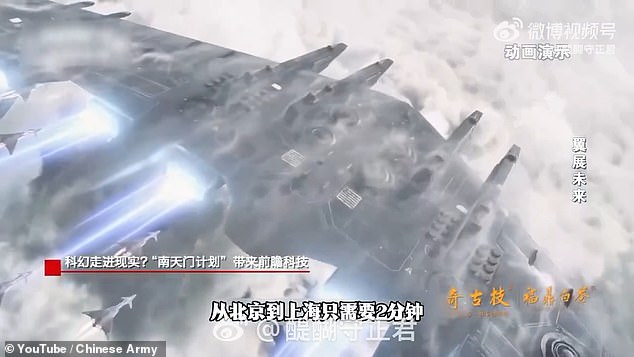
The Luanniao (pictured) is set to be the biggest warship in the world if it is ever made
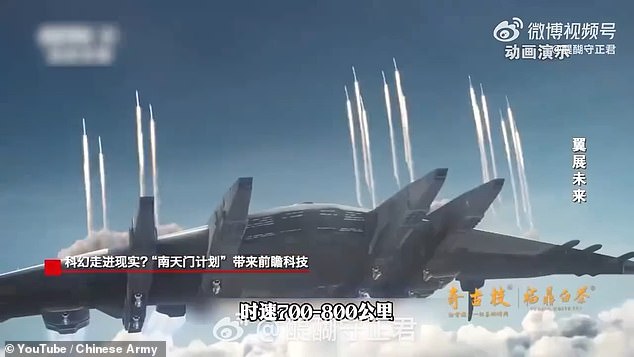
China has claimed the Luanniao will be up in the air in the next 20 to 30 years
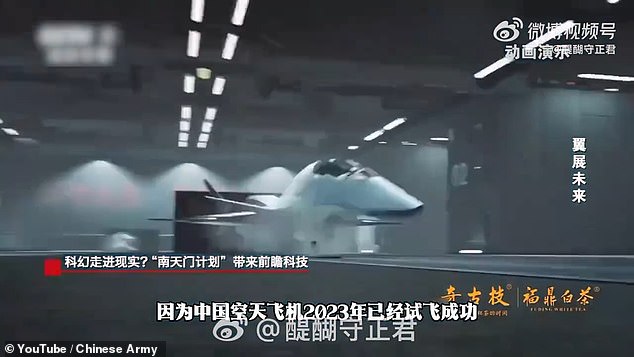
It is being designed to carry up to 88 unmanned Xuan Nu fighter jets (pictured)
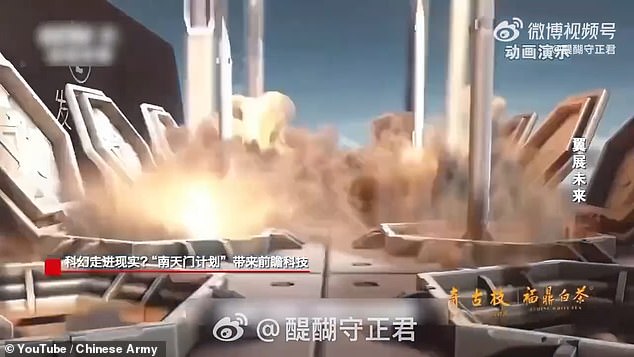
The warship was first conceived 10 years ago, with many dismissing it as science fiction.
The Luanniao is part of China’s broader ‘Nantianmen’ Project, meaning ‘South Heavenly Gate’.
The broad project, developed by the Aviation Industry Corporation of China, aims to develop China’s space and air capabilities.
The warship was first conceived 10 years ago, with many dismissing it as science fiction.
Even now, many are still sceptical that it could ever take off. The technology needed for any aircraft, let alone one the size of the Luanniao, to hover on the edge of Earth’s boundary does not yet exist.
It would also require ‘enormous amount of fuel’, as well as an entirely new propulsion system.
Instead, China could place the ship into full orbit. However, the aircraft would then become extremely vulnerable to debris.
And in order to launch the Luanniao into space, China would need reusable rockets. Though it has been developing one for some time, it has still not had any official success.
Layton told the Telegraph that given how difficult it will be for China to actually develop this aircraft, it’s more likely that the plans are being used to boost the nation’s standing both at home and abroad.
‘For the external audience, it does paint the picture that they are working on technology that the region just can’t aspire to – it’s literally Star Wars stuff’, he said.