Pineapple might not actually be the worst thing on your pizza, believe it or not.
It’s now been found that Per– and polyfluoroalkyl substances (PFAS), which create risks that ‘will likely remain for hundreds of years’, are.
Found in foods, drinking water and everything from pizza boxes to cookware, PFAS are human-manufactured chemicals that could be linked to liver damage, high cholesterol, reduced immune responses, low birth weights and cancer.
They take an extremely long time to break down, according to the UK’s Department for Environment Food and Rural Affairs, and pose long-lasting risks.
But the British Government has now unveiled its first-ever plan to tackle the ‘forever chemicals’, as they have been dubbed, and reduce risks to health and the environment.
A statement revealed that the plan aims to ‘understand where these chemicals are coming from, how they spread and how to reduce exposure’.
The Government will launch a consultation later this year about the possibility of introducing a statutory PFAS limit on Britain’s water supply.
Ministers have insisted that the UK has some of the highest quality drinking water in the world, but a legal limit would mean regulators can more easily take enforcement action against firms where permitted levels are exceeded.

Pineapple might not actually be the worst thing on your pizza, believe it or not
‘The transition away from PFAS will take time, as will putting new regulations in place, and the trade-offs applying to new regulatory measures need to be carefully considered,’ the plan noted.
‘We must balance ensuring that measures protect people and wildlife while recognising the potential negative impacts on society, consumers and industry.
‘Through our PFAS Plan, we will act decisively to reduce their harmful effects while transitioning to safer alternatives.
‘We will work in partnership with regulators, industry and local communities to deliver co-ordinated action to ensure forever chemicals are not a forever problem.’
The Government said tests will also be carried out on food packaging, like microwave popcorn bags and pizza boxes, and a website will be published to raise public awareness.
‘It’s crucial that we protect public health and the environment for future generations,’ said Environment Minister Emma Hardy in the statement.
She noted the Government would work with regulators, industry, and local communities ‘to ensure ‘forever chemicals’ are not a forever problem’.
In the days before the plan was unveiled, a study claimed that the chemicals could cost Britain an estimated £1.4trillion by 2050 if nothing is done about them.
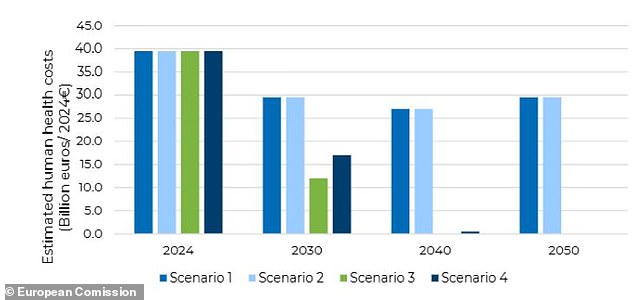
The cost of using ‘forever chemicals’ could cost Europe £1.4 trillion ($2 trillion) by 2050, a study has claimed. This graph shows the health costs of forever chemicals, in scenarios ranging from ‘business as usual’ (scenario 1) to a total ban (scenario 4)
Yearly health costs already stand at £34 billion every year, with no hope of cutting these bills without a ban.
However, the report describes this enormous bill as simply the ‘baseline’ costs of continuing to use PFAS. If Europe tries to treat polluted soil and water without banning PFAS, the costs will balloon to well over £1 trillion.
However if the EU passed a ban on forever chemicals, the yearly cost of treating health issues caused by these pollutants would fall to £433 million by 2040.
By the year 2050, that would lead to overall savings of over £95 billion.
Jessika Roswall, EU environment chief, says: ‘The study confirms that addressing PFAS at their source is both crucial and economically wise.
‘Balancing economic interest with nature and health costs is vital.’
The use of TFAS is already being restricted across the globe, with a handful of US states including California implementing a ban beginning in 2025. Several other states are set to follow suit.