This article is taken from the February 2026 issue of The Critic. To get the full magazine why not subscribe? Get five issues for just £25.
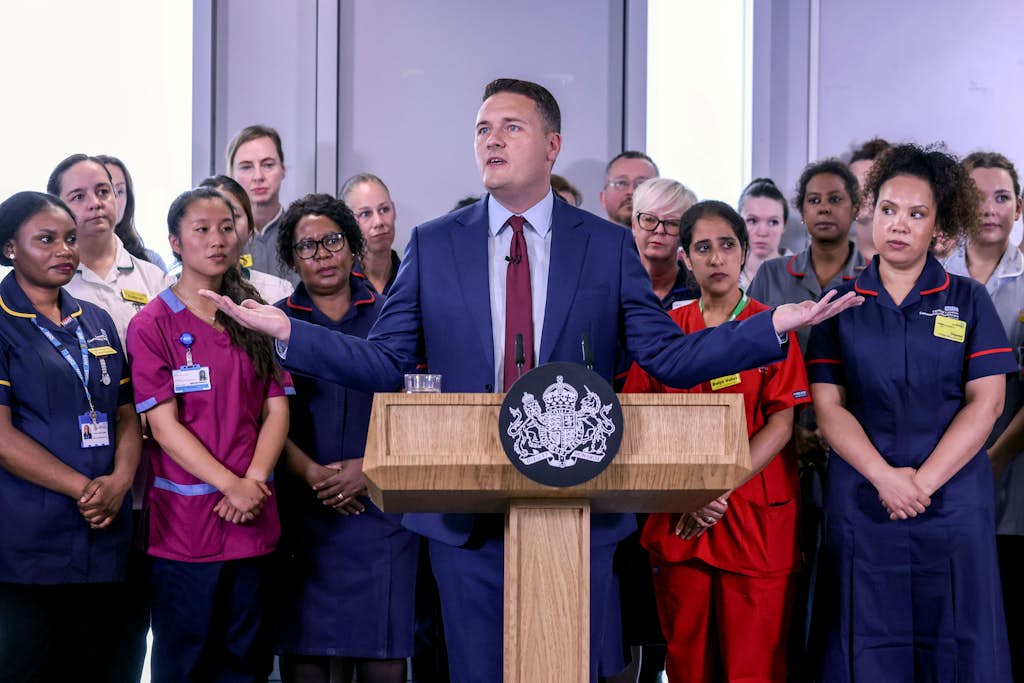
The government has licensed the “pathways” puberty blockers experiment to go ahead. Drugs used for chemical castration will be given to children with the hope of improving their mental wellbeing moderately for a few years. The Health Secretary, Wes Streeting, is the man responsible. Clinicians and parliamentarians have written to him, asking him to think again. He has said he feels “uncomfortable”. So he should. It is obscene to ask an overwrought child to make the unconscionable decision to take this drug for this purpose, and unethical for the state to offer it to them.
Children who are too young to vote, get a tattoo or even decide what subjects to study at school cannot understand what they are being asked to put at risk in order to pursue their desire to “transition”. This includes the chance to go through normal physical and mental development, to understand their sexual orientation, to have a fulfilling adult sex life, to have children and to enjoy decades of life in a healthy body rather than as a lifelong medical patient.
They are also too young to understand, or perhaps too strongly committed to accept, that the promise on the other side is a mis-sold dream. There is no combination of pills, surgeries and laws that can enable a boy to grow up to be a woman or a girl to become a man. The Supreme Court made this clear last year. This should have led to a re-evaluation of this proposed experiment on children. Instead, NHS bureaucrats and the medical researchers carried on regardless, and the Health Secretary allowed them.
On 13 January, Streeting wrote to MPs justifying his support for the experiment by saying the pressure is coming from the children. “Some young people are going to great lengths to source the drugs from unregulated providers”, and others are “experiencing extreme mental anguish” because they cannot access them.
In any case, he claims, the matter is out of his hands. The trial has been through “scientific, clinical, ethical and regulatory review”, including by a research ethics committee. Dr Hilary Cass, who has expressed public support for the trial, has also shucked off responsibility, saying that she would have been content for the trial to be stopped “if the ethics committee had said, despite everything, we don’t think this is an ethical approach”.
Ethics committees consist of volunteers, convened and overseen by the Health Research Authority (HRA). Each committee includes expert and lay members meant to “reflect the currency of public opinion”. Around 95 per cent of studies considered are approved.
To consider the puberty blockers study, a committee met by Zoom for one full meeting of nine participants in September. Members asked some questions, made some recommendations and passed the matter to a sub-committee. The next meeting had five decision-makers. The final decision in November was made by a sub-committee of three.
Just before Christmas the HRA quietly released the minutes. They reveal committee members did not probe the core rationale for the treatment. They did not ask whether a child’s goal to live as if they were the opposite sex is realistic. So they avoided the ethical question of whether children and their parents can make informed decisions to undergo medically induced harms in the desire to reach that goal.
Instead, they told the researchers to take “transition” out of the title of the study “so as not to imply that this study relates to transitioning”.
In the trial protocol, puberty blockers are presented as a stand-alone treatment, offering time to think and possible mental health benefits. The patient information sheet says:
Doctors think puberty-suppressing hormones may help young people with gender incongruence explore their gender identity without worrying about their body starting to change … to focus more on things that improve their quality of life, like their interests, school, friendships and relationships.
On what happens next, it says blandly to parents: “Your child and you will discuss the next steps in their care, what their options are, and what they would like to do. These might include staying on [puberty blockers], stopping the treatment, or going on to another treatment.”
The “time to think” rationale is the justification that was given by the previous flawed experiment at the Tavistock Clinic. The HRA investigated the study nearly ten years after approving it, admitting that the rationale for puberty blockers was not in fact to improve mental health whilst children are on them, but to “allow subsequent cross-sex hormone treatment without the need to surgically reverse or otherwise mask the unwanted physical effects of puberty”.
Now teenagers are to be offered that same treatment once again. Its known harms are the same as its unacknowledged purpose: to stop their body developing normally in order to try to look like the opposite sex.
Whilst Streeting says in his letter to MPs that “a very small number of children will actually qualify to be put on the trial”, the committee was concerned that too few children would receive the drug. They asked what would happen when the recruitment target of 226 children was reached. The researchers responded that they would apply to recruit more children, and they suspected the National Institute for Health Research would support this.
Certainly, the rationale of responding to anguished demand, cited by Streeting, would lead to pressure not to stop.
Demand-led extension of the experiment is exactly what happened last time puberty blockers were trialled. The Tavistock GIDS clinic, with University College London, set out to test blockers on a “carefully selected” group of 44 children starting in 2010.
Before the trial was over clinicians had adopted the research protocol as “established practice”. The trial results, finally published in 2020, found “no changes in psychological function, quality of life or degree of gender dysphoria”. But the trial had already opened the floodgates. By the time blockers were banned for lack of evidence of benefits, around 2,000 children had been prescribed the drug. And the NHS completely failed to track them into adulthood to see how they fared.
Streeting says his approach “has been led by the evidence, not ideology”. But the study protocol and the survey tools it uses are based on ideological concepts. Children will be asked questions such as whether they “prefer to behave like my affirmed gender” and whether they agree that “every time someone treats me like my assigned sex I feel hurt”.
The committee did not ask even basic questions, such as what is meant by “gender” and “sex” or what it would mean to “live and be accepted as a person of the affirmed gender” (desire to do this is amongst the diagnostic criteria).
Without qualms or concerns it signed off survey tools that ask children whether they are “definitely a boy”, “mainly a boy”, “definitely a girl”, “mainly a girl” or “neither a boy or girl”; and whether they describe themselves as “cisgender”, “transgender”, “non-binary”, “agender”, “genderfluid”, “genderqueer”, “two spirit” or “other”.
These terms and questions are based on the promise that a person can leave behind their sex (“assigned sex”, in the terminology of the trial protocol) and become a person of the opposite sex (“affirmed gender”). It uses “boy” and “girl” for both concepts. The committee did not ask if the children could understand this bait-and-switch in language. They didn’t even ask themselves if they understood it.
It is the committee’s job to ensure that any research study protects the rights of the participants. But instead of asking robust questions about children’s human rights, it signed off on a research framework that asks children whether their parents “advocate for my rights as a gender-expansive/trans child” and whether they defend them “against others’ prejudice against gender-non conforming/ transgender people”.
These questions are based on the unexamined idea that encouraging a child to transition is protecting their rights, whereas explaining it is impossible to change sex is prejudice, and harmful.
One of the survey questions asks children if they have “socially transitioned” at school. No one on the committee asked whether this means they expect teachers and other children to treat the child as the opposite sex.
The research ethics committee asked no questions about the legal framework for children’s lives at school, or later, as adults. The question of what is a realistic prospect for “transition” engages not just the child’s own strongly held desires, but other people’s rights, and the legal responsibilities of schools and other institutions.
Without a clear understanding of what is legally possible in life, how can a child or their parents consider the risks and benefits of a medical intervention? The committee did not ask.
Why didn’t it ask any of these questions or probe the meaning of the terms used in the protocol? Perhaps the members (despite rules that are supposed to prevent bias) share ideological assumptions about gender identity that are baked into the study, or perhaps they were too afraid to ask questions that might see them accused of “transphobia”. Perhaps they just didn’t want to appear unsophisticated or unkind.
Those working in and around the healthcare sector are likely to have been exposed to training steeped in gender ideology. In the sector, cancellation for dissent is a serious professional peril. Perhaps they had received specific training from the HRA, which has publicly expressed its “love and solidarity” for the “trans community”. Or perhaps they thought that someone else would ask the difficult questions. They were, after all, just volunteers meeting over Zoom.
✺
Now the burden of decision-making will be passed to a different committee. Streeting says there is a “triple lock” of checks. This involves the child, their parents and the “National Multi-Disciplinary Team”.
That committee will consider whether each individual child understands the possible risks and benefits “including immediate psychological and physical impacts and also long-term implications, benefits and harms”.
But the new service specification within which they work ducks responsibility in the same way as the PATHWAYS study itself. It treats “social transition” as a matter for the child to decide, defining it superficially in terms of clothing, hairstyle and name change, rather than an expectation that other people must come to refer to and think about the person as the opposite sex.
The question of whether it is reasonable for a child or their parents to expect this is shrugged off again, as it has been by every professional and policy-maker across whose desk it has so far passed. Social transition is presented as a decision for the child. And social acceptance is assumed.
Meanwhile Bridget Phillipson, Secretary of State for Education, continues to sit on guidance for schools. This guidance faces the same pressures of anguished and impassioned demand from teenagers.
The crucial question that must be answered before going any further with medical experimentation is whether the hope and expectation of children to live as the opposite sex is realistic or achievable.
This is not a question with a “case by case” answer to be negotiated with highly motivated parents and highly distressed children, or delegated to another committee with terms of reference that already rule out asking it.
Every decision-maker involved in this story has somehow overlooked two crucial facts that have been available in plain sight all along, and which were the basis for the Supreme Court judgment last year. Human beings cannot change sex. And other people have rights. It shouldn’t take courage — or indeed any particular insight — to say either of these things.
Stunting a child’s mental, physical, sexual and reproductive development based on an impossible dream isn’t kindness, it’s child abuse. Passing the responsibility to children to make the decision is deeply unethical.
The question of where the pathway of “transition” leads cannot be avoided any more. Streeting will have to answer for the fact that no decision-maker in the chain below him even asked this question, to his conscience, to his colleagues — or, if there is no last-minute rethink, in court.