It’s kind of interesting what’s happening on that island just south of Key West.
John had a post on it this afternoon – great minds, right? He had picked up on the fact that the Cubans have started talking to the Trump administration. They’ve gotten all sorts of chitty-chatty all of a sudden.
What’s forcing their hand is the oil situation. John quotes in-the-know types who say the regime is down to 15 or 20 days’ worth of oil, tops.
As I said back at the beginning of January, snatching up Maduro put a serious crimp in Cuba’s ability to operate in any capacity at all. It effectively cut the impoverished island’s energy jugular and left it bleeding out.
…The importance of the Venezuelan pipeline to the Cuban communist regime cannot be underestimated. Cuba didn’t buy oil from Venezuela – it was given to them.
1. The End of the “Free Oil” Lifeline
For over two decades, the single most important pillar of the Cuban economy has been the “Barrio Adentro” agreement, which saw Venezuela ship roughly 50,000 barrels of oil per day to Havana essentially for free. With the US military now securing Venezuelan ports and oil fields following yesterday’s operation, these shipments have hit zero overnight. Cuba, which is already cash-strapped, simply does not have the foreign currency reserves to buy this amount of oil on the open market at global prices, meaning the island’s energy supply has effectively been cut in half instantly.
2. The Loss of the “Resale” Revenue Stream
Few people realise that the Castro regime didn’t just use Venezuelan oil to keep the lights on; they used it as a major source of income by selling the surplus. Venezuela often sent more refined fuel than the island needed, allowing Havana to sell the excess on the international market to generate hard currency. The fall of Maduro wipes out this “middleman” profit entirely, removing one of the few remaining sources of US dollars the government used to import food and medicine, which will accelerate the humanitarian crisis to breaking point.
It might be inconvenient for Cuba’s regime leaders, but it was absolutely devastating for its residents.
Cubans are bracing for impact after US President Donald Trump vowed to cut off a lifeline of Venezuelan oil from Cuba. Shipping data shows Cuba hasn’t received Venezuelan oil for a month, leaving many residents in the dark https://t.co/iZs44oF8vg pic.twitter.com/knq46Ptpfv
— Reuters (@Reuters) January 13, 2026
And the loss of Venezuelan oil was only the beginning of the encirclement.
The next Hammer of Trump to fall was on Mexico and President Claudia Scheinbaum’s monthly shipments of oil to the island.
¿Sabías que México le ha enviado a Cuba ~US$89 millones mensuales en petróleo? 🛢️💸
Hasta que Trump le puso un alto 🛑‼️
Mientras aquí faltan medicinas y seguridad. ¿A quién está sirviendo el régimen guinda de @Claudiashein ? #NoTeRindas pic.twitter.com/2VMpHFAs6I
— Sociedad Civil México (@SocCivilMx) February 1, 2026
Did you know that Mexico has been sending Cuba ~US$89 million worth of oil every month? 🛢️💸
Until Trump put a stop to it 🛑‼️
While here we’re short on medicines and security. Who is the cherry-colored regime of @Claudiashein actually serving?
PEMEX canceled all the shipments. Scheinbaum will be sending food and medical supplies instead.
As the United States appears to actively seek regime change in Cuba, Mexico’s state oil company Pemex canceled plans to send a shipment of crude oil to the communist-run island this month, Bloomberg reported on Monday.
On Tuesday morning, President Claudia Sheinbaum stressed that Mexico makes its own “sovereign” decisions regarding oil shipments to Cuba, but didn’t deny that Pemex halted a planned shipment to the island.
Citing “documents” to which it had access, Bloomberg reported that Pemex was expected to send a shipment of oil to Cuba in January but “removed the cargo from its schedule.”
“… The shipment was set to load in mid-January and would have arrived in Cuba before the end of the month under the original schedule,” the news agency wrote.
“… The canceled shipment was expected to load … on board the vessel Swift Galaxy, according to the document. It was removed from the schedule without an explanation.”
And just a couple of days ago, Trump finished tightening the energy deprivation noose. The president signed an executive order that declared a national state of emergency and authorized both the Secretaries of State and Commerce to impose hefty tariffs on any nation caught exporting oil to the regime on the island.
On Thursday, President Donald J. Trump signed an Executive Order declaring a national emergency related to the threat posed by Cuba towards the United States, citing their support for China, Russia, Iran, Hamas, and Hezbollah. Under the order, the Secretary of State, along with… pic.twitter.com/oirBhbDaI4
— OSINTdefender (@sentdefender) January 30, 2026
…Under the order, the Secretary of State, along with the Secretary of Commerce, are directed to impose an additional “ad valoremrate of duty” on goods imported into the United States that are products by any other country that directly or indirectly sells or otherwise provides any oil to Cuba.
OUCH
There are signs that while Cuban mouths might be talking, regime leaders might well be putting on running shoes for getting the hell out of Dodge.
A mysterious sanctioned Russian jet, in echoes of flights into Caracas prior to the Maduro raid, has landed in Cuba after a very interesting global circumnavigation.
A Russian cargo plane typically used to transfer military equipment landed at a military airfield in Havana Sunday night, echoing flight patterns seen ahead of the capture of Nicolás Maduro in Venezuela.
The U.S.-sanctioned Ilyushin Il-76, operated by Russian state-linked airline Aviacon Zitotrans, was tracked landing at San Antonio de los Baños Airfield, a Cuban military installation roughly 30 miles south of Havana, according to public flight data.
Flight-tracking records show the aircraft stopped in St. Petersburg and Sochi in Russia; Mauritania, Africa; and the Dominican Republic. Each landing would have required approval from host governments, offering a window into which countries are continuing to permit Russian military-linked aviation activity despite Western sanctions.
The same aircraft conducted flights to Venezuela, Nicaragua and Cuba in late October 2025, as tensions between Washington and Caracas escalated. That movement preceded U.S. military action in Venezuela that ultimately ended Maduro’s rule — a sequence U.S. officials and analysts have since pointed to as a warning indicator when evaluating similar Russian aviation activity in the region.
Who and what are they taking out?
Or bringing in?
Whatever it is, the pace is described as ‘frantic.’
…It is unclear what cargo the aircraft is carrying on its current journey. When the same aircraft flew to Venezuela in advance of the U.S. strikes, it delivered Pantsir-S1 short-range and Buk-M2E medium-range air defense systems to Caracas, according to Russian lawmaker Alexei Zhuravlev and Russian state-owned media. Dimensions and weight of both systems make this plausible, although the Buk would likely have to be disassembled due to its height.
The Il-76’s current mission has striking similarities to its earlier flight to Venezuela, including several stops along the way in northern Africa and the backdrop of rapidly rising geopolitical tensions surrounding a Russian-aligned country in Latin America.
In Venezuela, Russian-made air defenses failed to protect against the U.S. raid that captured strongman president Nicolás Maduro, which experts have attributed to user error, lack of preparation and overwhelming U.S. capabilities.
In Cuba, citizens are speaking out that they hope the regime winds up like Maduro – gone.
Rebel News surreptitiously got a crew onto the island shortly after the Venezuelan raid went down, and managed to ask Cubans what they thought of the United States removing Maduro.
It seems to have been an awfully popular move, and Cubans were willing to say so.
The people we met risked everything just to speak with us, including up to 10 years in prison simply for giving an interview. We had to blur their faces to protect them, but their words and courage revealed the truth that the dictatorship tries to hide. Fear and silence have suffocated Cuba for decades, but we managed to capture what the state-controlled media won’t show you.
After all, they’re the template for Mamdani’s New York City, and they didn’t vote for it. They just want it gone.
🚨 Siete décadas de comunismo, miseria y hambre en Cuba. Gracias a la URSS primero y Venezuela + China después. pic.twitter.com/aKnTERvkUB
— Capitán Bitcoin (@CapitanBitcoin) February 1, 2026
…Seven decades of communism, misery, and hunger in Cuba. Thanks to the USSR first, and then Venezuela + China.
An Associated Press reporter who hadn’t been back in three years and returned this past month said there’s a stark difference in the country just in that little time.
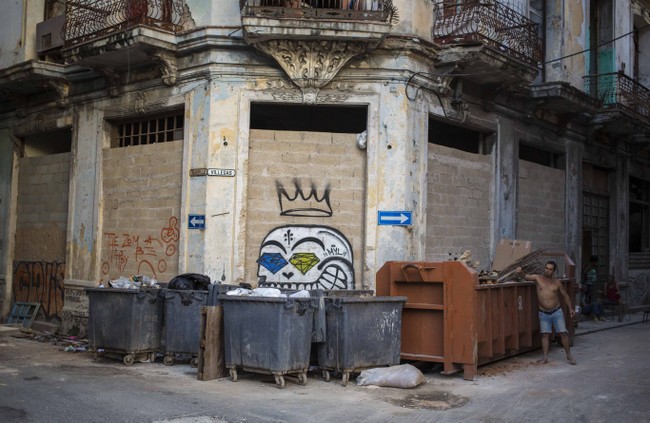
…I’m struck by the amount of garbage piling up in corners at popular tourist spots, and by the occasional Cuban wearing neatly pressed clothes rummaging through it. I observed one clean-cut man step into a pile of soggy rubbish, grab a small plastic container, fish for its lid and walk away with his find.
Fuel is hard to come by, and equipment including tractors and garbage trucks are breaking down, with crews unable to find the necessary spare parts.
I’ve also noticed that Havana’s beautiful architecture is crumbling more than ever. Once bright facades ranging from baroque to art nouveau are slowly being reduced to rubble in some areas.
At nighttime, the skyline is now largely black, with chronic outages, programmed and non-programmed, sinking the capital and beyond into darkness.
…It’s the smallest things that reveal the most. The upgraded hotel where I’m staying cuts flimsy napkins in half to save resources and occasionally offers very small dabs of butter when it’s available.
Meanwhile, it’s not uncommon for office buildings in Havana to lack toilet paper and for water to be cut by mid-afternoon.
A growing number of Cubans are turning to firewood and charcoal so they can cook, because not only are power outages common, but natural gas is not always available, and many cannot afford solar panels.
Solar panels.
Then again, she’s cheerleading for the regime by the end of the interview.
I have to guess she didn’t find this fellow busy with a spray can when she was out and about.
En la Habana, Cuba, cerca del Capitolio. pic.twitter.com/RV6nGpJx6H
— Emmanuel Rincón (@EmmaRincon) January 31, 2026
…In Havana, Cuba, near the Capitol.
It was probably dark.
Editor’s note: If we thought our job in pushing back against the Academia/media/Democrat censorship complex was over with the election, think again. This is going to be a long fight. If you want to join the conversation in the comments — and support independent platforms — why not join our VIP Membership program? Choose VIP to support Hot Air and access our premium content, VIP Gold to extend your access to all Townhall Media platforms and participate in this show, or VIP Platinum to get access to even more content and discounts on merchandise. Use the promo code FIGHT to join or to upgrade your existing membership level today, and get 60% off!