Floating bus stops rolled out across London under Sadiq Khan fail to conform to British Standards recommendations, it has emerged.
The British Standards Institute (BSI), which advises on ‘best practice’ for safety in all forms of UK industry, issued guidance in 2018 that warned road designers to avoid guiding people into the paths of cyclists when getting on or off buses.
However, under Mr Khan, Transport for London and the capital’s boroughs have aggressively rolled out floating bus stops that place cycle lanes either between the pavement and the bus stop, or between the bus stop and the buses themselves.
The BSI guidance notes: ‘Pedestrians should have access to and from the bus stop without crossing cycle routes, including where these run between the pedestrian route and the vehicle carriageway’.
Critics say this definition effectively recommends against any kind of floating bus stop – but new guidance was issued just last month that appears to ignore the British Standard and puts cyclists in direct conflict with vulnerable pedestrians.
As of March 2024 there were 164 floating bus stops across the capital, roughly split 50/50 between TfL and local borough-managed roads.
Some of these stops have zebra crossing markings that, per the Highway Code, should give pedestrians the right of way when boarding or leaving buses.
But a TfL report found that 60 percent of cyclists refused to acknowledge them – forcing pram-pushing parents, elderly people and sight-assisted people with guide dogs to ‘run the gauntlet’ when trying to board buses.
In horrifying examples, pensioners and even children have been run down by cyclists on e-bikes.
The Government says floating bus stops are meant to protect cyclists who were being injured by buses as they pulled out into the road, but disability charities say the ‘shambolic’ designs are putting blind and visually impaired people at risk.
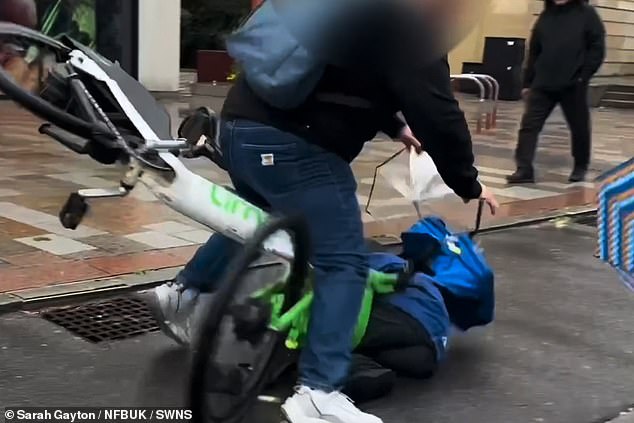
Floating bus stops that put cyclists in direct conflict with pedestrians boarding and leaving buses do not follow British Standards guidance (pictured: a child run down in September 2024)
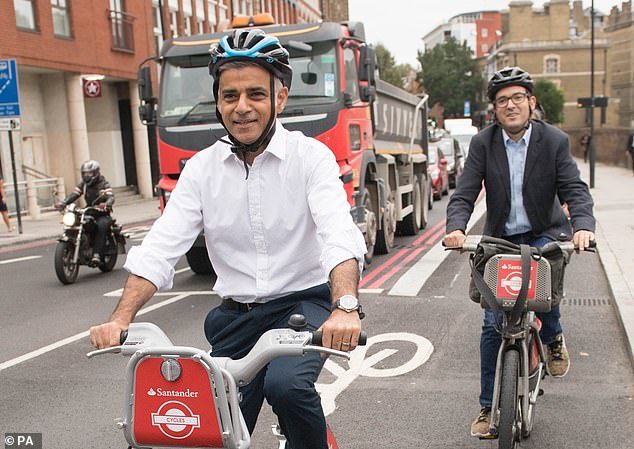
Sadiq Khan and London’s cycling commissioner Will Norman on TfL hire bicycles. Both have overseen an aggressive rollout of floating bus stops in London
Sarah Gayton, of the National Federation of the Blind UK (NFBUK), told the Mail it was ‘absolutely disgusting’ that British Standards guidance appeared to have been ignored.
‘This has been ignored since 2018. Blind people have been raising concerns since 2014 and many simply won’t use them,’ Ms Gayton said.
‘They’re not safe, they’re not suitable for everyone, and they have to come out.’
Floating bus stops come in several different types, two of which are recommended by the Department for Transport and Active Travel England in statutory guidance published on January 26 under the new Bus Services Act.
These are ‘bus stop bypasses’, which place a cycle lane between the pavement and the bus shelter, while ‘bus boarding islands’ route cyclists between the bus stop and a dedicated kerb on which people board the bus.
The DfT no longer recommends the use of ‘shared use bus boarders’, which requires people to board or leave buses directly onto cycle paths. However, these are used in a number of London boroughs.
It is understood, however, that while the Government did refer to it while drawing up the new guidelines. it regarded the BSI’s advice as ‘voluntary’.
It says it consulted with disability charities, and is looking into how to make existing floating stops safer.
But Ms Gayton believes that the BSI definition of a floating bus stop effectively recommends against their use altogether – and that the law on bus stop design is, effectively, putting pedestrians in harm’s way.
‘The Government guidance is not fit for purpose – Active Travel England is marking their own homework,’ she added.
In 2024, NFBUK released horrifying video footage of a child being run down by a Lime bike rider in Elephant and Castle, south London. The child had run to reach the bus stop and was clipped by the cyclist, whose comment after was: ‘Is he deaf? I rang the bell.’
Miss Gayton said at the time: ‘As if that excuses it. Surely that just shows that people need to be aware of those who may be blind and deaf – and may not notice bikes coming?’
Other charities have also expressed concern at the use of floating bus stops. The Guide Dogs for the Blind Association has called for the roll-out of all forms of floating bus stop to be halted until they can be proven safe.
It previously found through testing that trained guide dogs are naturally predisposed to avoid floating bus stops because they don’t think they are safe for their handler.
Professor Nick Tyler of University College London, who conducted the tests in a controlled environment, described the bus stops-cum-cycle paths as ‘conflict zones’.
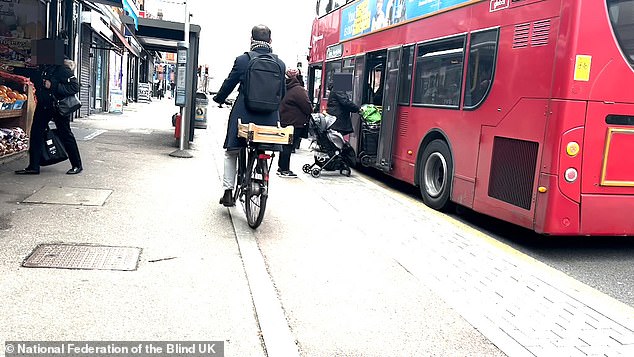
Video footage shot by the National Federation of the Blind UK shows close shaves between pedestrians and cyclists at a number of floating bus stops
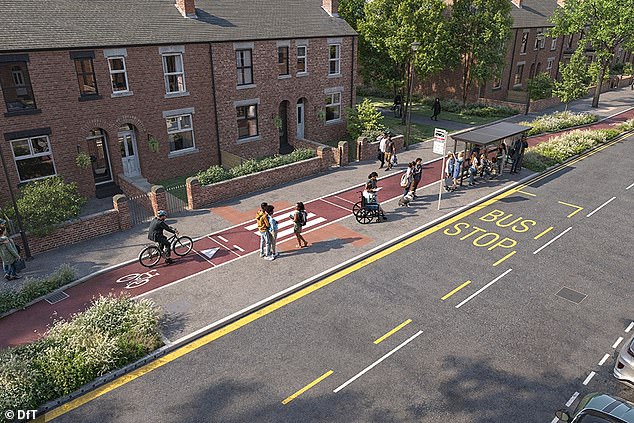
The Department for Transport still recommends ‘bus stop bypasses’ (pictured) – which routes cyclists through the middle of the pavement
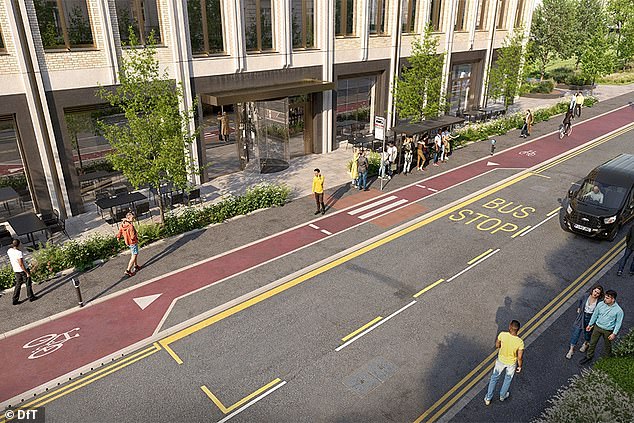
It also recommends, under law, ‘bus boarding islands’ that force people to cross a cycle path in order to board the bus
TfL has sought to claim that floating bus stops are safe, but a 2024 safety review was found to have misrepresented their safety record earlier this year.
Of the 121 bus stops used to justify their ongoing use, 37 were of the wrong type, according to the Telegraph. The safety review has been pulled from TfL’s website.
A government spokesperson said: ‘Making bus travel accessible and safe for everyone is a key priority for this Government, which is why we have published this guidance.
‘Following our pause on some floating bus stops in November, this is the next step to ensuring new bus stops are designed with safety and accessibility at their heart, and we will provide funding to help local authorities make changes to existing sites where appropriate.’
TfL was contacted for comment. A spokesperson earlier said: ‘We engage with local communities on proposals for investment on our roads and consider relevant recommendations from different bodies and organisations.
‘The BSI is an independent organisation that produces its own voluntary codes of practice.’
Anthony Burd, BSI’s director of built environment, told the Telegraph the body was ‘committed to promoting the widespread adoption’ of its recommendation which offers ‘good practice guidance’ for safe and inclusive streets.
The BSI is preparing an update to the advice to help create better ‘accessible transport systems’.