Right arm extended, thumb waggling wildly against a forefinger pointed left, I am peering, I think, into the future.
The future, however, is not going well.
“Try flicking your thumb in an exaggerated way,” says Jason, who is running this high-tech demo for me.
Why We Wrote This
Meta and Ray-Ban have teamed up for the new Display smart glasses. Our reporter gives them a try, reflecting on ways the high-tech glasses might – or might not – enhance daily life.
I am flicking my thumb in an exaggerated way, and nothing is happening on the lens of the glasses I’m wearing. Other customers at this Best Buy in Nashua, N.H., walk by. I try to act nonchalant. But I’ve never shopped for smart glasses, and I’m aware people are staring.
Tech researchers and companies have long dreamed of turning smartphones into eyewear. In 2011, Epson launched the BT-100, the world’s first Android-based, see-through, wearable mini-computer screens, which allowed users to put the device on like glasses, then adjust the lenses to watch movies or read books. It was an innovative device. But in the end, it didn’t sell well and was discontinued.
In 2013, Google launched Glass, a monocular (one-eye) glass display that delivered on new smart-glasses features (like taking an displaying photos, and hands-free updates), but not the sales.
Since then, several companies have tried and failed to find the right combination of features and form to create a consumer phenomenon.
Catching consumers’ attention
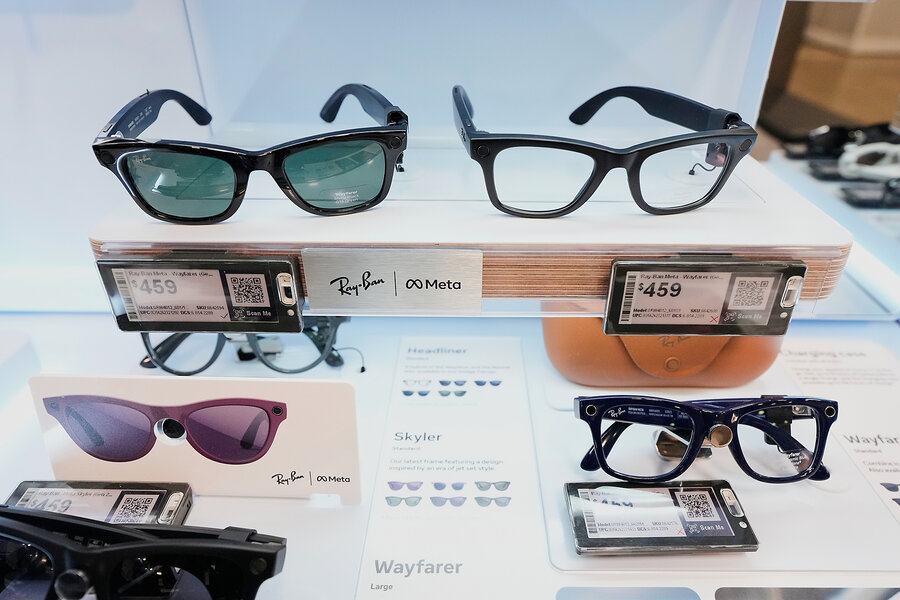
Now, Meta, which teamed up with eyewear company Ray-Ban early on, has made the greatest inroads. When the Menlo Park, California-based company launched its Ray-Ban smart glasses, called Display, last September, the response was so overwhelmingly positive that Meta quickly ran out of stock and is still struggling to catch up.
In fact, the company has delayed the international rollout of Displays, saying it is prioritizing the fulfillment of U.S. orders to manage the limited inventory before focusing on orders from other countries.
If Display can attract people beyond the early adopters who have snapped up that initial supply, Meta may have created the consumer hit for this age of artificial intelligence – as Apple did with the iPhone in the internet era.
Even if this Meta iteration ultimately falters, Apple, Google, and several other tech players are racing to find a breakthrough in what many experts believe is a strong potential market.
“In a couple of decades, we will start to get rid of mobile phones, the way we see it, and information and interaction will belong right in front of your eyes on these smart glasses,” says Saeed Boorboor, a professor of computer science affiliated with the Electronic Visualization Laboratory at the University of Illinois at Chicago.
To wear, or not to wear
Not everyone is gung-ho.
“Glasses are an interesting form factor, but not everyone wears a pair of glasses,” says Cindy Kao, professor and director of the Hybrid Body Lab at Cornell University. Are the features “compelling enough for everyone to get a pair of glasses and to wear them? … Do you want to be seen as wearing something like this?”
That’s one of the things I’m asking myself in this Best Buy showroom.
But the experience of trying out Meta’s Display demo, which is mandatory to qualify to buy the glasses, makes it hard not to side with the optimists.

Laurent Belsie/The Christian Science Monitor
Jason takes me through various applications included in the newest smart glasses. I’m beginning to get the hang of thumb-swiping to reach “Calls” in the menu displayed on the glasses. Then I bring my thumb and forefinger together to open the phone feature. To close out, I bring my middle finger and thumb together and swipe to other options, such as email, maps, and even a game.
One of the most impressive features is real-time translation, where words appear in English on your lens as someone is speaking in, say, Spanish. I envision the work possibilities: marking and saving important quotes as an interviewee speaks, snapping their picture, even recording a video interview, then turning my story into a podcast.
The possibilities quickly expand beyond work. I could use the glasses as my own personal teleprompter while giving speeches, never losing eye contact with the audience. I could look something up discreetly on the internet at the dinner table without incurring the wrath of my mother-in-law. And, most important, I could eventually ask the system where I misplaced some item because it would remember where I went, or where I put my car keys, or wallet.
Google demonstrated that feature with a smartphone a few years ago in a lab setting. If it ever got incorporated into a pair of Display glasses, I could envision spending the $800 Meta is charging.
Then reality sets in. Video clips are limited to a few minutes. Currently, the maps work only for walking in cities, not driving long distances. The Display’s battery, which is supposed to last up to six hours, can poop out after three or four hours with intensive use, users report. Far from ditching my smartphone, I’d have to carry it constantly because the Display, like other smart glasses, offloads much of its computation to the smartphones it connects to wirelessly.
And, I’d have to strap on a special neural wristband for the hand gestures – or commands – to work. (Other smart glasses rely on a ring.)
Then there’s the creep factor. Would others feel comfortable around me, knowing I might be photographing or recording them? Would they find my thumb-waggling weirdly cute? Or weird, and run, screaming, in the other direction? And how much of my smart-glass use data would Meta collect, and how would the company use it?
Meta CEO Mark Zuckerberg says the gestures become much more subtle as the system adapts to the individual. He says he can now type texts and emails with subtle hand movements while talking to someone face-to-face. (Great efficiency for a busy tech CEO, but is that really a step forward in human relations?)
Then there’s the clunk factor. When I first looked at a photo of myself wearing the glasses (the one you’re seeing, dear reader), I laughed aloud. A friend, trying to be supportive, said, “You certainly make a statement.” I didn’t have to ask for details. I knew I looked like a super-nerd or a genius villain from a 1960s spy movie.
There are, in fact, other wearable technologies – such as clothing and even peel-off digital tattoos – that Dr. Kao is working on that could steal the thunder from smart glasses.
So I didn’t buy the Display. But I love the promise. It’s the same feeling I had three decades ago, experimenting with early internet browsers. I knew they would transform the internet from a techie playground to a mainstream consumer phenomenon.
Future wearables will become lighter, less creepy, more powerful, and seamless. My thumb and I can’t wait.