The headlines regarding the asylum crisis are invariably framed through the lens of the Home Office. We are all acutely aware of the figures regarding the multi-billion pound bill for hotel accommodation, the costs of processing centres and the high-profile legal battles over what feels like every single deportation. Yet, flying under the national radar, a second financial crisis is quietly hollowing out town halls across England. The invisible levy that is the cost of social care for asylum seekers.
New analysis of local authority outturn data from us at the TaxPayers’ Alliance shows that asylum-related social care spending has more than doubled in real terms since 2019-20, rising from £299 million to £744 million in 2024-25. This 148 per cent increase represents a massive redirection of public funds, often without any significant local debate or democratic mandate.
The most explosive growth is found in Adult Social Care (ASC) support. This category, which covers advice, language services, and basic adult support, has seen a 165 per cent surge since 2019. In a single year between 2021-22 and 2022-23, spending on adult asylum support shot up by 211 per cent.
Surrey has borne the brunt of this. In the 2019-20 financial year, the council recorded a mere £1,243 in real expenditure on adult asylum seeker support but by 2024-25, that figure had skyrocketed to over £11.6 million. This represents an increase of 938,625 per cent. Similar spikes are seen in Bristol, where costs rose from £2 million to £12.5 million, and in Devon and Norfolk, which went from zero recorded spending to millions in just five years.
The fundamental issue is one of accountability and funding. Local authorities have effectively zero control over the volume or distribution of asylum seekers placed in their areas. Under the national dispersal system, adults and families are assigned to council areas, while unaccompanied children become the statutory responsibility of the authority the moment they arrive at a port, airport, or processing site.
Once an asylum seeker is in their area, the council’s “statutory duties”, established by the Immigration and Asylum Act 1999 and the Children Act 1989, kick in automatically. These duties bypass local accountability entirely. A council leader cannot vote to reduce spending on social care for asylum seekers to prioritise local people, even if elected on with a direct mandate to do so. This creates a democratic deficit where local residents see their council tax bills rise to fund a policy over which their elected local representatives have no say. The delayed elections in much of England are rightly causing consternation. But there needs to be a much broader reckoning about what exactly the point of local democracy is when so much of council spending is forced upon it by policy failures above.
Although the Home Office provides specific grants, councils consistently report that these reimbursements fall far short of the actual costs of care and support. When the funding gap appears, it must be filled from the council’s general fund, the same pot of money used for fixing potholes, maintaining parks, and cleaning streets. The result is that the asylum crisis is directly cannibalizing local services. The enshitiffication of Britain gets, well, enshittier.
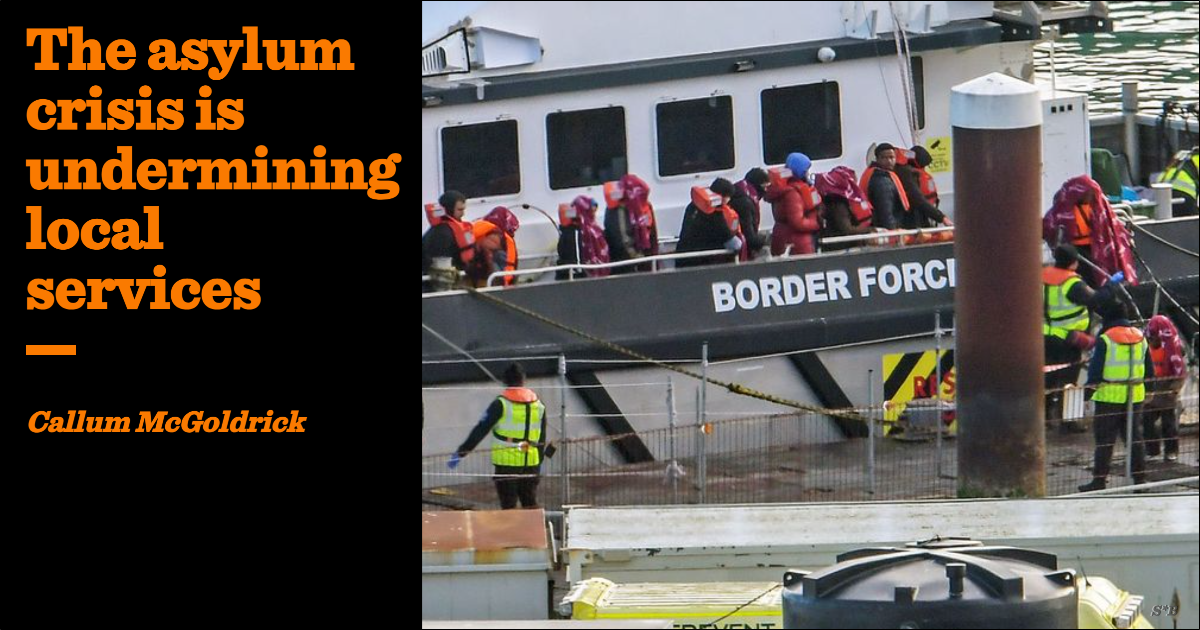
The burden is wildly uneven. In Kent, the geographical frontline of the Channel crossings, the expenditure is eye-watering. Kent County Council spent £41.6 million on asylum seeker social care in 2024-25 alone, nearly double that of the next highest-spending authority. This spending is almost entirely focused on “unaccompanied asylum-seeking children” (UASC), a category that now accounts for £323 million of spending nationally. The thousands of children — 20 per cent of channel arrivals — landing on Kent’s shores immediately become the responsibility of the council. (Whether they really are children is another matter — one in five disputed cases end up being adults.)
It is time the full local cost of the asylum system was brought out of the shadows
The per-household impact makes the disparity even clearer. While the average social care spending on asylum seekers per household across all authorities is £34, residents in the City of London are facing a cost of £400 per household. In Islington, it is £133, in Tower Hamlets, it is £119.
We are witnessing the emergence of a shadow social care system, funded by local taxpayers but directed by national policy. As long as “statutory duties” remain a blank check for central government policy, local authorities will continue to be the silent shock absorbers for a system they do not control and cannot afford, further contributing to the visible and visceral decline of our towns, cities and communities. It is time the full local cost of the asylum system was brought out of the shadows and into the ledger of national accountability.
Even more, simply replacing local authority spending with Home Office spending is not enough in the long run either as we are all paying for the asylum crisis in one way or another. The only real solution is to stop funding the pull factors that lead to the small boats making their way across the channel.