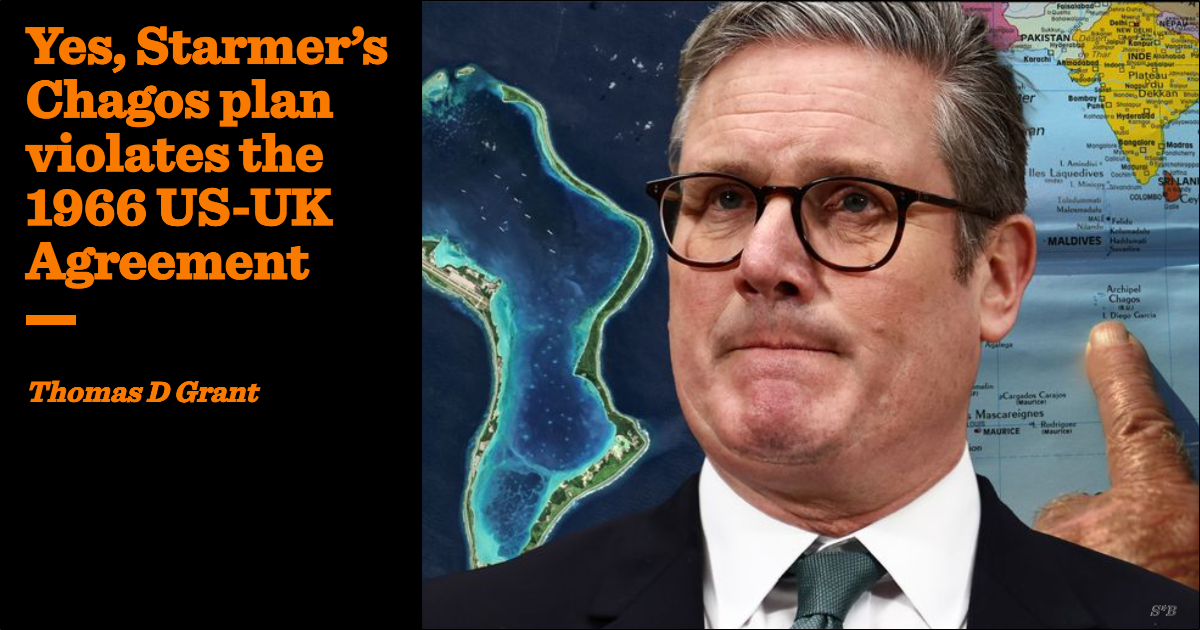
Like it or not, the 1966 US-UK Agreement is an obstacle for the UK-Mauritius Agreement
The Head of Policy Exchange’s Judicial Power Project, Professor Richard Ekins KC, recently observed that the United Kingdom, under an agreement with the United States in 1966, stipulated that “[t]he [Chagos Archipelago] shall remain under United Kingdom sovereignty”.
Conservative peers in the House of Lords on 26 January 2026 drew attention to the 1966 Agreement in debate over the Diego Garcia Military Base and British Indian Ocean Territory Bill. (See also Priti Patel in the House of Commons). The Bill, if Parliament adopts it, will clear the way for the Government to ratify the UK-Mauritius Agreement concluded on 22 May 2025— and that Agreement, if it enters into force, will provide that Mauritius, not the United Kingdom, is sovereign over the Chagos. A conflict is immediately visible between the 1966 and 2025 agreements, and, so, Professor Ekins and others have concluded that the United Kingdom would violate its agreement with the United States, if the Government were to ratify the UK-Mauritius Agreement. Are they right?
My colleague Marc Weller, professor of international law at Cambridge, thinks not. According to Professor Weller, in an article for Chatham House, the 1966 Agreement “reads as if the UK promises to the US that the archipelago shall forever be British — an undertaking that would be broken by ratification of the 2025 agreement,” but he goes on to say that “this would be a misreading of the intent of the parties to the US-UK agreement and disregard the context in which that statement is made.” If Professor Weller’s interpretation were accepted, and it has had some traction in the media, the UK might claim that US consent to amend the 1966 agreement is not required and that the UK may decide alone whether to relinquish sovereignty.
In Professor Weller’s interpretation, the words of the 1966 Agreement are not where we should turn to learn the two countries’ intent. Instead, says Professor Weller, we should look to the underlying purpose of the words — and “[t]he purpose… was to re-assure the UK, not the US. It confirms that, despite the broad rights granted to the US in the agreement, it would be Britain that retained sovereignty.”
Lawyers sometimes have occasion to consider evidence of the “intent of the parties” to a treaty beyond the evidence that the words of the treaty supply. However, the words are the main evidence of parties’ intent, and they therefore are the starting point. When the meaning of a treaty’s words are clear and following their meaning does not produce an absurd or unreasonable result, the words are conclusive. This is the cardinal rule of treaty interpretation, embodied in Articles 31 and 32 of the Vienna Convention on the Law of Treaties (VCLT).
The words of the 1966 Agreement present no ambiguity or obscurity. It is not ambiguous or obscure to say, as the first clause of the 1966 Agreement says, that a “Territory shall remain under United Kingdom sovereignty”. Nor does anything absurd or unreasonable result, as such, if we apply the plain meaning of those words.
But what if we were to set aside the literal meaning of the 1966 Agreement? What if, looking beyond the words, as Professor Weller has done, we were to consider the circumstances in which the two countries concluded it? Would the circumstances of the Agreement’s conclusion impart some other meaning to the words the two countries chose?
Not at all.
Professor Weller seems to think that the sovereignty clause was included on the UK’s insistence and that the UK insisted because the US was pondering a land grab. On that thinking, without the sovereignty clause the US might have mistaken the 1966 Agreement for a treaty of cession. But a territory such as the BIOT under modern international law does not change hands by mistake. Moreover, in context, Weller’s scenario was remote. It had been 50 years since the United States had last acquired new territory (and President Trump’s interest in Greenland was over 50 years in the future).
By contrast, the scenario in which the UK relinquished territory was not remote at all. This was an agreement concluded at the highwater mark of decolonization. In the preceding decade, the UK had granted independence to many colonies, and more were soon to follow. (For example,Mauritius became independent just two years later). It is well-documented, contrary to Professor Weller’s assertion, that the US was very much concerned in the 1960s that the territory then soon to be constituted the BIOT might become independent; that Britain stay sovereign there was a US policy goal. If we needed to look behind the plain wording of the sovereignty clause and divine the motivations that led the two parties to adopt it, then the pre-eminent motivation was to re-assure the US that the Territory was not soon to be swept up in the “wind of change” that already had seen Britain withdraw from most of its colonial holdings.
But no divination is called for here. Whatever the reason(s) the two countries agreed to the sovereignty clause, the plain wording is clear: “The Territory shall remain under United Kingdom sovereignty.”
In saying that the clause really was to “re-assure the UK”, not the US, Professor Weller ignores the careful steps that the UK took with the US in 1976 when assigning part of the BIOT to the Seychelles. In 1976, the UK and US amended the 1966 Agreement to reduce its territorial scope. The amendment, which HMG understood to be “necessary”, affirmed US consent to the change and thus ensured that the UK’s transfer of sovereignty over part of the British Indian Ocean Territory (BIOT) to the Seychelles upon independence was not illegal. The UK clearly understood that the US needed this assurance.
Professor Weller’s interpretation has a further problem. It deprives the sovereignty clause of effective meaning. As I suggested, the possibility of an inadvertent cession was extremely remote; and the United States in 1966 was not seeking sovereignty in any event. Moreover, nothing in the Agreement said it was. True, parties sometimes adopt clauses ex abundante cautula — that is, they repeat something obvious in order to remove even the scintilla of a possibility that someday somebody might interpret them to have meant something else. But that is not where we start when interpreting a treaty. We start with the assumption that every clause means something distinctive. We do not assume that a treaty’s provisions are redundant. Again, the cardinal rule — that a text means what it says — does not give way to special rules except in the exceptional situation where a clear text, if applied literally, would lead to an absurd or unreasonable result.
Whether as a matter of policy you like it or not, the 1966 US-UK Agreement is an obstacle for the UK-Mauritius Agreement in regard to the Chagos. Professor Weller offers no path around it.