- In Search of Now by Jo Marchant (Canongate £20, 336pp) is available now from the Mail Bookshop
The Amondawa indigenous people living in the Amazonian rainforest have no clocks or calendars. They don’t count time in seconds, minutes or hours. They don’t count at all above the number four. They have no word for ‘time’. As Jo Marchant puts it in this fascinating, often mind-boggling book, the Amondawa ‘live immersed in the present moment’.
How different they are to very nearly all the modern world’s other inhabitants. We are obsessed with the passage of time. Yet, in some sense, we, like the Amondawa, necessarily live in the Now. The immediate moment, which, Marchant writes, ‘bathes us like air, or gravity’.

Elusive: It is impossible for us to live in the Now, as Now only lasts less than a trillionth of a billionth of a second
However, according to some of the most commonly accepted ideas in physics, Now doesn’t exist. It is an illusion created in our brains. In the equations scientists use to explain the universe, ‘each and every point in time is ever-present and mathematically equal’. Time doesn’t flow like a river. It just is. As the American physicist Brian Greene puts it, ‘Our past may not be gone. Our future may already exist.’ And the concept of Now seems elusive.
Marchant aims to explore it in 300 pages. What, she asks, is ‘the smallest possible piece of now’? The shortest interval scientists have measured lasts 247 zeptoseconds.
A zeptosecond is a trillionth of a billionth of a second. In everyday life, the average human cannot distinguish between two events if they occur at anything less than 20 milliseconds apart. Otherwise they seem to be happening at the same time, joined in a single moment of Now.
Marchant examines how the brain constructs our sense of time passing. This can be altered by neurological illness and by drugs. Marchant writes about one unfortunate woman who suffered from akinetopsia, a rare condition that left her ‘marooned in a world of frozen moments’. Objects and people for her didn’t move smoothly but in a series of sudden jumps.
In 1913, Alfred Serko, a Slovenian physician, injected himself with the hallucinogenic drug mescaline. In addition to alarming delusions – he felt his head spinning through 180 degrees, for example – he found himself ‘swimming in a limitless river of time’. In a 1930s experiment, a volunteer given psilocybin, another hallucinogen, believed that a bowl of soup had been ‘in front of me for hundreds of years’.
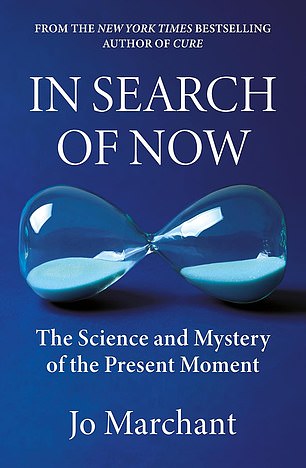
In Search of Now by Jo Marchant is available now from the Mail Bookshop
As Marchant points out, ‘We are literally held together by a stable, continuous Now.’
In 20 short chapters, she guides us through the ‘dizzying range of possibilities for Now’. In doing so she moves further away from the idea that all time exists simultaneously to examine developments in physics.
She also embarks on an enthralling tour of the theories in neuroscience. There is overwhelming evidence ‘that we each construct our own Now’ and that this is central to our sense of self.
Marchant quotes the Italian physicist Carlo Rovelli, ‘Precisely because of its impermanence… the Now has meaning and is precious.’