Crouching beneath an almond tree on a tiny Indian Ocean island, the young men joke that there are worse places to be stranded by people smugglers.
Even the sight of the white cliffs of Dover after a perilous Channel crossing would be less heart-stirring than this glorious square mile of sandy beaches and mountainous jungle.
For one thing the men, nine in all, have the island to themselves. Sometimes the only sound they hear all day as they pick bananas and coconuts is the hiss of lapping waves or the occasional drumbeat of rain on vegetation.
Abandoned here on coral reef-ringed Mtsamboro after a 40-mile journey in a small boat across the Mozambique Channel, they are hoping to reach a bigger island, Mayotte, a few miles away.
‘Mayotte is France and that means Europe and the chance of a better life,’ said one of the young men.
For now these illegal immigrants – found by The Mail on Sunday last week – play a cat-and-mouse game with French police who hunt them through the jungle with drones.
People smugglers, illegal migrants, the French, overcrowded small boats, a dangerous channel crossing? It all sounds strikingly familiar.
Indeed the parallels with what happens here on an almost daily basis and our own Channel migrant crisis are numerous.
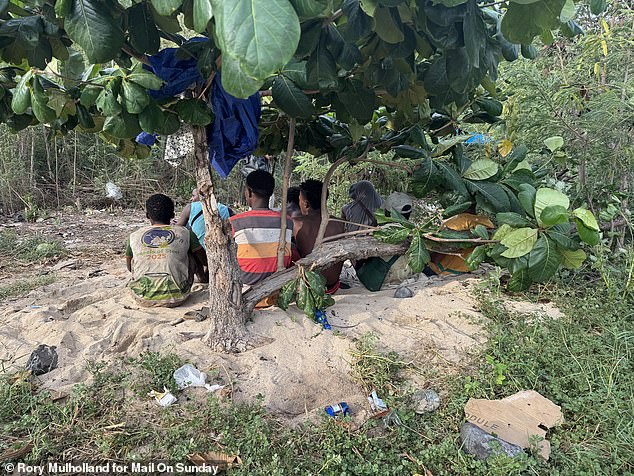
As well as fruit and whatever passing boats bring them, migrants survive on fish they catch (file image)
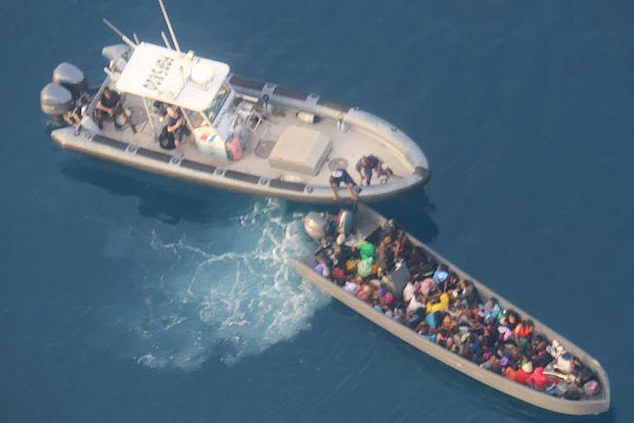
For now these illegal immigrants play a cat-and-mouse game with French police who hunt them through the jungle with drones, writes Ian Gallagher (file image of a small boat being intercepted by French police)
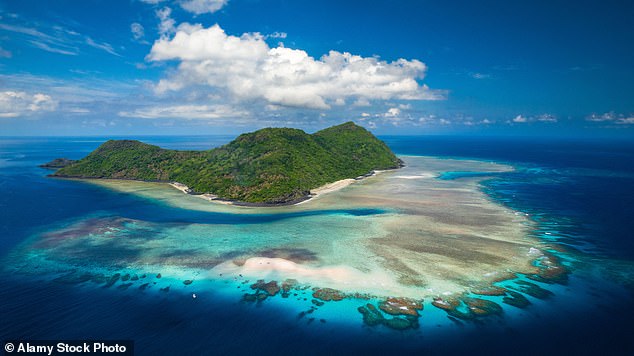
‘Mayotte is France and that means Europe and the chance of a better life,’ said one of the young migrants. Pictured: an aerial view of the islet M’Tsamboro, part of the island of Mayotte in the northernmost Mozambique Channel
What is different in these parts though – aside from the sea temperature – is the French authorities’ unswerving determination to stop the boats.
The young man was right. Odd though it sounds when we are somewhere between the east coast of Africa and Madagascar, Mayotte is indeed France.
And it is not merely a French overseas territory as the Falkland Islands are to Britain, for instance.
A speck in the Indian Ocean and 5,000 miles from Paris it may be, but Mayotte is a French department, which means, in theory, that the same rules apply here as Marseille or anywhere else in the republic.
This is why Mayotte is a magnet for people seeking work and better healthcare and education.
Nearly half its 350,000 residents are immigrants, mainly from the impoverished island nation of the Comoros, where the men stranded on Mtsamboro come from – and where they will be sent back if caught.
‘The police are very determined,’ said another of the men. ‘Sometimes we lie in the vegetation and hear their boots a few metres from where we hide.’
Many would be forgiven for imagining the French authorities in Mayotte take a relaxed view of the almost daily influx of small boats bringing tens of thousands every year.

Immigration has divided opinion on the island. Many believe President Macron should provide more financial support, with the liberals among them arguing immigrants should be allowed to settle in mainland France. Others take a different view (file image)
After all, they haven’t exactly gone out of their way to try to stop the English Channel crossings.Here, it is an altogether different story.
Last year there were reports that French police had rammed small fishing boats and circled them to make waves to stop them reaching Mayotte – just the sort of deadly ‘pushback’ tactics the French claimed were illegal in the Channel.
In one incident last year, two people were killed and a further seven were reported missing.
Others have suffered serious and life-changing injuries, including a man who lost his legs after being struck by the propeller on a police boat.
It’s estimated 10,000 people have drowned while trying to make this journey since 1995.
By all accounts the police are now behaving less aggressively but with no less determination.
In what will surprise many in the UK, the French security forces here use maritime radar to locate the traffickers in the Mozambique Channel then deploy helicopters and high-speed police boats to intercept them.
The smuggler boats are then towed to Mayotte and the immigrants processed with practised efficiency in a detention centre. Frequently they are deported to Comoros the same day.
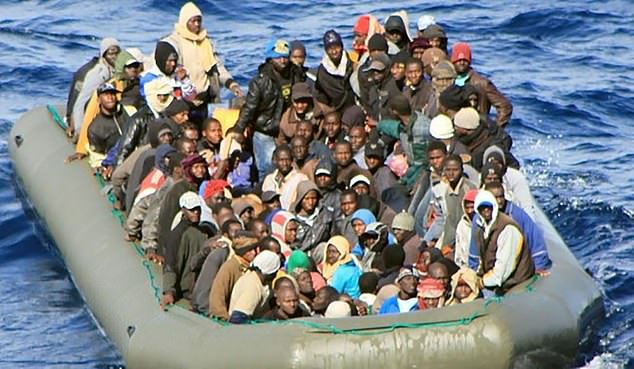
Boats travelling to Mayotte are considered overcrowded, and passengers do not wear life jackets, and therefore officers have a duty to act and intercept them, a senior officer said (file image)
A senior officer of the gendarmerie said that interceptions and collisions were accepted practice in Mayotte.
He said boats travelling to Mayotte were considered overcrowded, and passengers did not wear lifejackets, and therefore officers had a duty to act and intercept them.
Those who dodge the police patrol boats and make it to land aren’t safe from capture either.
Police officers drafted in from the French mainland raid houses on Mayotte’s largest island, Grande-Terre, seizing undocumented immigrants and deporting them.
Last year Mayotte deported 21,409 people. Over the same period the UK made 8,164 enforced returns.
Presiding over the immigrant crackdown is France’s representative on Mayotte, Francois-Xavier Bieuville, a career civil servant with a background in the military and crisis management and who, as prefect, governs the island with what one Paris-based newspaper called ‘iron discipline’.
It added that he likes to ‘play the sheriff’. Pity he wasn’t so tough in his last job – deputy prefect in Dunkirk, the very place from which illegal Channel crossings are launched.
The Mail on Sunday reached Mtsamboro island, off Mayotte’s north west coast, by fishing boat captained by a man called Said with one arm.
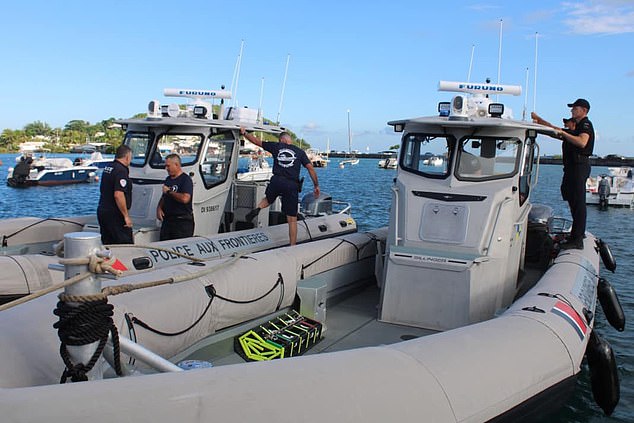
In the coming months police are expected to build a pontoon on the beach which will threaten their Robinson Crusoe existence and force them to make a final attempt to reach Mayotte (file image)
‘I lost it falling from a coconut tree at the age of ten,’ he explained. Owing to his prosthetic, some of his friends call him Dr No after Sean Connery’s adversary in the 007 film.
As he talked, the island loomed magnificently into view – looking like a Bond villain’s lair.
Beyond a couple of shacks on the beach there was nothing to denote human existence. But as our boat moved closer to the shore, figures just discernible in the vegetation began scattering inland.
As we waded ashore Said called out, assuring them we were journalists not police.
After several minutes they emerged from the lush forest and, after jamming a machete into the sand, took up position under the almond tree on the edge of the beach and agreed to grant us a short interview.
All had arrived on the island by small boats, they said. One came more than a year ago, the others a few months.
Most were in their late teens and early 20s; the youngest was 15. ‘The gendarmes come here to hunt us, sometimes for a week or more, and set up tents on the beach,’ said one of the men, wearing a basketball vest.
‘They use drones but we are familiar with the island and disappear to hidden shelters. It can be scary.’
Other migrants use the island as a stepping off point before reaching Mayotte. ‘Some of them have help – they know people who will bring them ashore,’ said the man.
At this point another man interjected. ‘I have been caught twice. I was unlucky, I must have made a sound and they found my hiding spot. T
‘The second time they chased me. They sent me back on a ferry but each time I come back. I will never give up. There is only poverty behind me. Maybe one day I can live in Europe.’
As well as fruit and whatever passing boats bring them, they survive on fish they catch.
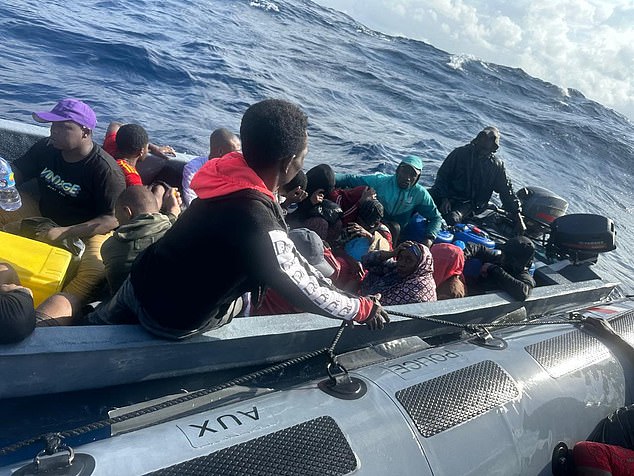
Presiding over the immigrant crackdown is France’s representative on Mayotte, Francois-Xavier Bieuville (file image: migrants amid ‘dangerous sea conditions’)
In the past there was small settlement on the island numbering about 20 but it is long gone and only the immigrants remain.
In the coming months police are expected to build a pontoon on the beach which will threaten their Robinson Crusoe existence and force them to make a final attempt to reach Mayotte.
Though it is France’s poorest region and scarred by decades of social unrest, poverty and crime – which many on the island claim is due to the vast influx of illegals – the migrants won’t be put off.
‘It can’t be worse than where we came from,’ said one.
Comoros was a French colony until 1975 when it declared independence. But Mayotte opted to remain part of France, voting in 2009 to become an integral part of France. In 2011, it became the 101st French department.
Immigration has divided opinion on the island. Many believe President Macron should provide more financial support, with the liberals among them arguing immigrants should be allowed to settle in mainland France.
Others take a different view. Salime Mdere, former vice-president of the departmental council of Mayotte, talked about ‘terrorist’ Comoran youths.
‘It might be necessary to kill some,’ he said.
France has economic interests in the Mozambique channel, and Mayotte allows control.
At least three times a week a ferry leaves for the Comoros with deportees on board.
Last week The Mail on Sunday watched as 50 men and some women were moved from a detention centre on Mayotte’s second island, Petite-Terre, and driven at speed in white vans to the port.
There they were ushered on board the ferry by gendarmes and ‘put in a secure part of the vessel’ before setting sail straight past the prefect’s luxury mansion.
People who witness this spectacle every week say they see the same faces going back and forth.
Another Mayotte politician, Said Omar Oili, who sits in the French senate, said: ‘Someone who is expelled in the morning can be back in Mayotte in the afternoon, then leaves again the next day.
‘And sometimes, when they want to go and see their family, they go to the police themselves; we send them back and they return.
‘The money spent on fighting immigration is counted as aid. When ministries say they’re putting a lot of money into Mayotte, the police salaries, bonuses, all of that is included.
‘It’s a shame, because that money could be used for other things.’
The Mail on Sunday put a series of questions to the prefect’s office and requested an interview with Mr Bieuville.
‘We can’t answer your questions and sorry he is a very busy man,’ said his spokesman.
No more so, one imagines, than he was in Dunkirk.
Additional reporting: Rory Mulholland.