What a wonderful thought it is that President Truman can ring a bell and give an order that American aircraft can load their bombs and fly from London to Moscow. The interest of their visit will not be returned on Washington, it will be returned on poor old London. All this talk about not giving up national sovereignty doesn’t mean much when the President of the United States or America can use England as an aircraft carrier without the knowledge of the ships company.
— Brendan Bracken, Conservative MP and manager of the Financial Times, 1950.
Britain was saved by World War Two but also devastated by it — saved from a Nazi imperialism but at heavy loss in casualties, and cost. The illusions of great power status remained but the reality was different to the situation after World War One when the Empire was still strong, the Soviet Union constrained, and America not seeking the overthrow of the British order, although in 1919-21 there was a serious challenge to British dominance in the British Isles in the shape of the Irish War of Independence, whereas there was no equivalent after World War Two. That, indeed, offers a contrast with the possible situation in coming years, as much government effort may have to be devoted to relations with Scotland and Wales while large-scale immigration has also led to concerns about future public order in some British cities.
All comparisons are open to criticism and contextualisation. Nevertheless, this system makes it possibly surprising that so much attention is being devoted today to distant issues in international relations, which suggests a reminder of the French July Revolution in 1830 when so much of the army was in Algeria or the Russian equivalents in 1917.
Britain planned for a postwar world even as the war continued, the assumption being that great power status would be sustained, although there was considerable uneasiness about American attitudes toward Britain, and notably those of President Roosevelt. Oliver Stanley, the Colonial Secretary, pertinently replied to Roosevelt in January 1945, by drawing attention to American gains in the Mexican-American War (1846-8) which was subsequent to that by Britain in 1841 of Hong Kong which Roosevelt proposed to rectify. America and Britain competed over Middle Eastern oil, with America successfully developing links with Saudi Arabia, and over economic interests elsewhere, while there was also strong American support for a Jewish state in Palestine, a policy opposed by Anthony Eden, the Foreign Secretary. In general and in specific terms, military and in economic respects, the war was central to the transition of great-power status from Britain to America.
In April-May 1944, the Admiralty discussed plans for big new capital ships. Postwar politics and realities, however, were to lead to very different priorities. In 1946, Admiral William Cunningham, Commander-in-Chief of the Mediterranean, could write about his optimism for a long-term, albeit smaller-scale, presence in Egypt. However, failure there followed a decade later. In the meanwhile, Britain was the major Middle Eastern power, a situation that owed much to success in the two world wars and to the French withdrawal from Syria and Lebanon in 1946. At the same time, it is important not to draw too clearcut a line or linkage in developments. Thus, the abandonment of the Palestine Mandate in 1948 freed Britain from an incubus, while, despite a loss of influence to America in Iran, failure in the Suez Crisis in 1956, and the overthrow of the favourable Iraqi regime in 1958, British forces successfully intervened in Jordan in 1958 and Kuwait in 1961, in order to maintain friendly governments in power and resist the pressures of Pan-Arabism and both Egyptian and Iraqi expansionism.
In practice, however, the decades of defence were to be focused on Western Europe and the North Atlantic, and notably so from the late 1960s, as the alternative of imperial defence receded. Already, on 14 March 1946, the embassy in Moscow had asked if the world was now “faced with the danger of the modern equivalent of the religious wars of the sixteenth century”, with Communism battling against Western social democracy and American capitalism for “domination of the world”. There was an awareness that fear of enemies helped motivate the Soviets but also an understandable concern about Soviet expansion.
Brought to new intensity from the late 1940s, the Cold War with the Soviet Union lasted longer than the two world wars. Nevertheless, it was less significant politically than it might have been because Labour as well as the Conservatives supported anti-Soviet policies and a domestic stance against Communism. On 13 April 1948, the Cabinet discussed the need for propaganda against Communism, specifically activity by the Labour Party, the Co-operative and trade union movements, and the churches, to help anti-Communist Socialist tendencies. British achievements were to be emphasised to give confidence to Social Democratic parties in Europe. The Cabinet also decided that the BBC should be pressed about the speakers it asked to appear on leading radio programmes. On 1 June, the Cabinet returned to these themes. The pro-Western policies of Clement Attlee’s Labour governments from 1945 to 1951 were supported by the vast majority of the Labour Party and trade union movement, Communist and Soviet sympathisers within both were isolated, and the Communist Party kept at a distance. In 1949, the government sent in troops to deal with a London dock strike that it blamed on Communists, and in 1950 argued that a strike in the power stations was instigated by Communist shop stewards. An alliance between labour and capital was developed alongside a mixed economy.
Political division within Britain therefore was not defined by foreign policy and war as readily as had been the case in the first half of the eighteenth century. Furthermore, the end of the Empire was not a cause of acute and sustained electoral division, and, if it did cause significant short-lived divisions within the Conservative Party, this was far less so than for France and Algeria.
The government was interested in the idea of a Western European Third Force independent of America and the Soviet Union, and Britain and France accordingly signed the Treaty of Dunkirk in 1947. This agreement was directed against Soviet expansionism, although fear of a resurgent Germany also played a role.
Yet, in response to fears about Soviet plans, an American alliance for Britain, and a commitment to Europe, appeared essential. In February 1947, heavily indebted by the war, Britain acknowledged that it could no longer provide the military and economic aid deemed necessary to keep Greece and Turkey out of Communist hands, an urgent issue in light of the Greek Civil War and of Soviet pressure on Turkey. Instead, Britain successfully sought American intervention. Indeed, notably in the Middle East, but also more generally, the Cold War took on the character of the War of the British Succession, as Britain’s imperial inheritance was contested.
Meanwhile, Britain was an active member of international organisations, not least with a permanent seat on the United Nations Security Council and as a founder member of the North Atlantic Treaty Organisation (NATO). Britain sent a significant contingent of troops to take part in the United Nations forces engaged in the Korean War (1950-3), the government seeing it necessary to act in part in response to American criticism, Stafford Barff, the Director of British Information Services in Chicago, reporting that newspapers presented the British as psychologically unfit to wage war, adding:
… the cynical comments about America being left alone to do the fighting are mainly confined to the lightweight and lunatic newspapers and have not been indulged in by the more responsible press which understands the implications on a world-wide basis of Soviet strategy.
Once engaged, the British found that the Americans tended to make decisions without much, or any, consultation. Attlee made representations concerning General Douglas MacArthur’s bellicosity toward China, but that was not the reason he was relieved of command in Korea in April 1951.
Under American pressure, Britain embarked in 1950 on a costly rearmament programme that undid recent economic gains and strengthened the military commitment that was to be such a heavy post-war economic burden; and disproportionately so compared to West Germany. Separately, having decided in January 1947 to develop an atomic bomb, Britain had one ready by 1952.
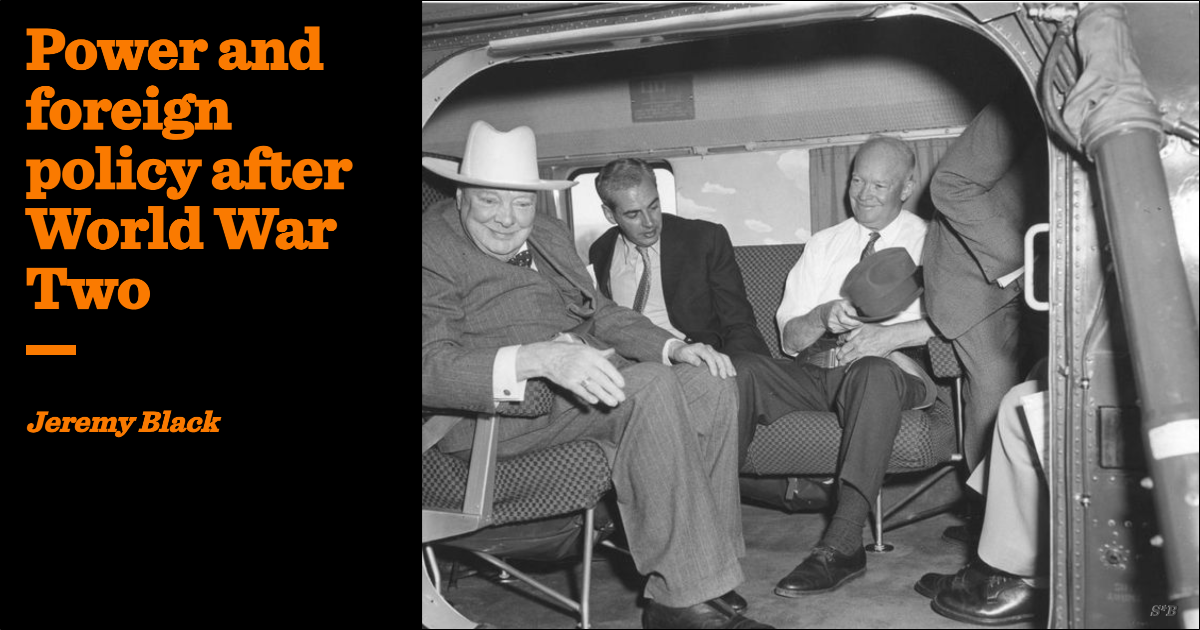
British influence was limited. Seeking to negotiate a reduction in Cold War tensions, Churchill, after Stalin’s death in 1953, proposed a summit of American, British and Soviet leaders, only to be rejected by President Eisenhower. This division helped ensure that Soviet approaches after Stalin’s death were not reciprocated, but the Soviet leadership anyway did not believe that Britain could restrain America.
Despite the portentous language he often used, Churchill’s commitment to Europe was always strictly qualified and more rhetorical than real. When he did clarify his position, as in May 1953, it was usually to suggest that Britain was with, not of, the European states, and he saw Britain’s role as that of a benevolent sponsor and encouraging supporter, rather than as a direct participant.
When the Conservatives, under Churchill, returned to power in October 1951, there was interest on their part in strengthening Western European defence, but far less so in any new Western European economic entity. Steel was to be privatized/denationalized by the Conservatives, not transferred to the control of a European organization, the European Coal and Steel Community (ECSC), and, again, British political assumptions came first, with no sense that anything else was appropriate. In government, Labour had refused to join negotiations for ECSC.
In contrast, although the British preferred the NATO solution for Western European security, active support, but, crucially, short of full membership, was also provided to the idea of a European Defence Community (EDC), which was seen as a way to control a rearmed West Germany. The government only abandoned the European Army concept in June 1954 when its failure seemed certain: passed by the other five Parliaments of the ECSC, the measure had proved bitterly divisive in France, and was rejected by the French National Assembly that August.
However, in 1954, the failure of the EDC did not prevent the process that led to the creation in 1958 of the very different European Economic Community (EEC), which, from 1967, was transformed into the European Community (EC) and, from 1982, into the European Union (EU). Furthermore, in the 1950s, there was no willingness, in France or Britain, to seek support from a popular referendum. This factor, again in this case a negative, was (and remains) a significant instance of the crucial domestic dimension to foreign policy.
Had the EDC succeeded, it would have resulted in an important measure of European political integration which would have been led by defence, a field in which Britain played, and has continued to play, a major role; and not the economic drive that was crucial in the development of the EEC. Conservatives might have found such a defence-based identity for Europe easier to accept. It was certainly that which was in effect to be pursued by Sir Keir Starmer in the Ukraine crisis of the 2020s. This counterfactual point serves as a reminder of the role of international factors, and therefore contingencies, in affecting domestic political options and responses. For instance, the 2013 German elections, by creating a need for Angela Merkel, the German Chancellor, to turn for support from the Social Democratic Party, made it less likely that Germany would support David Cameron’s attempt to chart what he could present as a middle path on European policy.
During the 1950s in Britain (as in France, Portugal, Belgium and Spain; but not, after 1949 in the Netherlands), there was still a strong commitment to Empire. Such a commitment had long involved major tensions over policy, both goals and means, as with the opposition, by those described by Frederick, 1st Earl of Birkenhead, the Lord Chancellor (later Secretary of State for India from 1924 to 1928), as “the medievalists among us”, to the Anglo-Irish Treaty of 1921, as well as to Dominion status for India and the Government of India Act of 1935. Similarly, in the mid-1950s, the “Suez Group” argued that Colonel Nasser, the nationalist dictator of Egypt from 1954, was a threat to British interests and should be resisted. There was opposition, accordingly, to the 1954 agreement ending British occupation of the Suez Canal zone. However, Eden, the Foreign Secretary, claimed that the agreement would ease relations and lessen the strain on Britain’s military situation.
Like its Labour predecessor, the Conservative government that came to power in 1951 saw independence for India in 1947 as prefiguring, not the end of Empire, but, rather, a continued international presence and identity based on its continuation, albeit more in the shape of informal control than hitherto. In the 1950s, British troops were to be used to fight for Empire in Cyprus, Kenya, Malaya and Suez, and to be deployed elsewhere. Indeed, despite the commitment, through NATO, to the defence of Western Europe, which led to the continued presence of British forces in West Germany after the end of post-war occupation, much of the British defence effort in the 1950s was still dominated by concern about imperial security and that of allies outside Europe. This remained the case until the late 1960s, and was repeated for such allies and interests from 1990 until 2022.
The factor is also at continuing play in Britain’s ANKUS Pacific strategy with the consequent links with America, Australia and Japan. Yet, ANKUS is not designed to protect territories in the Pacific (which are nugatory compared to the extensive French ones). Nor is there any serious suggestion that Britain will, or can, deploy major assets.
This stance was seen in the 1950s alliance architecture which was not only focused on NATO. In 1955, Britain supported the creation of the Baghdad Pact, an attempt to create a northern layer of states in the Middle East opposed to southward expansion by the Soviet Union. Turkey, Iraq, Pakistan and Iran were the other members. Exaggerating British power, the Baghdad Pact was part of an assertive British policy in the Middle East.
France also evinced a firm commitment to Empire. While keen on establishing NATO and ensuring American support for the defence of Western Europe, France devoted much military effort in the late 1940s and 1950s to trying to maintain its imperial position, first in Indochina and then in North Africa, in the end a debilitating and unsuccessful project. The French, however, proved better than Britain at combining their imperial position with advancing their European interests, especially in the EEC. In part, this contrast reflected political circumstances and skill, but different political cultures were also significant.
Britain and France both found it very difficult to manage their situation after World War Two. In the British case, there was an assumption that Britain could help manage an international order in which the British Empire and Commonwealth, America, Western Europe and the Soviet sphere all played a key role, but this was a misunderstanding of the relationship between these elements, of Britain’s position, and of the British influence in the running of the international system. To that extent, there was anticipation of the situation today, when Britain is far weaker in relative terms, but still has extraordinary ambitions for its influence. Moreover, these stretch across the political spectrum. A lack of realism was more understandable in the late 1940s given the need to avoid a recurrence of the security disaster of 1940 and also the drive to take forward the recent wartime effort and eventual achievement. There are far fewer excuses for a lack of realism today but that does not prevent many being stakeholders in folly.