Downstream from the Eiffel Tower, on a narrow stretch of the Seine River, sits a miniature version of the Statue of Liberty. It was given to France by U.S. expats in 1889 to celebrate the 100th anniversary of the French Revolution, as a symbol of friendship between the two nations.
But today, that friendship is at risk of unraveling, as relations between the United States and France – and Europe more broadly – become increasingly strained.
U.S. President Donald Trump has described Europe as “weak” and “decaying,” and at Davos earlier this month, he called Europeans who had invested in wind power, “stupid people.” This month, he threatened the continent with steep tariffs for those who would not agree to his plans to acquire Greenland from Denmark.
Why We Wrote This
The immigration crackdown in Minnesota isn’t just causing tensions in the United States. It’s also hastening the erosion of Europeans’ esteem for their long-time ally under President Donald Trump.
But more significant than the insults and threats are the growing concerns that the U.S. administration and Europe no longer share the same values. The recent killings of two U.S. citizens in Minneapolis during immigration operations by U.S. Immigration and Customs Enforcement and Border Patrol agents have shocked Europeans, even those who have pushed for more immigration control on the continent.
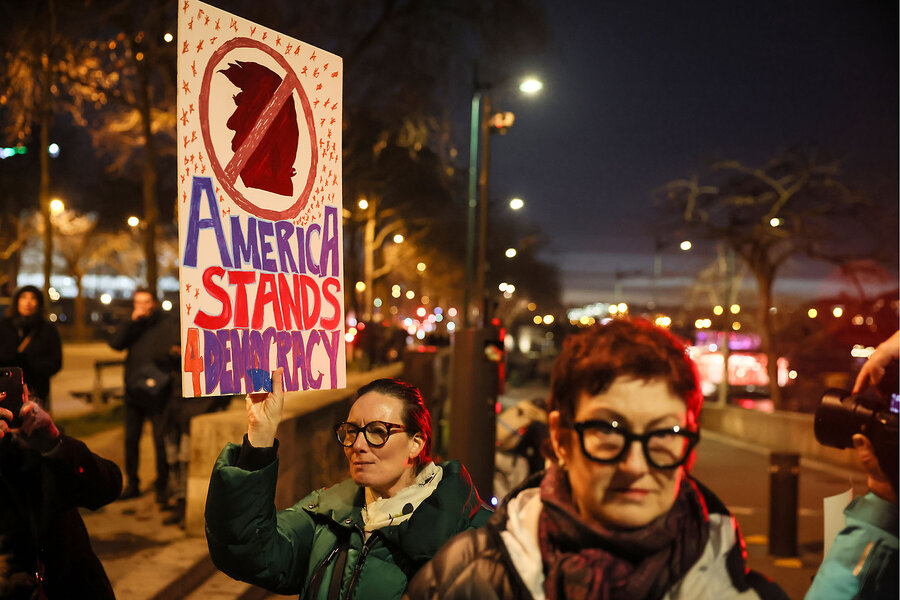
News that ICE will accompany the U.S. delegation to the Winter Olympics in Italy next month has been met with controversy among Italians, many of whom say ICE has no place in Europe. Protests against ICE have taken place this week in Germany, France, Ireland, the United Kingdom, and Luxembourg in a show of solidarity.
As the U.S. administration pushes a heavy-handed approach to immigration, Europeans are increasingly saying, “That’s not who we are.”
“No matter what Europeans think of American violence, they always had a kind of reliance on the international regime arena and NATO, things like that,” says Mabel Berezin, director of the Institute for European Studies at Cornell University, who has done research at institutions across Europe. ”Suddenly all of this seems to be smashing apart.”

Guglielmo Mangiapane/Reuters
Growing doubts about the U.S.
On a continent where gun-related deaths are relatively low, the killings of Renee Good and Alex Pretti in Minneapolis this month have been met with a sense of disillusionment here in Europe. Where they once regarded the U.S. as the vanguard of freedom and democracy, some Europeans have felt their view shattered by the increase in violence against immigrants and protesters in the U.S.
“[Immigration officers] are acting with impunity, Trump is trying to rewrite the constitution, the country is sliding toward fascism,” says Frenchman Jean-Pierre Goulée, who attended an anti-ICE protest in Paris Wednesday. “I always thought the U.S. was sheltered from all this.”
Violence related to U.S. immigration control has garnered comparisons to some of the darkest periods in Europe’s history. In May, Minnesota Governor Tim Walz likened ICE agents to the Gestapo, the secret police of Nazi Germany. While historians are careful about drawing direct comparisons, Europeans say they have the hindsight of the effects of state-sponsored violence in a way that Americans do not.
Ireland has been a net exporter of people for centuries, and so has a strong sympathy for immigrants – and for the U.S., where the Irish once made up nearly half of all arrivals. On Wednesday, several Irish parliamentarians called on Prime Minister Micheál Martin to cancel his St. Patrick’s Day visit with Mr. Trump, a long-standing tradition that would see the Irish prime minister offering a bowl of shamrocks to the U.S. leader.
“Almost everyone in Ireland has someone in their family with an immigration story involving the U.S.,” says Paul Murphy, an Irish politician with the far-left People Before Profit-Solidarity party, which organized a protest this week against ICE operations. “Now people look at the U.S. and ask, ‘Is this the direction we’re heading?”
Could it happen here?
That’s not to say that Europe has all the answers.
Europe has a complicated relationship with immigration, and views on how to welcome and integrate new arrivals vary widely across the continent. In 2023, over 4 million people migrated to the EU in 2023, and recent polling shows that Europeans want less immigration, not more.
This week, the Spanish government bucked that trend by announcing that it would grant legal status to the half million immigrants already living and working in Spain. But, like many countries in Western Europe, it struggles to integrate its immigrant population, and police brutality disproportionately affects Black and brown people.
“We’re watching with astonishment what is happening in the United States and the impunity with which it is happening,” says Youssef Ouled, a Madrid-based anti-racism activist. “But also with fear because we have all the conditions to make it possible to exist here as well.”
Part of that fear stems from the rising popularity of Europe’s far-right, which has broadly pushed an anti-immigrant agenda, as well as the center-right parties taking more conservative stances to make gains at the polls. This month, citizen video showed police in Paris violently arresting a Mauritanian refugee who later died in custody. France’s Ministry of the Interior has ignored requests by the victim’s family to suspend the police officers involved.
Following the killing of Mr. Pretti in Minneapolis, French far-right politician Marion Maréchal downplayed the legal questions, calling it “an accident.” This week, Arno Klarsfeld, former head of the French Immigration and Integration Office, caused a hailstorm of controversy after he seemed to suggest on French television that the country would need to engage in ICE-style “round-ups” if it hoped to get rid of people living in the country illegally.
“What happens in the U.S. has consequences here,” says Assa Traoré, a Paris-based anti-racism activist whose brother Adama died in police custody in 2016. “If we don’t strongly denounce this type of behavior immediately, we risk having the same situation in France.”
Broken trust
Polls regarding how Europeans feel specifically about ICE operations are scant, but previous polling suggests that Europeans were already wary of President Trump’s leadership before immigration operations began.
According to a January YouGov survey, Britons’ attitudes toward the U.S. are the lowest since it began tracking them a decade ago, with 35% of Britons saying they see the U.S. as unfriendly or hostile to Europe. In an IFOP survey, a majority of French respondents said they considered the U.S. to be a military threat to France in the coming years.
Mr. Trump’s relationships with European leaders have also begun to fray. Italian Prime Minister Giorgia Meloni, once seen as a bridge between Mr. Trump and Western leaders, criticized the U.S. president after he downplayed the role of NATO allies in U.S.-led operations in Afghanistan. And Mr. Trump’s attempts to acquire Greenland have created a uncharacteristically unified response by European leaders.
For regular Europeans, the events in Minneapolis have been a wake-up call and caused many to rethink their future support for the U.S.
Jessie, a French artist who requested anonymity for her protection, is still planning to travel to the U.S. for professional reasons this spring but is opposed to going for tourism purposes.
Franco-American journalist Diane de Vignemont says her decision not to travel to the U.S. while Trump is president has more do with concerns over her personal safety. “At this point,” she says, “I would be worried about being detained.”
Still, some Europeans express hope in the face of what has recently been relentless bad news coming out of the U.S.
“We’re here in solidarity,” says Pascale, a French woman who protested against ICE with dozens of others this week and asked that only her first name be used for her privacy. “We know America is not Trump. We hope this generation will help bring change.”
Audrey Thibert reported from Boston.