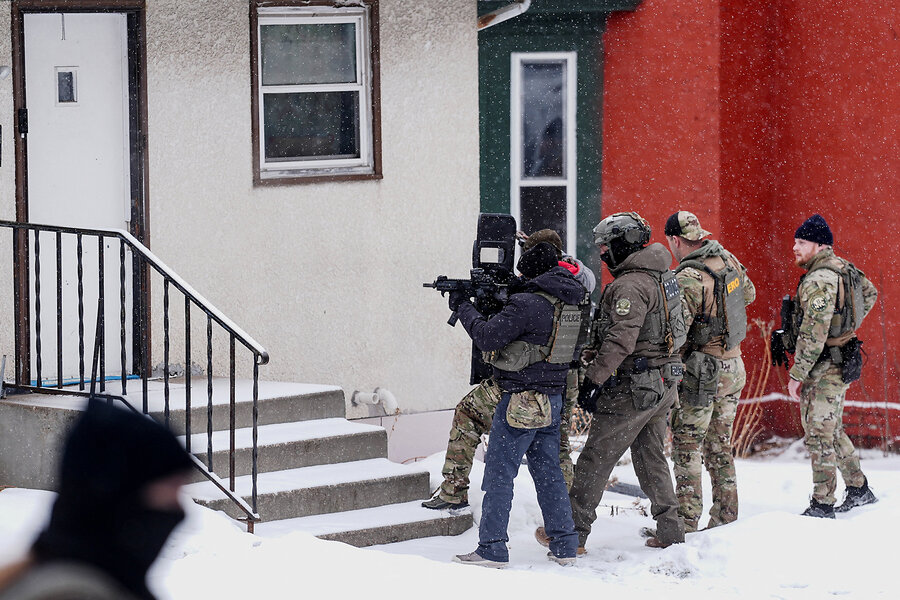
The deaths of Renee Good and Alex Pretti in Minneapolis have raised questions around the constraints on the use of lethal force by federal law enforcement officers in an American city and how fatal incidents are investigated.
On Jan. 7, Jonathan Ross – an officer with Immigration and Customs Enforcement (ICE) – shot Ms. Good through the window of her car as she started driving away. On Jan. 24, officials with Customs and Border Protection (CBP) shot Mr. Pretti after tackling him as he filmed their actions with his cellphone. The government has said each of the shooters acted in self-defense.
The shootings, recorded in real time by bystanders on their cellphones, spread quickly on social media. The videos appear to contradict statements from Trump administration officials that the two U.S. citizens engaged in acts of “domestic terrorism,” and sparked protests in cities across the country.
Why We Wrote This
After the fatal shootings of two U.S. citizens in Minneapolis, members of the public and lawmakers are looking for more information about when local and federal law enforcement can use force and how incidents are investigated.
President Donald Trump dispatched his “border czar,” Tom Homan, to Minneapolis in late January to de-escalate tensions. On Thursday, Mr. Homan announced a coming drawdown of federal law enforcement, based on stronger immigration enforcement cooperation with local authorities. He noted that federal agents who don’t uphold standards of “integrity, professionalism, and compassion” will be “dealt with.” That followed calls from an increasing number of Republican lawmakers for impartial investigations of the two incidents.

When is the use of lethal force acceptable, and when is it not?
The use of lethal force – by state, federal, or local officers – is governed by the Fourth Amendment, which protects individuals from unreasonable searches and seizures. U.S. Supreme Court rulings have defined the use of lethal force as “seizure,” meaning it can be legally justified in certain circumstances.
Two Supreme Court cases defined that standard. Tennessee v. Garner (1985) set the precedent that an officer may not use deadly force on a suspect who is fleeing, unless the officer is under a direct threat.
Building upon the precedent, Graham v. Connor (1989) held that an officer’s actions are assessed based on “objective reasonableness,” considering what an officer’s most reasonable judgment would be in the moment without the benefit of hindsight.
Department of Justice guidelines for its officers state that they “may use force only when no reasonably effective, safe, and feasible alternative appears to exist and may use only the level of force that a reasonable officer on the scene would use under the same or similar circumstances.” (All federal law enforcement agencies were required in 2022 to adopt guidelines that match or exceed the Justice Department policy.)
The use of deadly force requires that the officer is facing a threat to their life in that specific moment, not merely weighing the potential of a future threat, attempting to flee, or engaging in a verbal altercation, according to Brandon Garrett, a professor at Duke University School of Law.
Cases in which lethal force is deemed unusual occur if the officer violates safety protocol, such as not identifying themselves as law enforcement, using force against a fleeing suspect, firing warning shots, or placing themselves directly in harm’s way. Using lethal force is reliant upon an officer’s assessment of whether a subject will cause legitimate harm.
In the two Minneapolis cases, administration officials have argued that the officers did face imminent threats. Ms. Good was behind the wheel of a car and had started driving. Mr. Pretti had been lawfully carrying a concealed handgun, which made him more of a threat to the CBP officers, administration officials have argued. “You can’t walk in with guns,” President Trump said earlier this week.
But if a law enforcement officer is feeling threatened, there are still steps that they’re supposed to take before using lethal force.
“Lots of people have cars. Lots of people are allowed to have firearms in this country. Just because the person has a weapon does not mean that they pose a deadly threat to you,” says Professor Garrett. “You absolutely are supposed to use verbal warnings and assess whether the person actually poses a deadly [threat]. … It can’t just be preventative.”
Are there differences in the application of lethal force between federal and local law enforcement agencies?
While all law enforcement officers are subject to the Fourth Amendment, accountability and training policies vary by agency. It’s unclear, however – given events in Minneapolis so far – how those policies vary and the extent to which they’re being followed.
At a City Council meeting in West St. Paul this week, police Chief Brian Sturgeon told his constituents that ICE has “a different playbook.”
“They have a playbook that I am not trained in,” he added. “They have a playbook that we disagree with on some aspects.”

On paper, guidelines set by the Department of Homeland Security – which houses both ICE and CBP – reinforce the Supreme Court’s “reasonableness” precedent.
“Courts allow for the fact that [law enforcement officers] are often forced to make split-second judgments, in circumstances that are tense, uncertain, and rapidly evolving,” states the DHS’ policy outline that was last updated in 2023. An officer, it adds, “shall only use the force that is objectively reasonable in light of the facts … at the time force is applied.”
The latest revisions instruct that each DHS officer undergoes both de-escalation and use-of-force training annually. Agents are instructed to employ tactics that “promote” the safety of both officers and individuals, making decisions that “minimize risk.” Officers are also instructed to “avoid intentionally placing themselves in positions in which they have no alternative to using deadly force.”
Two CBP agents who opened fire on Mr. Pretti were placed on leave. It’s unclear if Mr. Ross has faced any internal discipline.
How is a fatal shooting by a federal law enforcement officer supposed to be investigated?
States can prosecute federal officers, but only under limited conditions. The supremacy clause of the Constitution holds that federal law preempts state laws when the two conflict. However, if a federal officer is found to be acting outside the bounds of their duties, state authorities can proceed with an investigation and, potentially, a prosecution, according to the State Democracy Research Initiative at the University of Wisconsin School of Law. In practice, it’s been difficult for state prosecutors to bring charges against federal officers or agents.
In cases like the Minnesota shootings, investigations are typically carried out jointly by both state and federal agencies, experts say. That has not been the case in Minneapolis. Justice Department officials kicked state agencies out of the investigation into Ms. Good’s death. After Mr. Pretti’s shooting, state officials took unusual legal measures to secure evidence from the scene. The Justice Department has reportedly asked Homeland Security Investigations, a branch of ICE, to lead the Pretti investigation, with the FBI assisting, in another departure from protocol. Minnesota lawmakers have raised concerns that federal investigations will not be fair and impartial.
It’s unclear if the officers involved will face criminal prosecution or a civil lawsuit, but a thorough and independent investigation is important not just for determining potential legal consequences, but for the law enforcement profession in general, legal experts say.
“Uses of deadly force are the highest-priority investigations,” says Professor Garrett. “All uses of force by any federal officers, or any agency, have to be documented and investigated.”
“That’s what any professional police department in this country does,” he adds. “They’re also supposed to do a postmortem to figure out how to prevent it from happening again.”