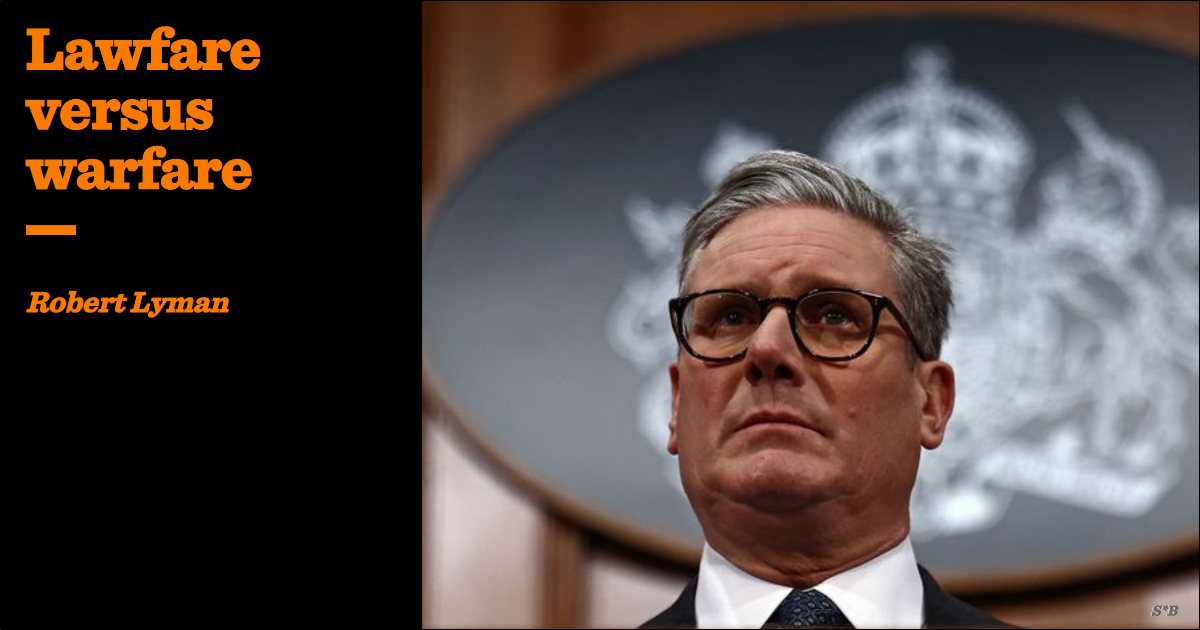
Alas, I’m not at all surprised about the revelations of Sir Keir Starmer’s involvement in the Shiner affair — the torrid story of a frankly nasty individual, Phil Shiner, hounding innocent British soldiers — male and female — for lawful acts on the Iraqi battlefield over twenty years ago.
As a left-leaning lawyer, this is where one would expect his predilections to lie. Similarly to the current Attorney General dismissing his historic defence of the IRA’s Gerry Adams as merely a duty he enacted as a result of the “cab rank” principle, it now appears that Starmer actively volunteered his services to chase British servicemen.
No cab rank for Starmer. Not just that, but he did it pro bono. Why? To my mind, observing the warfare versus lawfare clash over the past two decades, first as a soldier and now as an historian, the answer seems clear. For Starmer, lawfare was a just pursuit — the very reason why he was a lawyer in the first place — and one that was even higher than his need for payment. This was something he genuinely, deeply believed in, and wanted to do.
Shiner was clearly a very unpleasant piece of work. But Starmer? I’m pretty sure that he didn’t believe the British Armed Forces was full to the brim of psychopathic maniacs intent on using their legally held weapons to murder and maim at will. For him, it wasn’t about the professional thrill of chasing down hapless British servicemen and women, taken unawares by this attack on their professionalism and integrity, something for which none were adequately prepared. No. There was something far deeper behind the motivation to use the law to attack soldiers doing their duty. It was, rather, a means of attacking the British state.
This opposition to the state’s right to use force in pursuit of its national interest was something to which, it appears Starmer, Shiner, Hemer and Co, were deeply, intuitively, intellectually, politically and emotionally opposed. Accordingly, the law was the tool they would use to attack one of the prerogatives of the state: to bear and use arms against its enemies.
And in this battle it was the Poor Bloody Infantry, attacked unsuspectingly from the rear, who became caught up in this unprecedented battlefield. Innocent young men and women had their lives and careers ruined by allegations of misbehaviour on the battlefield by such ideologically driven bewigged legal warriors. It was a sorry affair, the ramifications of which remain unresolved in our current day.
They were determined to use the law to bring into disrepute the principle that a nation state could use force in pursuit of its national interests
The shocking thing about the Shiner affair, in which it is now clear that Sir Keir Starmer was intimately involved, was the reality that they were determined to use the law to bring into disrepute the principle that a nation state could use force in pursuit of its national interests. Shiner, Starmer et al thought that the invasion of Iraq was illegal under international law. Stll, they knew full well that they would get nowhere with this argument, as the issue is as long as a lawyer’s rope. Ultimately, a nation state can still do what it can get away with, as international law allows for self-defence, among other things. A UN resolution in favour of military action is helpful of course, but it is not an essential prerequisite for a country determined to act in its national interest. This is especially true since, in recent decades, the UN has become deeply politicised itself, as has its judicial arm, the International Court of Justice.
The poor defenceless victims of their attack were simply the collateral in this new battlefield. Targeting soldiers, one by one, and demonstrating that “ordinary” Iraqis were killed by the military arm of the British state, would undermine the entire edifice of nationally instituted warfare. If soldiers were unable to engage in warfare on a modern state-sanctioned battlefield, the entire purpose of the state’s Clausewitzian foreign policy (i.e. the belief that states have the right to use legitimate force in the pursuit of national interest) would be undermined.
In its place would come a higher law, that of international human rights which would ultimately do away with the traditional Clausewitzian way in which states have viewed the exercise of its international prerogatives. It just so happened that Shiner and friends had the perfect tool available to them to help in their witch-hunt: the European Court of Human Rights.
So, the legal witch-hunters went for the soldiers because they couldn’t go for the government of the day which had authorised these wars. Soldiers — simple men and women doing their duty — were easy targets. And they were struck down in their droves.
This is the man who is now our Prime Minister. He wasn’t caught, like Shiner, with his hand in the till, fabricating the evidence and encouraging witnesses to lie. But he was part of an outrageous process that attacked the very best of our society; those who were determined to serve it by joining the Armed Forces, doing their government’s duty as it occasionally demanded. Sir Keir Starmer, though he might have thought so at the time, and might still do so today, was not on the side of the righteous. He has much to ponder. So do we.