Oxford is ditching admissions tests altogether for subjects including Classics, Philosophy and all languages, it confirmed today.
Under a major shake-up, a number of Oxford in-house admissions tests are being phased out with no replacements.
The Archaeology and Ancient History course will also lose its test, while those for History and English Literature were phased out over the last two years.
The changes, effective for applicants to 2027 entry, come after the university announced it will no longer run its own bespoke admissions exams, in a bid to ‘streamline’ the process.
Instead, 16 courses including Maths, Physics and Politics, Philosophy and Economics (PPE) will adopt generic ones taken by other top universities and run online via Pearson.
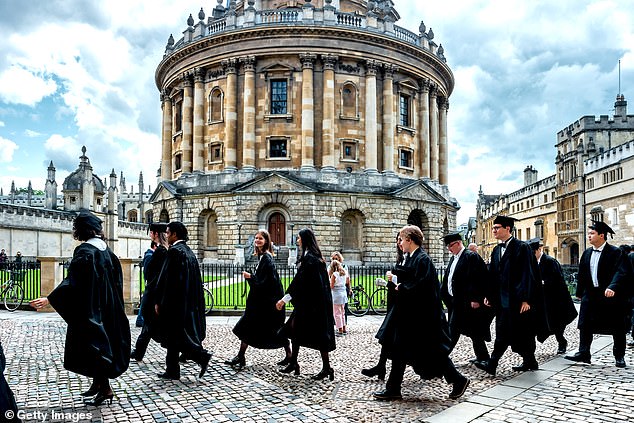
Oxford is ditching admissions tests altogether for subjects including Classics, Philosophy and all languages, it confirmed today (file picture)

Oxford’s entrance exams were dramatized in Alan Bennett’s 1980s nostalgia play The History Boys, which was made into a film in 2006 starring Dominic Cooper and James Corden
Today, Oxford insisted the courses that have lost entrance tests entirely will still retain a ‘rigorous’ selection process, including an interview.
However, Professor Anthony Glees, security expert at Buckingham University and an Oxford alumnus, said the old exams were valuable in selecting students best-suited to the courses.
He said: ‘These latest changes are simply appalling.
‘The risk that students will suffer by finding themselves studying and paying for courses for which they have no aptitude will be a very expensive mistake for them.
‘Dropping standards, discarding benchmarks, brushing aside youthful schoolkid brilliance and hard graft at 6th form level can only subvert Oxford’s global pre-eminence as a unique place of great learning and academic excellence.
‘Instead of dumbing down, they should spend money subsidising the teaching of these subjects at secondary level.’
The in-house Oxford tests which are not being replaced are the Classics Admissions Test (CAT), the Philosophy Test (PhilAT), the Modern Languages Admissions Test (MLAT), and the Ancient History and Classical Archaeology Admissions Test (AHCAAT).
Meanwhile, the History Aptitude Test (HAT) was phased out in 2025 and the English Literature Admissions Test (ELAT) was dropped in 2024.
The university has not provided clarity on the exact reason for this decision.
However, it comes following concerns in the sector about the accessibility of certain courses.
Many state schools do not have the resources to lay on extensive preparation in less popular subjects like Classics, Philosophy and languages.
It has led to a dominance of privately-educated students in Classics, who make up 57 per cent of the intake despite only making up 44 per cent of the university’s population.
The old entrance exams, which asked subject-specific questions, would have favoured people with a familiarity with the subject.
Evelyn Pike, a specialist in Oxbridge applications at William Clarence Education, said: ‘These tests were typical of those where forms of rote learning could sometimes provide an unfair advantage to students from excellent educational backgrounds.
‘Their scrapping doesn’t mean that it’ll be easier to get a place at Oxford, not whilst interviews are still being used and, as we’ve seen in the last five years, increasing in complexity and difficulty. Many Oxford interviews already use unseen text interpretation and response, akin to an admissions test but “live,” so we expect to see more of that, as well as more challenging logic puzzles for philosophy, for example.
‘This implies that Oxford may be on the search for more “raw talent” from a wider pool of applicants, whilst also trying to avoid the pitfalls of students using AI as a crutch in the admissions process.’
The 16 courses switching to new exams will use three tests provided by UAT-UK, a partnership between Cambridge University and Imperial College.
These are the Engineering and Science Admission Test (ESAT), the Test of Academic Reasoning for Admissions (TARA), and the Test of Mathematics for University Admission (TMUA).
It is understood Oxford is switching to the new exam system to ‘streamline’ the process for applicants, who will now only need to sit one exam to apply to multiple top universities.
An Oxford spokesman said: ‘Oxford’s undergraduate admissions process is rigorous and designed to identify academic potential.
‘The university is continually reviewing its admissions processes and practices to ensure they best meet the needs of the University, schools, and applicants. Our approach varies according to subject and considers a range of information as evidence of a candidate’s ability to thrive here.
‘All those offered a place to study at Oxford have been interviewed and every year more than 20,000 interviews for approximately 10,000 applicants are conducted, allowing tutors to assess directly a candidate’s ability to think independently and engage with new ideas – qualities that underpin learning at Oxford.’