Forget the claptrap about global warming and the inexorable arrival of greener, cleaner energy.
Oil is king. Gas is king. And America is going to be the king of both for decades to come.
Those are the assumptions guiding a range of policy moves by U.S. President Donald Trump since returning to office a year ago – and especially during the past few weeks.
Why We Wrote This
Donald Trump is sweeping away environmental regulations at home and dismissing green efforts abroad. But is his vision ceding the future of energy production to China?
They are also high-stakes assumptions, not just because of potential economic or ecological implications at home.
Last week, in publishing the quadrennial National Defense Strategy, the Trump administration did not mince words in describing President Xi Jinping’s China: “the second most powerful country in the world” and “the most powerful state relative to us since the 19th century.”
And China is making very different assumptions about the world’s energy future.
Beijing is betting it will be shaped by green electricity. Solar power, wind power, new battery technology – all are areas in which Beijing has carved out near-monopoly status internationally. By electric vehicles, too, where Chinese automakers have overtaken Tesla as market leaders.
If any of this is giving pause to Mr. Trump, he’s given no sign of this.

Tingshu Wang/Reuters/File
Early in his second term, he withdrew the United States from the 2015 Paris Agreement on climate change. He is unwinding former President Joe Biden’s program to promote green-energy development, deployment, and innovation within the U.S. He is also moving to open new areas for oil and gas development.
And since the new year, he has reinforced that energy message.
He has made it clear that oil was a main driver behind the Jan. 3 seizure of Venezuelan President Nicolás Maduro.
The U.S. now has a de facto partnership with Mr. Maduro’s former No. 2, Delcy Rodríguez, under which it will market Venezuelan crude internationally. Mr. Trump is also urging major American companies to rebuild Venezuela’s dilapidated oil industry.
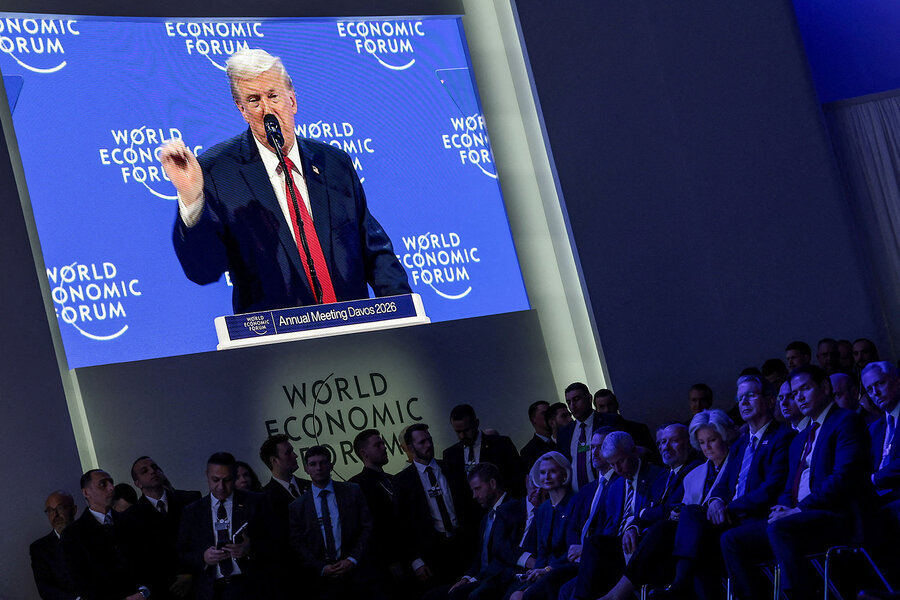
At last week’s annual gathering of political and economic leaders in Davos, Switzerland, Mr. Trump’s remarks regarding Greenland grabbed most of the headlines.
But he also assailed green energy.
He denounced the multibillion-dollar investment initiative by the 27-nation European Union in clean energy, known as the Green New Deal. He called it the “Green New Scam.”
He took particular aim at windmills, nearly all of which come from China. He called them a scourge on the landscape, with little energy value. Proof positive, he said, was that while Beijing made huge sums from exporting them, it didn’t actually use them – though, in fact, China has installed more wind-energy capacity than any country in the world.
In the short term at least, the attractions Mr. Trump sees in oil and gas are clear.

One is national security. By ensuring self-sufficiency – the U.S. has become a net oil and gas exporter, thanks in large part to the development of shale – he is intent on avoiding a return to America’s past dependency on Middle Eastern oil.
There are domestic political attractions, too. Broadsides on green energy chime with the “anti-woke” views of his supporters. And with affordability a key issue ahead of this year’s midterm elections, each additional barrel in an already soft international oil market could make it easier to deliver on promises of lower prices at the gas pump.
Yet a worldwide shift toward green energy sources is already underway.
Last year, for the first time, solar and wind generated more electricity worldwide than coal. Sales of electric passenger vehicles were also up by some 20%, though still well behind gas-powered cars.
Oil and gas do still matter.
Some industries, such as petrochemicals, appear likely to rely on them for many decades. The EU itself still needs gas. Though it has phased out its dependence on Russian gas since Moscow’s full-scale invasion of Ukraine in 2022, it relies on significant imports of liquid natural gas from the U.S.
The latest future energy projection by the International Energy Agency outlined two possible scenarios for when world growth in demand for oil will peak and start declining.

Nicolas Koutsokostas/NurPhoto/AP
The slower one envisages a peak around 2050. That’s if governments take no new policy initiatives to encourage the shift to greener energy. Yet, if all currently announced climate policies are implemented, demand could begin falling just five years from now.
China might well have a huge part to play in the future of oil.
Its shift away from coal and toward renewables for its domestic electricity is being driven in part by hard-nosed national security logic.
China is the world’s largest oil and natural gas importer, and much of it passes through a waterway that could be choked off by U.S. naval power in a time of crisis. Beijing is determined to reduce that vulnerability by scaling back oil purchases.
There’s an economic impetus for China as well: its desire to offset the importance of trade with the U.S. at a time of tariff uncertainty by selling its windmills, solar panels, and electric cars to other countries.
Ultimately, it hopes to displace America as the economic kingpin in what it clearly views as an irreversibly changing world energy economy.
Two decades ago, 5% of “new energy” patents registered worldwide came from China.
Last year, that figure was 75%.