THE exact amount your water bill is set to rise to stop “greedy” providers from dumping sewage in our rivers and seas has been revealed.
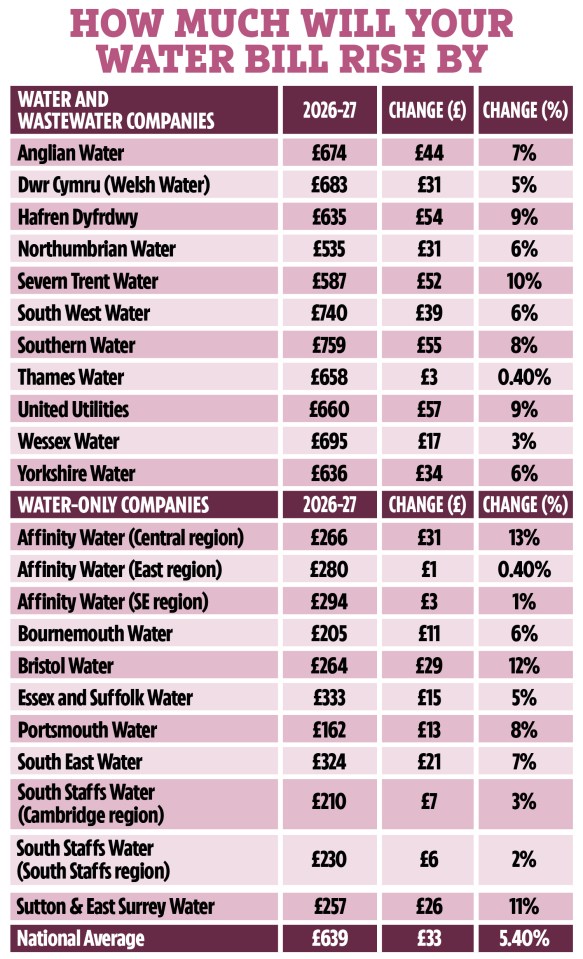
Water bills across England and Wales will rise by an average of 5.4% come April, Water UK has confirmed today.
Households will have to fork out an extra £33 on average, despite Britain’s rivers being pumped with sewage and some customers being left without drinking water for weeks.
The figure is two percentage points above inflation but comes as companies prepare to invest £20billion over 2026-27 to secure water supplies and end sewage entering rivers and seas, Water UK said.
Severn Trent customers will see a 10% increase, while Sutton and East Surrey is imposing an 11% increase.
South East Water is raising bills by an average 7% to £324 a year after its customers suffered days of supply disruption this month, blamed on Storm Goretti causing burst pipes and power cuts.


This followed a similar incident the previous month when 24,000 people in Tunbridge Wells were left without drinking water for two weeks.
There has been ongoing public anger about the amount of sewage being released into waterways, exacerbated by firms increasing bills to pay for upgrades after decades of under investment.
Ofwat has allowed water firms to put up bills by 36% between 2025 and 2030, with most of that – 20% or an average £86 – front-loaded on to last April’s annual rise.
Consumer expert Martyn James said: “The latest round of water bill price increases will outrage people.
“Yes, we do need to invest and spend more to turn the industry around, but people want greedy bosses and shareholders to pay the price – especially in challenging financial times.”
Rob Abrams, campaign manager at Surfers Against Sewage, added: “Water isn’t a commodity. It’s a necessity. Yet it’s being milked for profit while sewage is pumped into our waters.”
Water UK said the cash raised from water bills could only be used to fund infrastructure that had been independently determined to be “new, necessary and value for money”.
A money-back guarantee meant that customer bills would automatically be refunded by the regulator if improvements were not delivered, it said.
More than two million households currently receive help with their bills through social tariffs, the WaterSure scheme and other affordability measures, and this will expand by an expected extra 300,000 households over the coming year.
Water UK chief executive David Henderson said: “We understand increasing bills is never welcome, but the money is needed to fund vital upgrades to secure our water supplies, support economic growth and end sewage entering our rivers and seas.”
Ofwat interim chief executive Chris Walters said:”We recognise that these bill increases may be difficult for some people. That is why we approved a doubling of company support available for customers.”
What water bill support is available?
IT’S always worth checking if you qualify for a discount or extra support to help pay your water bill.
Over two million households who qualify to be on discounted social water tariffs aren’t claiming the savings provided, according to the Consumer Council for Water (CCW).
Only 1.3million households are currently issued with a social water tariff – up 19% from the previous year.
And the average household qualifying for the discounted water rates can slash their bills by £160 a year.
Every water company has a social tariff scheme which can help reduce your bills if you’re on a low income and the CCW is calling on customers to take advantage before bills rise in April.
Who’s eligible for help and the level of support offered varies depending on your water company.
Most suppliers also have a pot of money to dish out to thousands of customers who are under pressure from rising costs – and you don’t have to pay it back.
These grants can be worth hundreds of pounds offering a vital lifeline when faced with daunting water bills.
The exact amount you can get depends on where you live and your supplier, as well as your individual circumstances.
Many billpayers across the country could also get help paying off water debts through a little-known scheme and even get the balance written off.
Companies match the payments eligible customers make against the debt on their account to help clear it sooner.
If you’re on a water meter but find it hard to save water as you have a large family or water-dependent medical condition, you may be able to cap your bills through the WaterSure scheme.
Bills are capped at the average amount for your supplier, so the amount you could save will vary.
The Consumer Council for Water estimates that bills are reduced by £307 on average through the scheme.