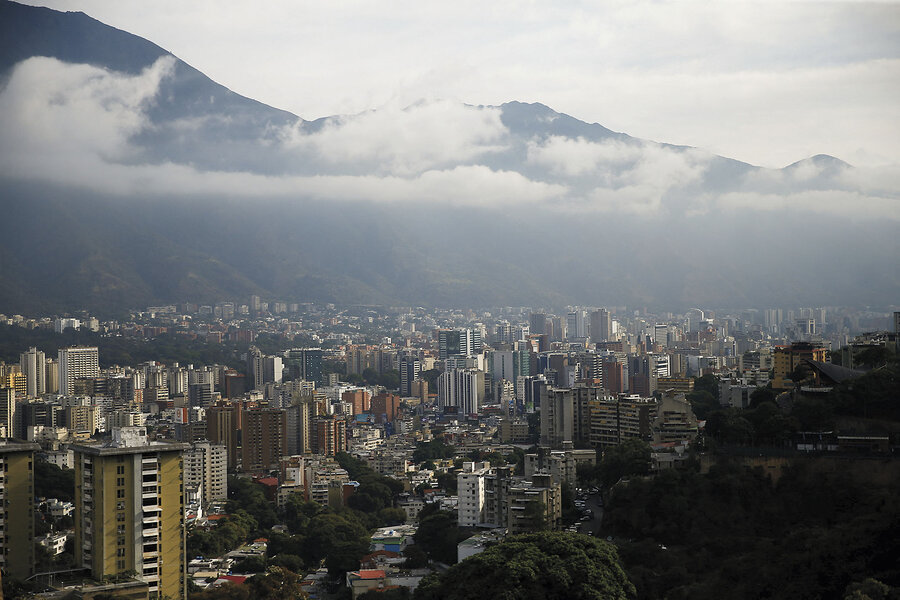
Amid a lush mountain valley just beyond the glittering Caribbean Sea sits the sprawling urban center of Caracas.
It was there, in the heady capital of high-rise buildings and sleek commercial centers built with vast oil wealth that C., referred to by one of his initials to protect his security, was born in the early 1970s. He has lived the ups and downs of Venezuela’s recent history: growing up during an economic boom, then witnessing an economic crisis that generated widespread protests and violent government crackdowns as a teenager, and as a professional launching his career as an engineer watching friends and family members vote into office a populist outsider who would transform the nation for a generation.
Hugo Chávez was democratically elected in 1998, and by the start of his second term, finding work in Venezuela and running a business had become nearly impossible, says C.
Why We Wrote This
The seizure of Nicolás Maduro has encouraged Venezuelans, especially in terms of economic growth, but they are unsure what it means for the state of democracy in the South American nation.
But, it was when C.’s daughter was born in 2014, the year after Nicolás Maduro rose to power with an even tighter grip, and inheriting an economic crisis exacerbated by falling oil prices, that C. understood Venezuela was no longer a country he recognized.
When C.’s wife went into labor a month early, the private hospital they attended said they wouldn’t be admitted without bringing their own medical equipment. The request was “totally normal in Venezuela” at that point. They were only admitted after signing a release saying they wouldn’t hold the hospital responsible for their baby’s well-being.
Their daughter was born healthy. “But that was a turning point for us,” C. says. “We said ‘no more children in this Venezuela.’”
Now, following the U.S. seizure of Mr. Maduro on Jan. 3, more than a quarter-century of leftist, populist rule known as Chavismo might be drawing to an end. A country that has been defined by runaway inflation, a destruction of independent institutions, and anti-imperialist rally cries – but that stood, at least rhetorically, as a regional champion for equality – will be, according to President Donald Trump, “run” for the foreseeable future by the United States.
Even with Mr. Maduro out of the picture, his ruling party is still in power. But C. is hesitantly starting to allow himself to imagine a different future for his children, one in which there might be reason for them to build a career and start their own families in the South American nation.

“We’re on the right path, but I wouldn’t say I feel good,” says the father of two. Mr. Maduro’s ouster “is a small but necessary step, but we’re still living our complicated reality” of little work, little food, and lots of heartache.
“We still don’t know how profound Jan. 3 was,” says Margarita López Maya, a retired history professor from the Central University of Venezuela, who for her final few years teaching in Caracas earned $3 a month.
One thing is certain:This is a new chapter for a country that, conditioned to geopolitical turbulence, has been a key player shaping the hemisphere’s affairs since its independence movement led by Simón Bolívar two centuries ago.
“The highest price”
The United States escalated pressure on Mr. Maduro this past fall, using military strikes to blow suspected drug boats out of the water, then seizing oil tankers, and conducting a partial oil blockade. Operation Absolute Resolve, as the U.S. plan to capture Mr. Maduro was labeled, included a Central Intelligence Agency team moving inside Caracas for months to gather intelligence about his daily habits.
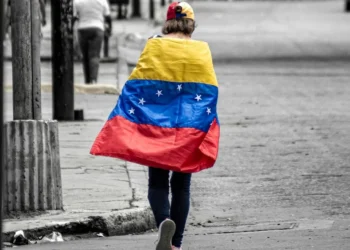
In the days following the U.S. operation, Caracas appeared to be holding its breath. Typically bustling plazas in the city center, where informal vendors sell tiny thimbles of coffee or cotton underwear, were relatively quiet as paramilitary groups set up checkpoints around the city.
“There are moments where I feel things might be on the right track,” says Y.B., a woman in her 20s who works in communication in Caracas. “But I’m also overwhelmed with uncertainty and fear. We have paid the highest price all these years.”
Most of the estimated 8 million Venezuelans, nearly one-third of the population, who fled their home country over the past decade welcomed the news of Mr. Maduro’s apprehension. The diaspora danced and cried tears of joy from Bogotá, Colombia, to Miami. The large numbers of Venezuelans fleeing to neighboring countries in recent years – nearly 3 million made their way to next-door Colombia – have created tensions in the region.

But, for decades starting in the late 1950s, it was Venezuela that attracted immigrants from all over the world. The country appeared to have it all: oil wealth, jobs that paid high wages, excellent higher education, and relative political stability.
Venezuela has the world’s largest proven oil reserves. But it is heavy crude, which requires special technology and know-how. When oil was discovered there in the 1920s, the U.S. invested in special equipment and refineries to process the petroleum. U.S. companies enjoyed cozy relationships with Venezuela’s dictatorship, which lasted almost the entire first third of the 20th century.
“Oil has always been central to the U.S.-Venezuela relationship,” says Dan Beeton of the Center for Economic and Policy Research, a left-leaning think tank.
In the 1950s, a U.S. diplomat in Caracas wired the State Department describing Venezuela as “the showroom for [the] USA system in Latin America,” according to a 2009 book by historian Miguel Tinker-Salas. In the 1970s, Venezuelans had so much oil wealth that per local lore, they were known to fly to Miami for weekend shopping trips, telling salespeople, “It’s cheap; give me two!”
The anti-imperialist discourse coming out of Cuba in the 1960s never matched reality in Venezuela, despite it being a cornerstone of Mr. Chávez’s and Mr. Maduro’s image, says Tomás Helmut Straka Medina, director of the history department at the Andrés Bello Catholic University in Caracas. “We never lived a U.S. invasion. Citizens don’t feel that deep hate toward the United States.”
Hugo Chávez’s revolution
But it wasn’t the United States that Mr. Chávez eyed as an enemy when he launched his political career. It was corrupt politicians and the economic elite at home.
When oil prices started to fall in the 1980s, the country faced an economic crisis that left both rich and poor frustrated with what they felt was a dishonest, self-serving political class.
Then came a wave of deadly protests in 1989 over austerity measures that left at least 300 civilians dead. Public discontent paved the way for a failed 1992 coup spearheaded by Mr. Chávez, then a young paratrooper.

In a televised speech, he famously told the country that his efforts to create a more just and equitable nation had failed – “for now.” The coup was a turning point for Venezuela, planting the idea in the national psyche that Mr. Chávez, who was jailed temporarily and then pardoned, was the alternative to the long-ruling political class.
After Mr. Chávez won democratically in 1998, his 14 years in office coincided with record-high oil prices. His vast social spending helped slash extreme poverty from roughly 26% in 1999 to 9% in 2013.
Inflation was a problem even before Mr. Chávez took office, but shortages grew during his administration, as he disincentivized local production in favor of importing goods from allied countries – a way to use Venezuela’s oil windfall to lift up neighboring economies as well. Under Mr. Chávez, it was common to enter a grocery store to find niche products, such as quail’s eggs, but no toilet paper or fresh milk.
But perhaps most influential, Mr. Chávez created an energy alliance in 2005 that provided oil to Caribbean and Central American countries on preferential terms, including low interest rates. His coziest relationship was with Cuba.
“Cuba served Venezuela for 25 years and Venezuela served Cuba,” says Eduardo Gamarra, professor of international relations at Florida International University. Venezuelans sent crude oil to the Communist-run island, while tens of thousands of Cuban doctors traveled to serve in low-income communities in Venezuela.
Venezuela also relied on Cuba for intelligence and security support, a legacy that carried forward into the Maduro government. According to official reports from the Cuban government, at least 32 military personnel were among the at least 80 people killed during Mr. Maduro’s capture by the U.S. They were believed to be part of his close security detail.
A new “banana republic”?
When Mr. Chávez died in 2013, his supporters collapsed in the street in tears and created altars honoring their hero.
By comparison, Mr. Maduro’s forced exit brought paramilitary bike-gangs, known as colectivos, to the street as well as civilian arrests. Regime-allied men and women armed with Russian-made rifles stalked main boulevards in Caracas and set up checkpoints where they searched the phones of civilians, looking for messages and photos that might prove sympathy for the U.S. or Mr. Maduro’s abduction.
Back when Mr. Maduro took office, oil prices had begun to plummet while inflation exploded. By 2014, more than 90% of Venezuela’s export earnings came from oil. But, when oil prices fell, so too did foreign demand for the Venezuelan currency, the bolívar,causing its value to fall.
Mr. Maduro responded by printing more money. That led to hyperinflation and a currency so worthless people started using it to make jewelry and purses to sell. Shopkeepers couldn’t afford imports, and shortages of basic foods and medicine grew, with grocery store lines snaking down city blocks and making shopping for food for one’s family an almost full-time job.
In a social media post on Jan. 6, Mr. Trump said Venezuela, now run by interim President Delcy Rodríguez, would be “turning over” up to 50 million barrels of sanctioned oil to the United States. “That money will be controlled by me, as President of the United States of America, to ensure it is used to benefit the people of Venezuela and the United States,” he wrote.
It could take close to a decade and an estimated $183 billion of investment to get Venezuela’s oil sector – nationalized under Mr. Chávez and shut down almost entirely by U.S. sanctions in 2019 – up and running again at 1990s-era production levels.
In the 20th century, Latin America was sprinkled with so-called “banana republics” – typically, small nations dependent on one export and controlled by U.S. corporations.
“Venezuela was never a banana republic – until now,” says Dr. López Maya. The United States stepping in is “the result of 25 years of errors, excesses, and destruction” by the Venezuelan government, she adds.
Removing Mr. Maduro from power is not a clean break from the past.
Ms. Rodríguez, the former vice president, comes from the same group of power players that propped up Mr. Maduro. She is not a moderate, says David Smilde, a Venezuela expert at Tulane University. But the interim president has a more modern take on authoritarian leadership, comfortable with international commerce and open markets.
In the historic center of Caracas lies the breezy, lush Plaza Bolívar. An imposing statue of the nation’s home-grown revolutionary hero sits astride a towering horse.
Bolívar is known as “The Liberator,” who fought in the early 1800s for Latin American independence from Spain. He’s a hero of Chavismo, with his face and story broadcast to the masses for the past generation to remind Venezuelans of their roots as soldiers for independence from outside influence.
And their next challenge might be the greatest one yet: turning their No. 1 enemy into a potential partner for the future of Venezuela.
Whitney Eulich reported this story from Mexico City, and Valentina Gil from Caracas.