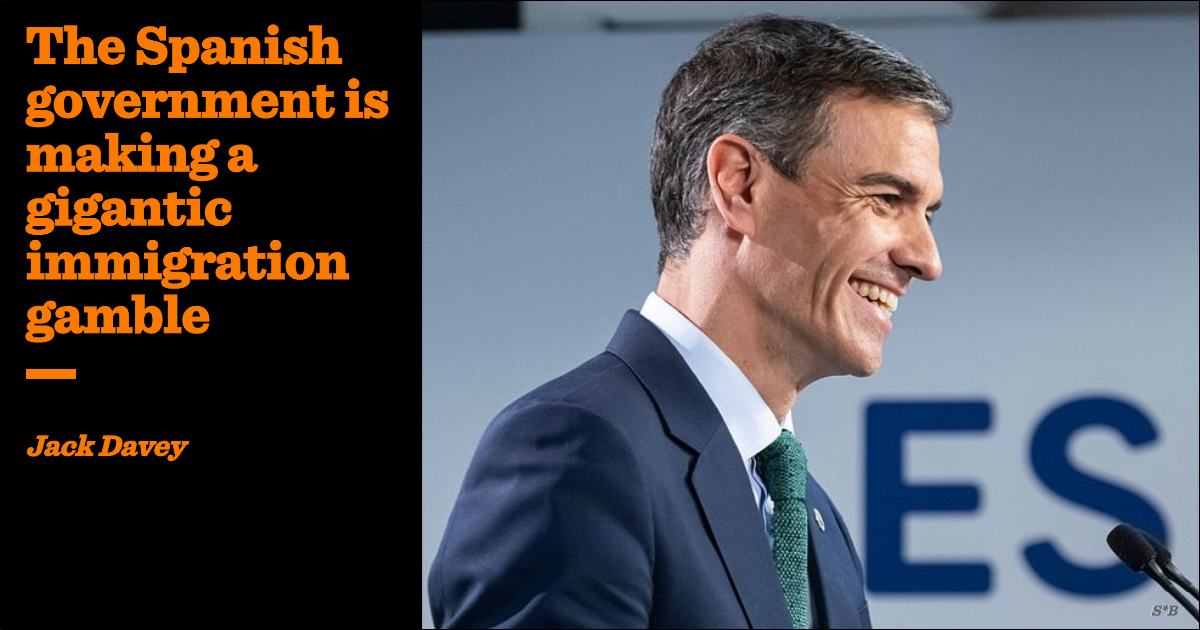
As right-wingers gain ground, Pedro Sánchez has announced a massive amnesty for immigrants
Across Europe, governments are seeking to curtail immigration — but not in Spain. The announcement of an amnesty for at least half a million illegal migrants confirms Socialist Prime Minister Pedro Sánchez’s radical stance. Forced through without a vote in Congress, amid a surge in support for the Spanish nationalist party Vox, the proposal seems designed to cause maximum tension.
That’s because it is.
Monday evening’s amnesty announcement was presented by Podemos, one of the small left-wing parties the centre-left PSOE government relies on to stay in power. Supported by the other scattered formations that make up the Spanish left, the move, although bold, is not unsurprising. It follows Prime Minister Pedro Sánchez’s unwaveringly pro-migration line, which has remained firm despite criticism from separatist parties he also needs to stay in power.
The measure will grant rights to migrants without papers who have no criminal record and who had been in the country for at least five months before 31 December 2025. Its consequences will be enormous. Official estimates state that over 500,000 people could be included under the amnesty, but the true number will probably be far larger. The best estimates state that Spain has 840,000 irregular migrants. However, a Podemos source told El País that the number of regularised migrants could well exceed one million by the end of the process. The majority of those subject to the amnesty will be from Colombia, Peru, and Honduras, reflective of Spain’s Latin Americanisation in recent years. There are already over one million Spanish-speaking Latin Americans in Madrid alone. These immigrants come from across the economic spectrum, with very wealthy Madrid suburbs transformed as much as poorer ones.
Podemos announced the measure after negotiating with the government for months over the policy. After months of political crisis in the wake of major corruption scandals, Sánchez has been trying to recover his minority government’s ability to pass legislation. This has necessitated deals with the minor parties who hold the balance of power. Basque and Catalan separatists were paid off by increasing spending, despite representing two of Spain’s wealthier regions. Now the left is receiving its tribute in turn. It is unlikely the amnesty would ever have been approved by Parliament. Thus an executive action known as a Royal Decree is being used to expedite the process and bypass legislators.
An amnesty of this scale has been a long time coming. The campaign for the measure began with a 2024 petition that received over 600,000 signatures. This was backed by a number of NGOs and Spain’s Catholic Episcopal Conference. The leaders of Catholicism in Spain said it would be an act “of democratic maturity”. The Church hierarchy in Spain has consistently pushed for more pro-migrant policies, leading to clashes with Vox and its leader, Santiago Abascal. Although the amnesty was initially opposed by the government, it aligns with its zealously pro-immigration stance. The move is by no means unprecedented. Spain has a history of mass amnesties for illegal migrants; the last, in 2005, regularised 575,506 people — but this is far more controversial.
In recent years, Pedro Sánchez’s economic model has been built on large-scale immigration, particularly to fuel the hospitality industry. Net migration figures exceeded 600,000 in both 2023 and 2024. This is by design too. The Democratic Memory Law, controversially passed in 2022, gave descendants of those who fled during and after the Civil War the right to claim citizenship. This has led to 2.3 million applications, overwhelming Spain’s consular offices, with a rejection rate of just 2 per cent. That measure alone could increase Spain’s population by close to 5 per cent. In a nation already deeply divided over immigration, the amnesty only adds to an already febrile environment.
The country is in the midst of a right-wing surge, much of it driven by anger over immigration. The Spanish nationalist Vox party is on the cusp of reaching 20 per cent and is taking votes from across the political spectrum. The party’s leader, Santiago Abascal, reacted to the amnesty by saying: “It has to be stopped. Repatriations, deportations, and remigration” adding that “Invasion kills.” The centre-right Partido Popular’s leader — and favourite to be the next Prime Minister — Alberto Núñez Feijóo, also criticised the measure, saying: “Nationality should be earned, not gifted.”
Europe is moving in one direction, and Spain in another
With most polls predicting a clear majority for the right in the 2027 elections, an amnesty may seem politically insane — but Pedro Sánchez is one of Europe’s most cunning politicians. Those opposed to him because of immigration are likely irreconcilable, and even the ambivalent may not mind too much as long as their pensions rise. By adding even more fuel to the immigration debate, Sánchez is stoking the Vox fire so he can present himself as the only barrier between them and power. In 2023, he survived against miraculous odds by presenting himself as the alternative to a Partido Popular unable to function with Vox. Despite seemingly constant crises, the same trick could well work again.
Europe is moving in one direction, and Spain in another. In a nation already beset by a housing crisis, overstretched infrastructure, and still reeling from the Adamuz train crash, Pedro Sánchez’s strategy seems, at best, a huge gamble. The Prime Minister appears to be engineering a crisis so large that the only alternative to his rule is a radicalised right, with Vox either in government or close to it. The stakes may be high — but that’s how Sánchez likes them.