Pakistan is no stranger to political polarization, but on one thing, nearly everyone could agree: solidarity with the Palestinian cause.
A Gallup poll conducted soon after the Oct. 7, 2023, Hamas attack on Israel found that 91% of Pakistanis aligned their sympathies with the Palestinians of Gaza, compared with just 2% who said they supported Israel. It’s a solidarity seen everywhere – from the ATM home screens that explain how to donate to the Pakistani Prime Minister’s Relief Fund for Gaza and Lebanon, to the countless mosques where every Friday imams ask Allah to protect their “brothers in Palestine.”
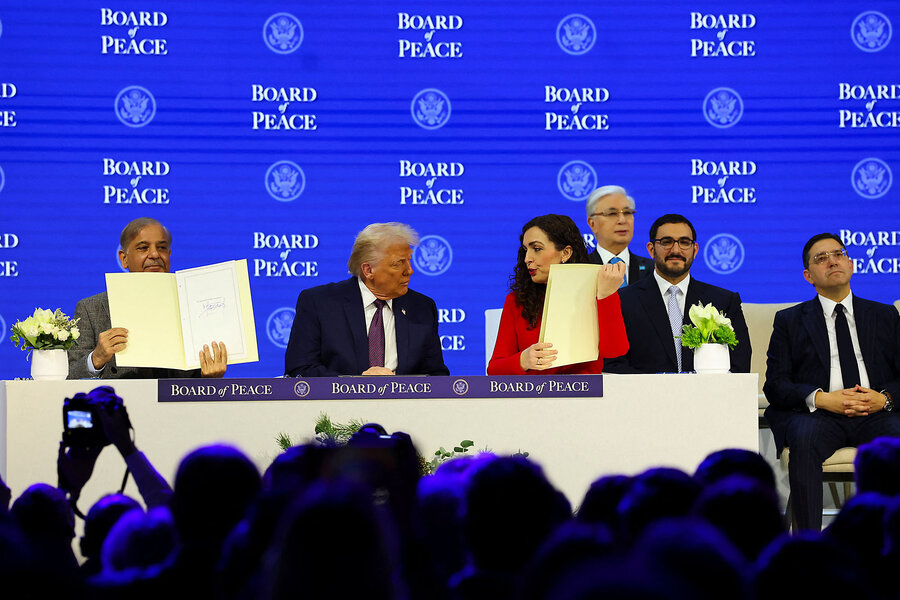
This is why Islamabad’s decision to join the U.S.-led Board of Peace, at a time when Pakistan has been drawing closer to Washington, has rattled the nation of 250 million. Critics note that the board, which is expected to oversee the reconstruction of the Gaza Strip, has no Palestinian representation. More than 20 countries have joined the initiative.
Why We Wrote This
In Pakistan, U.S.-Pakistan rapprochement has always been viewed as a double-edged sword. But now that Islamabad is joining Trump’s “Board of Peace,” many worry the government has made a Faustian pact.
“It is a betrayal not just of the Palestinian people, but of the Pakistani people as well,” says human rights activist Tahira Abdullah.
Colonial or practical?
The Board of Peace was first proposed in September as a body that would support the reconstruction of the Gaza Strip, but it has been controversial from the start. The charter of the board does not mention Gaza by name, instead describing itself as an organization that seeks to “secure enduring peace in areas affected or threatened by conflict.”
It includes no Palestinians. Ibrahim Khraishi, the Palestinian Authority’s permanent observer to the United Nations in Geneva, said that there had been no contact with the Trump administration since last year. Israeli Prime Minister Benjamin Netanyahu initially objected to the board’s makeup, which included regional rival Turkey, but Israel has since agreed to join.
The possibility that the future of Gaza could end up being decided without Palestinian input has led many in Pakistan to describe the initiative as colonial in nature. But for Pakistan and other Muslim countries, such as Turkey, Qatar, and Indonesia, the absence of Palestinian representation is a key reason to join.

The prime minister’s spokesperson, Mosharraf Zaidi, told the Monitor that the decision to join the Board of Peace was fully within the government’s jurisdiction, and that Pakistan would use its position to advocate for the rights of the Palestinian people.
“We will use the opportunity created by President [Donald] Trump to ensure that the Pakistani people’s seven-decades-long commitment to the Palestinian cause is articulated and argued for,” he says.
Yet Maleeha Lodhi, Pakistan’s former permanent representative to the United Nations, describes the initiative as “a smoke screen for Trump’s unilateral policies and pro-Israel plan.”
Indeed, some experts say that Pakistan is compromising its values and interests for greater closeness with the Trump administration. After years of froideur, the U.S.-Pakistan relationship has experienced a public renaissance. In the wake of a heated standoff between India and Pakistan in May 2025, President Trump sided with Pakistan, repeatedly echoing Islamabad’s version of events rather than Delhi’s.
According to veteran political commentator Cyril Almeida, joining the Board of Peace along with other Muslim nations is part of a pragmatic decision to “stick close to Trump, but do so in a pack – minimizing blowback and reducing the risk of attracting Trump’s ire,” he says. “The people of Pakistan are rarely a consideration when such foreign policy decisions are made.”
Eroding trust
Pakistanis’ dissatisfaction with their government’s stance on the Israel-Palestine conflict is not entirely new. In that same Gallup poll conducted after Oct. 7, around a third of respondents said that they did not look favorably upon the government’s policy on the Israeli-Palestinian conflict. Many see the failure of Pakistan – a nuclear-armed nation with one of the largest armies in the world – to play a more significant role deterring Israel from carrying out its assault in Gaza as evidence of the state’s performative solidarity, where it says a great deal but delivers very little.

That frustration was underscored by the high-profile arrests of a handful of pro-Palestine demonstrators over the past year – including Ms. Abdullah, who was detained in May 2025 on her way to a demonstration in solidarity with Gaza.
After being kept in custody for several hours, a period in which she says she was denied legal counsel, the 73-year-old activist was released without charge.
Human rights groups and lawyers decried the arrest. For Ms. Abdullah, the episode was as baffling as it was worrisome. Pakistan has no diplomatic relations with Israel, so she says the state should not have found her demonstration objectionable. She believes the government is taking steps toward normalization with Israel.
“To me there was absolutely not a shadow of a doubt that the state of Pakistan had been persuaded, convinced, cajoled, arm-twisted, whatever word you want to use, to join the Abraham Accords and to recognize the state of Israel,” she says. “Now that for me is the crux of the matter.”
And as U.S.-Pakistan ties warmed, those suspicions grew. Pakistan joined the Board of Peace without consulting Parliament. That is proof to many that the government is prioritizing its budding U.S. alliance over religious solidarity and democracy.
“Was this not a big enough issue to bring to the Parliament of Pakistan and to have a full, proper and transparent debate?” asks Sayed Zulfikar Bukhari, who served in the Cabinet of former Prime Minister Imran Khan. “Ultimately the Prime Minister might still have got what he wanted, but he would have given the cause and the Pakistani people a lot more respect.”