A former police officer is suing the Met Police for £1million in compensation, claiming years of investigating crimes against children left her so traumatised that she developed PTSD and a phobia of police stations.
Kirstie Coy-Martin, 52, says her mental health was destroyed by repeated exposure to ‘harrowing’ scenes of child abuse and child death, ultimately forcing her into ill-health retirement in 2023.
She claims her condition deteriorated to the point where she would suffer panic attacks simply at the thought of attending a police station, and was even triggered by routine paperwork featuring a logo of a baby’s foot.
Now living in Chichester, West Sussex, Ms Coy-Martin is taking the Met to Central London County Court, alleging the force breached its duty of care by exposing her to ‘excessive stress’ and failing to protect her mental health.
The Met is strongly contesting the claim, calling it ‘incredible’ that a serving police officer should argue she should not have been required to attend police buildings.
Ms Coy-Martin joined the Met in 1997 and worked in child abuse and sexual offence teams between 2005 and 2016, according to court papers.
Her lawyers say that during that period she was repeatedly exposed to disturbing material.

Kirstie Coy-Martin says her mental health was ruined by years of having to investigate crimes against children, including attending ‘harrowing’ scenes of abuse and child death

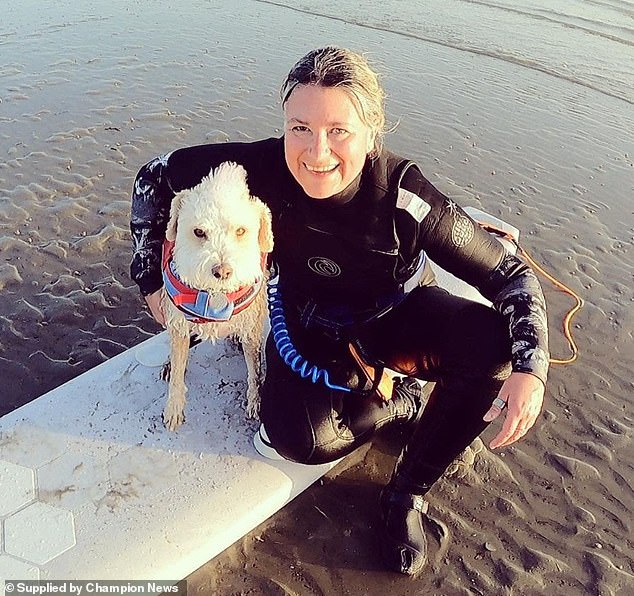
Lifelong surfer Ms Coy-Martin, 52, later spoke of using her time on her board as a ‘safe space’ and even taught her therapy dog Scooter to surf with her
Such work carries a much greater risk of experiencing ‘harrowing, distressing and shocking events, material and environments,’ her lawyers say.
But the Met is denying the claim, saying it is ‘incredible’ for a serving police officer to claim they should not have been asked to attend police stations.
The force also says she did not complain about stress during the years she was working on sexual and child abuse investigations and insists she had not been placed under ‘excessive’ work stress in more recent years.
According to papers filed at the court, Mrs Coy-Martin joined the Met in 1997 and worked in child abuse and sexual offence teams between 2005 and 2016.
‘As such, the claimant was exposed to extremely shocking and distressing incidents, which she was required to investigate,’ say her lawyers.
‘This necessitated attending to scenes of abuse against babies, children and young people, and which in some cases had led to their death.
‘Such working environment was inherently unsafe due to the horrific nature of the crimes the claimant was required to investigate.
‘It was inherently foreseeable to the defendant that exposure to such would expose the claimant to a risk of psychiatric injury.
‘Throughout the claimant’s time with the Child Abuse Investigation Team, it is averred that the defendant failed to take any, or any adequate, steps to prevent the claimant from suffering psychiatric harm.’
Mrs Coy-Martin later moved on to work as a custody sergeant, taking her away from the child abuse, and later in a mostly home-based job which involved analysing CCTV footage.
In 2020, after overhearing a video call participant criticising her, she became extremely distressed and was signed off work the next day, say her lawyers.

She left her child abuse work in 2016, but says her career was ended in 2023 due to the ‘triggering’ of her PTSD by everyday work experiences
While off, she began to suffer ‘extreme symptoms of psychiatric ill health,’ including flashbacks to her time on the child abuse team.
She was ultimately diagnosed with PTSD, which her doctor put down to her experiences working on abuse cases.
When she returned to work, she was placed into a home-based investigations role due to fears that having to attend police stations might trigger her PTSD.
However, even in that role she experienced stress when told she would need to attend a police building to pick up CCTV evidence.
She claims that thereafter her condition was exacerbated by a series of incidents at work, including being nominated for a job as a family representative.
As part of that, she was sent job literature, which included a picture of a baby’s foot, something she claims was a trigger for her mental condition.
It led to a relapse, which kept her off work for months.
Back at work again in 2021, she said she had again been asked to attend a police station and suffered a panic attack, only to be told ‘don’t stress, it’s not worth it.’
As time went on, she continued to be asked to attend police buildings, her lawyers continued, ‘despite the known impact this had on the claimant’s health.’
She was ultimately ill health retired in October 2023.
Ms Coy-Martin blames her condition on the Met, claiming that she was at a ‘foreseeable risk of injury’ due to stress and that her bosses had ignored warning signs, including the fact she had disclosed her use of anti-depressants.
She says she was placed under ‘excessive stress’ at work, there had been a failure to take adequate action when she complained and there had not been suitable ‘health surveillance.’
Overall, there had been ‘clear signs’ of impending harm when the Met should have been aware of the need to keep her safe, in the knowledge of the harrowing scenes she had investigated earlier in her career.
For the Met, barrister Edwin Buckett denies any negligence in how she was treated at work and points out the fact that her time in the child and sex abuse teams was many years ago.
Ms Coy-Martin, from Chichester, West Sussex, is now suing the Met at Central London County Court for £1m in damages
However, he said it was denied that the teams were ‘inherently unsafe’ to work in or that it was ‘foreseeable’ that they carried a risk of psychiatric injury.
‘The working environment was safe,’ he says in the Met’s defence. ‘The claimant was assessed and vetted for working in these units and nothing untoward was identified before and during her time there.’
She had not claimed of being ‘depressed, anxious, stressed’ or of not being able to cope at work while on those teams and had only made limited disclosures of mental health issues after she left them.
Those issues had been linked to other problems, including her having an epileptic seizure, suffering physical medical issues and a surfing injury, and being assaulted by a shoplifter.
‘It is denied that from 4th April 2016 the claimant indicated that she was vulnerable to sustaining psychiatric injury,’ he continued.
‘Overall, prior to May 2020 the claimant had a very poor sickness record which was linked to physical incidents/symptoms – save for one reference to anxiety in 2016.
‘None of the reasons given by the claimant for time off work previously indicated a vulnerability to sustaining psychiatric injury.
‘The defendant adequately supported the claimant and did not cause or contribute to her psychiatric injury.’
He added: ‘Requiring the claimant to attend a police building was entirely reasonable and it is incredible to assert that a serving police officer should not have to attend such a building on occasion or that this caused or contributed to the claimant’s alleged psychiatric condition.
‘The fact that the claimant was sent an email with a baby’s foot logo on it was not inappropriate or negligent, nor did this cause or contribute to the claimant’s alleged psychiatric condition.
‘It is denied that there were warnings signs of the danger that the claimant was suffering imminent and foreseeable psychiatric injury. The claimant was treated reasonably.
‘It is denied that the claimant was placed under excessive stress and/or pressure of work. She did not complain of excessive stress or pressure of work.’
The case – described by the Met as ‘strongly disputed’ – reached court last week for a pre-trial hearing dealing with the evidence to be included at the trial of the claim.
It will return to court for a full trial at a later date, unless the parties agree a settlement earlier.