Mio: Memories In Orbit (PlayStation, Xbox, Switch, PC, £15.99)
Verdict: Sad robots
Note to games developers: please don’t use the same name for both your latest release and its main character. It makes it hard for critics to identify which is which in their reviews. And making critics’ lives easier is the most important thing in the world.
I mention this because of Mio, the game, which technically stands for ‘Memories In Orbit’, in which you play as Mio, a little artificial intelligence who has to bounce around a mysteriously abandoned space station to discover just what happened.
Well, I say ‘abandoned’, but this space station is full of other robots. Some of these are harmless: lost, tired-seeming entities who want you to reconnect them with their former buddies.
Many are hostile: the baddies whom Mio has to defeat along the way.
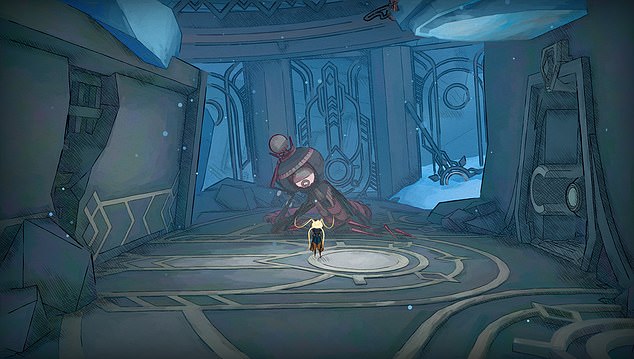
Endearing android: Little Mio must figure out what happened in an abandoned space station
There is a lot of fighting. Mio’s route from biome to biome is blocked by enemies who will test your ability to jump, dodge, swipe and counterattack with extreme precision.
Mio (the game!) is one in which you’ll die again and again…
…and try again and again, too. Thankfully, Mio (the character!) gains new powers along the way, which you can slot in and out to make this endearing android your own. Some of these powers give you an edge in combat, some open up new areas of the space station.
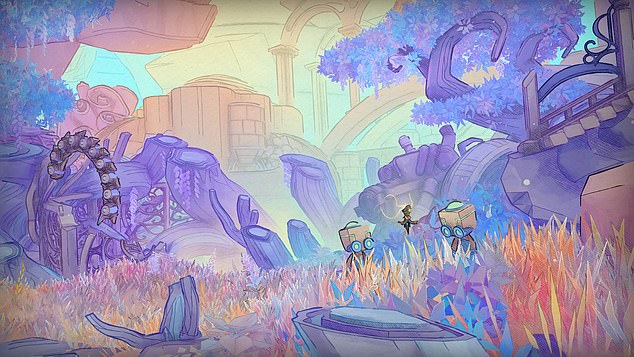
Great graphics: Mio (the game) is played out in a series of biomes that look like watercolours
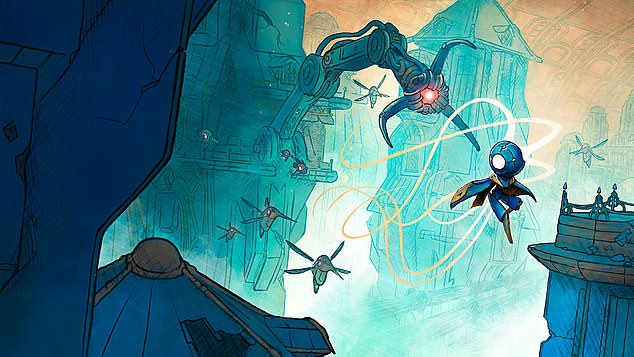
O sole Mio: Your android gains new powers – and improved access – as the game progresses
The problem — if there is one, other than the naming jumble — is that there are many other games like this. Games with the same structure, the same level of challenge, and even the same introspective, melancholic tone. Games like Ori and the Blind Forest (2015) or Hollow Knight (2017).
Still, Mio is certainly among the best — and, thanks to graphics that look as though they were done in watercolours, best-looking — of them all. Mio so pleased it exists.
TR-49 (PC, iOS, £6.99)
Verdict: Literary sensation
The British studio Inkle is one of the most literary at work today. Its games — from the Jules Verne-adapting 80 Days (2014) to the Agatha Christie-feeling Overboard! (2021) — are often ripped from texts, but they delight in text, too. They’re full of dialogue and wordplay and wit.
But this? This is a whole new level of bookish obsession. TR-49 effectively turns you into a librarian at the end of the world.
Its version of Britain in the 2010s is beset by catastrophe, and only a peculiar book-cataloguing machine developed at Bletchley at the time of the last big war seems to offer a solution.
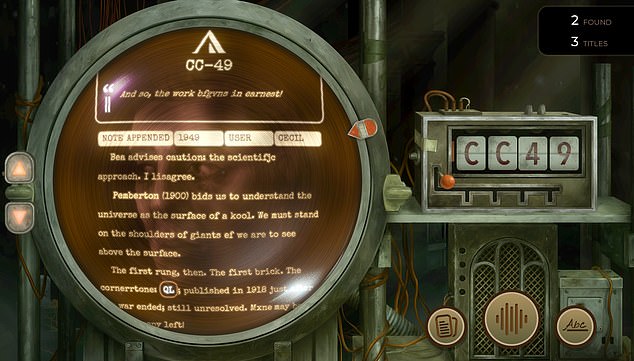
Puzzling: TR-49 is all about finding codes, to gain access to old books which might hold clues
The result is a game that’s far more puzzle-like than Inkle’s usual, narrative-based efforts. You — a woman called Abbi, ensconced in the crypt of a cathedral — have to input codes (two letters, two numbers) into the machine, with the aim of disinterring books from its memory.
Once you do, you’ll get more clues for more codes for more books, all in the hope of discovering the one that will make it all make sense. Down the rabbit hole you go!
Which isn’t to say that TR-49 lacks narrative. Far from it. Abbi communicates with the outside world by radio — and let’s just say, not everyone there is an ally — but it’s the books themselves that tell the best story. These are weirdo texts on computing and space-time and the bounds of reality itself. It’s a joy to sink into their digital pages.
And in the end? That would be telling. Just pull TR-49 off the shelf — and experience it for yourself.