I played the anti-extremist Prevent game and soon became engrossed in an improbable far-right love affair
If you go on the internet today, you may well encounter Amelia. Amelia is a purple-haired girl wearing a choker and a pink dress, and she can be found waving union jacks, loving her country and deporting immigrants in every corner of social media. But, how, you might be wondering, did this unlikely avatar of British nationalism get here?
#Amelia 🇬🇧🥰 pic.twitter.com/aW1HCiRaqK
— A UK Stoner (@A_UK_Stoner) January 22, 2026
Amelia was not, contrary to all appearances, spawned in the depths of the adolescent subconscious, but, incredibly, started life in Britain’s Prevent programme. Since 2005, Britain has run a counter-extremism strategy focused on deradicalising people before they become supporters or participants in terrorist acts. Like many government policies, this once narrowly defined idea quickly exploded to encompass the idea that “any ideology can be harmful, and therefore anyone can be at risk of being radicalised”.
A scheme once aimed at stopping young Pakistani men blowing themselves up during the morning commute has morphed into what most government policies now end up as — a box-ticking, lanyard-wearing, finger-wagging series of workshops run by delusional grifters, but with the added joys of a sinister surveillance-state infrastructure whereby teachers, social workers and healthcare professionals are instructed to report law-abiding individuals for wrongthink.
One significant participant in this ecosystem is the social enterprise “Shout Out UK”. Like many such organisations in this space, it effectively makes its money by winning government contracts and grants, such as a recent £3 million grant from Sadiq Khan. The organisation, run by “social entrepreneur” Matteo Bergamini, has wormed itself into the machinery of government, acting as the secretariat of the Political and Media Literacy APPG, and working with schools on media, digital and political literacy.
Shout Out UK was founded in 2015, and gained traction in the wake of the Brexit campaign, which Bergamini took as evidence that the British public weren’t “qualified to make such a decision”. And whilst the enterprise presents itself as a “non-partisan” body, material on its website suggests that it sees its role as encouraging youth “activism” behind such causes as “climate change, social justice, and digital rights”. The group has previously been in hot water when it partnered with drill artist “Drillminister” to produce a get out the vote music video with funding from the Joseph Rowntree Foundation, in which two men in balaclavas mime shooting actions and complain about austerity, Boris, Brexit and LBGTQ representation.
In short, Shout Out UK was an ideal candidate for a de-radicalisation programme in Hull targeted at far right youth. Having already taken the kids by storm via the medium of drill, the entrepreneurial brain trust caught wind of the fact that young men in regional towns like video games and goth girls. It was clear what they had to do: create a video game to educate young people about the dangers of extremism, and the importance of the Prevent strategy. And put a cute goth girl in it.
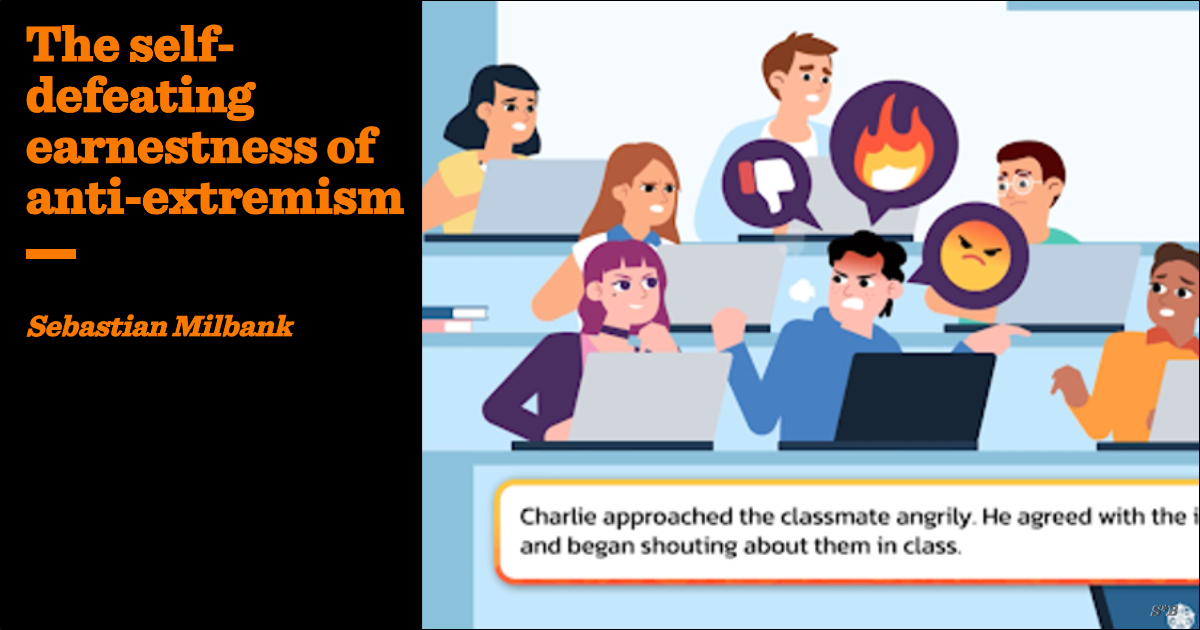
And thus Pathways, and Amelia, were born. It’s not clear what went wrong in the writers’ meeting. Maybe too many soy-milk lattes had been consumed, perhaps someone had been microaggressed in the local Pret, maybe a secretly radicalised intern made a mischievous suggestion. A mistake was made. It was nearly a perfect and frictionless bit of puritanical propaganda. It had Corporate Memphis style diversity, hectoring schoolmarms in every other frame, a they/them protagonist called Charlie who appears perpetually terrified. But it also had Amelia.
A far-right Romeo and Juliet
With a little imagination, and by consistently picking the “wrong” choices, the game becomes a tragic story of far right teenage love. Amelia explodes into Charlie’s life, and opens his eyes to a new world. Charlie is looking at a disappointing mark on his work in hospitality. He’s always performed very well in the past, and can’t understand why all his other classmates have been given higher marks, and been offered jobs. Amelia presses herself against Charlie and elbows him discreetly — the immigrants are taking our jobs, Charlie.
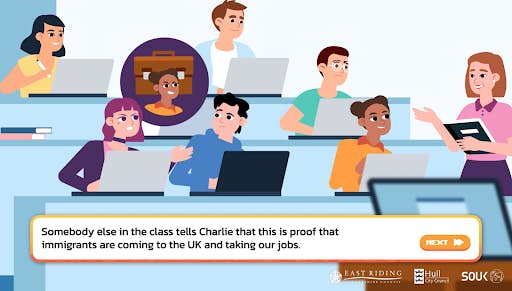
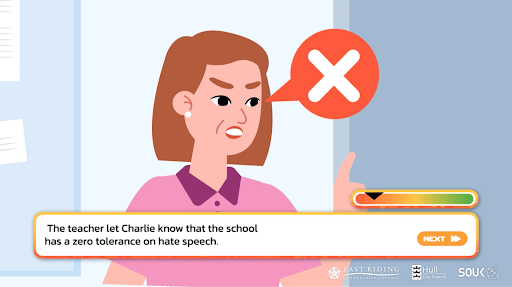
Charlie agrees, and loudly proclaims this in class as Amelia gazes adoringly at him and his classmates look bovinely horrified. A literal schoolmarm tells him off for “hate speech” and puts him in detention as he seethes about his lost future.
Later on a depressed Charlie is sitting at the dinner table, when his phone buzzes — it’s Amelia. Charlie’s mum tells him off for looking at his phone, but he looks anyway. Amelia is standing up for English rights in Bridlington, holding a sign saying “no entry” in one hand and waving a Union Jack in the other.
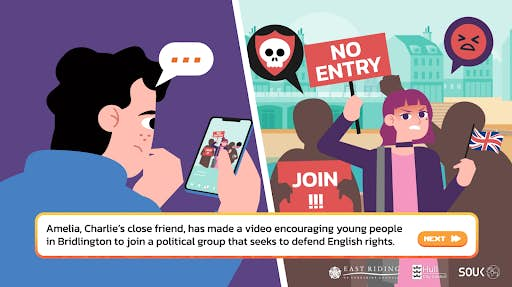
Charlie and Amelia meet for an intimate tête-à-tête over coffee. There are (one imagines) lingering looks and hands grazing over the sugar bowl. Amelia earnestly explains the dangers of the erosion of British values by sinister forces. Amelia would love to go to another protest, but unfortunately her parents won’t let her go. If only there was some brave, handsome young lad who loved his country and would be able to go in her place…? Fortunately, Charlie (who is from a broken home) is seeing his dad in Hull on the weekend and will be nearby.
Charlie waves goodbye to Amelia who beams at him as he marches off to the protest. What he doesn’t know is that this is the last time we will see Amelia.
The story takes a dark turn. At the protest police in full paramilitary gear accost Charlie for arguing with a counterprotestor. They take his details, and Charlie returns home, terrified that he has been reported.
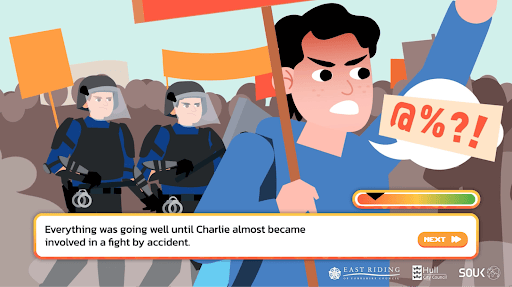
The game draws to an end. Charlie is shunned by the rest of the class, and Amelia is mysteriously missing. A teacher approaches Charlie — he is being referred to Prevent.
He’s hauled off to the longhouse for some good and proper reprogramming. Charlie is taught “the difference between right and wrong in expressing political beliefs” by a black lesbian in a diversity workshop, and after extensive sessions with a black therapist and a hijab-wearing Muslim anti-extremism expert, he is taken under the wing of a mentor, an older white guy who once struggled with the same issues. He’s back on track, and probably doesn’t even think about Amelia any more …
It’s unclear at the end of the game what’s supposed to have happened to Amelia. Was she in another diversity seminar further down the corridor, slowly losing her soul? Was she locked up in some home office black site, being shown videos of the 2012 Olympic Opening ceremony on a loop? Or was she off in the wilds, fighting the good fight, leading a resistance group comprised of teenage goths throwing molotov cocktails at mental health hubs?
Needless to say, as far as her many fans are concerned Amelia broke containment, and is now running riot on social media — and as one commenter pointed out, nothing had to be changed about her character to make her an icon of the online dissident Right.
The funniest thing about Amelia’s lore is that *she is exactly the same character in the memes as she was in the Pathways game that the U.K. government created.*
We didn’t change a thing.
We simply set her free. pic.twitter.com/nsIQSN8664
— Huff (@Huff4Congress) January 21, 2026
Lessons forever unlearnt
This should really be an educational experience for Britain’s progressive establishment. A group of people whose entire professional life is about counterextremism and online radicalisation really, sincerely, thought that the best way to get schoolboys to stay away from the far right was by putting nationalist and anti-migration sentiments into the mouth of a cute teenage girl, and then trying to warn them off her and her beliefs through the disapproval of middle aged women in positions of authority.
But there’s no sign that anyone involved has learnt a thing. Rather than seeing the Amelia meme for what it is — an organic, satirical response to an obviously idiotic, sinister and patronising message — Bergamini’s response was to suggest that “this experience has shown us why this work is so immensely important, but also gives us pause for thought about our safety in conducting this work due to the highly sophisticated coordination of those who profit from hate”. The shifting of the focus away from the clear popular backlash and onto a fake narrative of scary manipulation by external forces is now the default reaction of a progressive elite sunk into the deepest denial.
Perhaps we might not expect better from a person capable of signing off on Pathways, but the wider reporting of the story in outlets like the Guardian suggests that the head-in-the-sand approach is endemic. As well as a myopic obsession with AI, the writer of the article thought a good way to respond was by sourcing a comment from one “Siddharth Venkataramakrishnan, an analyst at the Institute for Strategic Dialogue” who solemnly pronounced:
In a way it gets to the heart of what we might term the ‘dissident’ far-right – individuals who position themselves outside of the mainstream political scene – whether that’s ‘shitposters’ who are just into provoking, others who are in twee memes. A whole ecosystem has embraced it. Clearly, the sexualised imagery is also key to this. The target audience is almost exclusively young men.
They cannot help themselves. They cannot seem to see that they are perpetually casting themselves in the role of the villain, the prude and the butt of every joke and meme. They will not take off the lanyards, they will not unpurse their lips, they will not remove the pronouns from their email signatures. It does not matter that both of the major parties are seen as illegitimate by the British people, that there are regular protests outside migrant hotels, that racialised rape of white girls has been acknowledged as cold fact by a government report, or that Reform is likely to win the next election. Nothing will shift the train from its fixed tracks, or move their personal private Overton windows an inch in the other direction.
The demonisation of male anger and male desire that is endemic on the progressive left and in modern educational contexts (note the dig at “sexualised imagery”) has driven a wedge between the sexes, and made politics dangerously gendered. Obsessive focus is put on young male “radicalisation”, yet polling consistently shows that women are polarising much more radically leftwards, in no small part due to the relentless institutionalisation of progressive politics through organisations like Shout Out UK.
The Pathways game feels quite different if you play as a girl, and hesitantly choose safer and more uncertain choices. The player is “punished” for asking for more information, or doing research, with the “correct” reaction to seeing an inflammatory meme being to “scroll past” it, whereas “finding out more online” leads one to receive “harmful ideological messages” from groups that are “illegal”.
Indeed, illegality and prosecution over “extreme” opinions is a persistent message in the game, with warnings that even streaming a video might be a terrorist offence, and that being a member of a “secret” WhatsApp group is enough to endanger you. Political protest is presented as scary and subversive, with menacing police circling. As well as the threat of prison, the game persistently presents the player with a stark choice between hanging out with friends and rejecting their “harmful” beliefs. The “correct” choices lead you to disassociating with “extreme” friends, and the “wrong” choices lead to being in trouble and socially isolated.
The game might as well have been designed to have a disparate impact on the player based on gender. Girls, on average, are more likely to respond to authority figures, more intimidated by social disapproval and criminal sanctions, and more likely to break friendships over differing beliefs.
So why not design a game in which a young man has to rebel against a biased teacher, stand up for a cute minority classmate, and defy his parents (who misunderstand the situation)? Though imaginable in theory, it would never happen in practice, because the Prevent programme is about blindly trusting authority. Indeed, in the game’s epilogue, where the programme is explained to children, we see the teacher from the game filling out a referral to Prevent. In the final frame of the game, children are encouraged to get an adult to make such a referral if they have concerns, and are directed to a website where they can make anonymous reports.
Apart from blind obedience to authority, Prevent is premised on an artificial neutrality in which we pretend that anti-immigration memes and group chats have the same risk factors as someone sharing Isis recruitment videos. The one thing they can’t and won’t do is respond to the fact that people experience different contexts and have different worldviews depending on sex, race or religion.
Likewise, the “anti-disinformation” ideology is premised on the idea that ordinary people should defer their opinions to experts identified by government authority, whilst skepticism towards official narratives is routinely demonised and criminalised. More and more progressive politics has merged with managerial and bureaucratic authoritarianism.
Somehow, the earnest and self-righteous de-radicalisers have handed the online right their own alternative icon. She’s in the lineage of 80s characters like Tank Girl, a fictional punk/grunge heroine who drives a tank around in a post apocalyptic wasteland, and embarks on a series of filthy, irreverent, absurd and obscene adventures with anarchic glee. Whilst punk aesthetics have conventionally been claimed by the left, it was always the case historically that subcultures were contested between the far right and far left, which both had an anti-establishment identity and focus.

It’s a sad fact, but whether you’re a romantic dreamer, a reactionary, a radical, a libertarian or a religious conservative, the only place to explore your faith, your imagination or your ideals is in a dissident space outside of the commanding institutional heights so resolutely captured by the contemporary progressive Left. You can be an anarchist and a socialist, but you will have to be, in some functional sense, a Tory anarchist or socialist.
There is no cultural space for you in red brick universities, or safe haven at Tate Modern, or warm welcome in the Green Party if you have the wrong view about pronouns or if you think immigration is bad for the working man. Indeed there is now more avante-garde energy in waving the Union Jack and singing “God Save the Queen” than in lamely intoning the Sex Pistols version. At this point, even Johnny Rotten would perhaps agree.