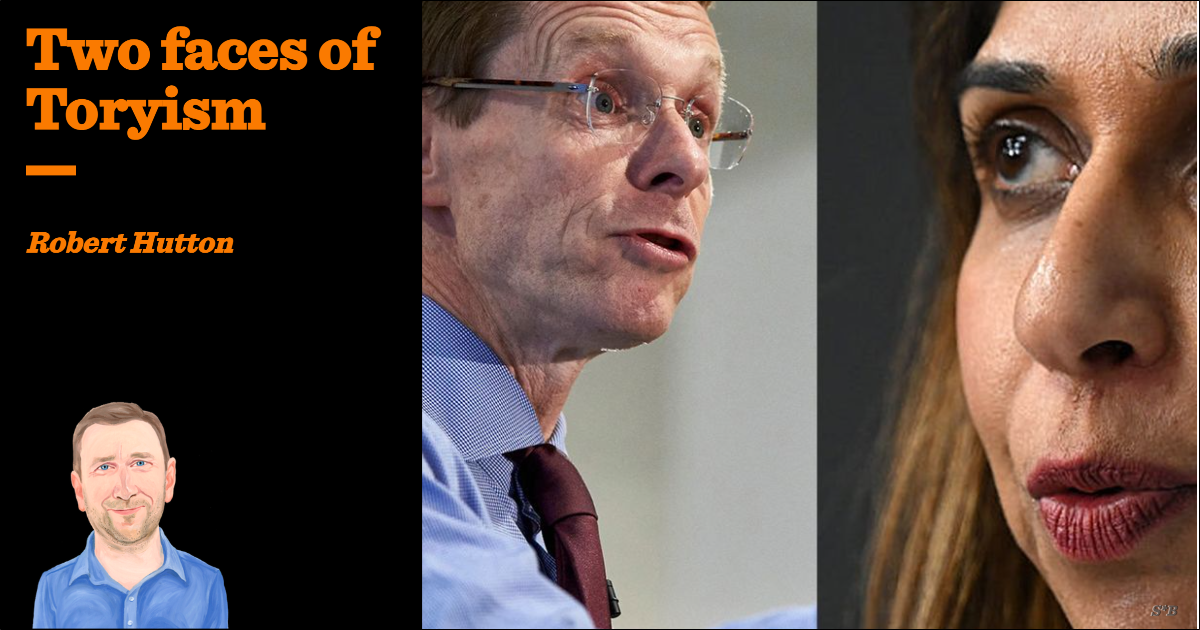
“Would you mind if I said something in response to your first question?” Andy Street, former Tory mayor of the West Midlands, asked a journalist solicitously, giving the distinct impression that if the assembled press replied that we’d had enough of answers, then he’d shut up.
This unusual level of diffidence was a sign that we were at an event that was out of place in our new shouty age of politics. It was the launch of Prosper, a centre right campaign group. Everywhere we looked were people who had been massive in British public life in about 2018: David Gauke, Amber Rudd, David Lidington, Ruth Davidson.
Exiled under Boris Johnson, irrelevant in the glory days of Brexit, they had returned to ask whether we might, on balance, want to have a think about doing things a touch differently. It was, Street assured us, “a very significant day in British political history.”
What will the movie be called? The Empiricists Strike Back? The Revenge of the Seething? This outfit were less The Fast and The Furious than The Mild and The Miffed.
At the same time as Earth’s Politest Heroes were making sure that everyone had a chance to make their point, on the other side of town their arch-enemy, Nigel Farage, was unveiling his latest star recruit, Suella Braverman. Her appearance on stage prompted a flurry of Googling to check that yes, she is still an MP and no, actually she hadn’t already joined Reform.
“I feel like I’ve come home,” she told the rally, gasping with pleasure. It was another coup for Farage, who is busy reconstructing the 2022 Home Office team whose works he daily denounces. More than half of Reform’s MPs were elected as Tories in 2019, raising the interesting question of at what point Reform ceases to be Farage’s new party and starts being Boris Johnson’s old one. It’s a variation of the Trigger’s Broom question. Or, for the classically inclined among you, the Shits of Theseus.
“My dad wasn’t even 20 when he was kicked out of Kenya,” Braverman told us, giving an insight of the experience she wants to pass on to a new generation. The event was officially the launch of Veterans For Reform, which is probably not intended as the party’s paramilitary wing, although they certainly have the skills. As a result, Braverman’s denunciation of the government in which she’d been a significant figure had a military tinge. “We have failed our veterans,” she said, using the specific version of the first person plural deployed by former Tory Cabinet ministers that somehow excludes the first person singular.
Farage had earlier denounced “a government that doesn’t have a patriotic bone in its body”, with the breezy confidence of a man who knows everyone has already forgotten that the leader of Reform Wales is currently serving a ten-year prison sentence for taking Russian bribes. “Our armed forces are something the rest of the world looks up to,” he said. Does every country feel that way, Nigel? Can you think of any close friends of yours who might in recent days have expressed a different view? Unusually, he had decided not to take press questions at this event.
Reform events are an assault on the senses, with Farage played on stage by entrance music before he hectors us all about what a mess the country has become since we started following his advice. There are videos, in which the great leader is filmed from a low angle in a desperate effort to make him look five foot nine. And there are the furious responses to questions, when subjects that he doesn’t want to discuss (anything before 1990, anything said by Reform’s councillors and MPs, anything said by him more than ten minutes earlier) are greeted by theatrical yawns and shouts of “BORING!”
It is this style of angry populism that Prosper aims to fight, although they might have to toughen up a touch. The closest we got to an attack was when Rupert Soames, the chair of the CBI, said that Reform’s remarks about business were likely to discourage investment.
“Introduce yourself,” Street told a questioner, “so that everyone knows who you are.” As if. I saw more unfamiliar faces at my wedding. Before the event started, everyone was stood in clumps discussing the lovely things they’re doing now they’re out of politics: writing books, running think tanks, a bit of broadcast work.
Why were they here? “If you believe in something, then you fight for it,” Davidson told the room. Although obviously you stop if anyone complains about the noise.
Prosper’s goal is to push the Conservative Party back to the space it occupied just over a decade ago: pro-free markets, pro-European, concerned about immigration but also climate change. Although this sounds like a doomed effort, it might not be. As Reform takes right-wing Tory MPs and members, people joining the Conservatives from the left of the party have an opportunity to wield influence: there will be a lot of candidate selection meetings in the coming years. Think of it as re-entryism.
In the shorter term, the Conservative Party must at some point realise that “Farage is right, don’t vote for him” is a message that no longer works. One day Kemi Badenoch may wonder whether there are opportunities in the unclaimed territory between Reform and the left, the space occupied by people who like Conservative ideas but are repelled by Farage, who look at what is happening in America and are, unlike Farage, horrified.
We soon learned that Monday wouldn’t be that day. Badenoch’s office responded to Braverman’s flit with a message of characteristic grace. “The Conservatives did all we could to look after Suella’s mental health,” it began, “but she was clearly very unhappy.” It was a comment so unpleasant that they later claimed it had been sent by mistake. Perhaps sometimes it really would be better not to answer the question.