A rescue bid for a broadband provider with £300million of debt was scuppered because of fears its cables have been chewed to pieces by rats, it has emerged.
G.Network, an ‘altnet’ provider of internet services offering packages for as little as £25 a month, plunged into administration on January 12 after amassing huge debts.
It had spent millions on installing much of its own fibre-optic cabling across London in an attempt to take on giants like Openreach and Virgin Media at their own game with its own high-speed gigabit fibre internet.
Community Fibre, a rival altnet firm, had been weighing up whether to buy the company – but says it bowed out of a bid after totting up the potential cost of repairing any cabling chewed up by rodents.
Rodent issues have long pestered other firms such as Openreach, which have taken action to seal up broadband ducts in order to keep the pests out.
Rivals like Openreach and Virgin buried their cables under pavements instead – making repairs much easier, cheaper and less inconvenient to residents.
But G.Network had passed up using Openreach’s existing pavement ducts under an agreement known as physical infrastructure access (PIA), instead choosing to dig up the roads instead at much greater expense.
Responding to any rat attack would involve digging the roads up all over again – at huge, prohibitive cost.
Community Fibre chief executive Graeme Oxby said that his firm’s rescue deal would not go ahead, partly because of the cost of repairing any damage.
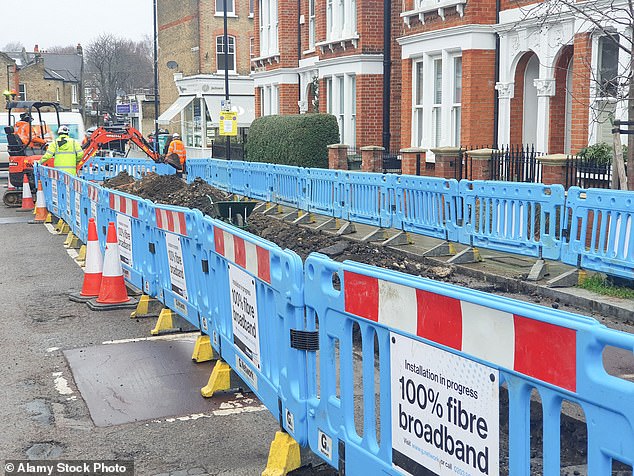
London broadband firm G.Network had a rescue bid rescinded after it emerged some of its network had been chewed up by rats
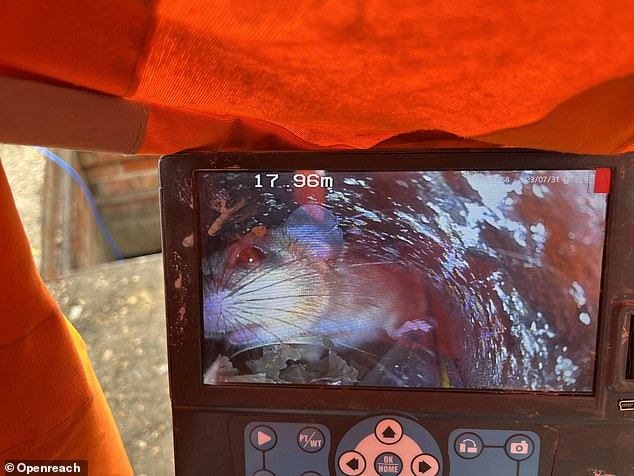
Rodents are drawn to broadband cables because the cable housings are ideal for keeping their teeth sharp (pictured: a rat in a broadband duct in Tring in 2023)
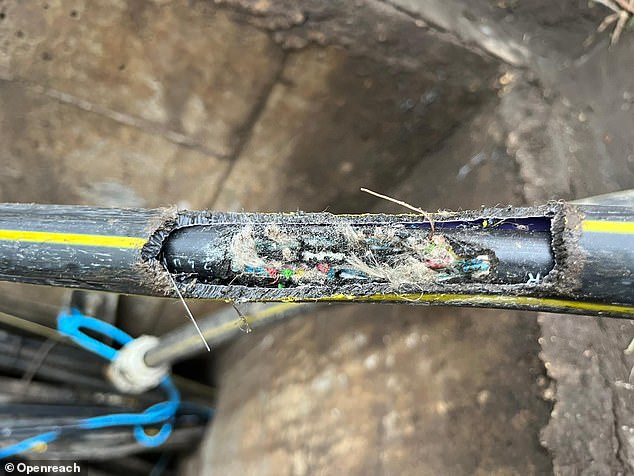
A cable gnawed through by a rat in Tring. The inner fibres are thought to make ideal materials for rat nests
‘Rodents like ducts and they like fibres which are very tasty. It’s not something we’ve been particularly interested in because we think it’s got quite a lot of structural issues and would be quite an expensive fix,’ he told the Telegraph.
Rats have become a blight on broadband cabling in recent years: the ducts housing the cables are favoured as a nesting space, while the cable materials themselves are ideal for use in the nests themselves for warmth and shelter.
The super-thick cable housings are also perfect to gnaw on, helping to keep the pests’ teeth sharp.
It’s an issue that is becoming a larger headache for fibre firms as fibre networks are expanded, replacing the dilapidated copper wire networks that are gradually being phased out for both phone and internet access, the latter known as ADSL.
Around 100 households in Askern, Doncaster had their internet knocked out in November after a rat tucked into their internet cables – to the chagrin of local MP Ed Miliband, who contacted Openreach for an explanation.
‘I’ve been in touch with Openreach, who’ve explained that the problem started with rodent damage to cables,’ the Labourite said in a social media post at the time.
And in 2023, the Hertfordshire market town of Tring had its telecoms brought to a standstill by a cheeky rodent – who was spotted on an Openreach camera as engineers assessed the damage.
Some 650 metres of cabling was rerouted to avoid disturbing a rat’s nest, Openreach said.
While G.Network’s infrastructure covered some 420,000 homes, it had around 25,000 paying customers when it appointed Alvarez & Marsal Europe as administrators earlier this month.
‘The company will continue to trade as normal, with its services being delivered to existing and new customers,’ it said in a statement.
‘The company benefits from a robust network and a strong customer base. The administrators do not anticipate that there will be any adverse impact on customers.’
The firm chose to lay cables in the middle of the road in London, even marketing itself to locals with the slogan: ‘Fantastic news, we’re digging up your street.’
Its insistence on digging up roads to install its network cables won it few fans among locals, who complained to local newspapers about massive disruption to their days.
During lockdown, locals complained about all-day use of pneumatic drills to break open roads while they tried to work from home.
One told the Camden New Journal: ‘Everyone is working from home and having to listen to this all day. I’m already going mad. The vibration is shaking our kitchen.’