Nothing about Stek Oost, an accommodation block for 250 students and young people in East Amsterdam, looked welcoming or homely last week.
Not the shopping trolleys full of fetid rubbish abandoned near the front door. Nor the sodden mattresses and abandoned sofas piled up in the muddy grass outside, let alone the smeary windows, rust-stained cladding and filthy orange awnings.
And certainly not the young residents who sloped in and out, hunched against the cold, looking tired, anxious, paranoid and deeply antisocial.
‘I never mix with my neighbours. I only sleep here,’ says a male Dutch marketing student. ‘I keep myself to myself. I used to integrate, but not any more. This is not a friendly place,’ says a blonde girl, hurrying away on her bicycle.
Which is a crying shame because, when it opened in 2018, Stek Oost – which describes itself as a ‘safe and comfortable environment where young people and refugee status holders are building a new life together’ – was hailed as one of the Netherlands’ most innovative and inclusive housing schemes.
The pioneering plan, dreamed up by the municipality of Amsterdam and a housing corporation called Stadgenoot, was that 125 Dutch students and young workers up the age of 28 would share brand-new, purpose-built accommodation with 125 of the 30,000-odd asylum seekers from places such as Syria, Eritrea, Iraq and Iran arriving into the Netherlands each year.
So the Dutch would enjoy subsidised rent – just €300 (£260) a month – in a city where prices are sky-high and, in return, were expected to help the refugees better integrate into society.
To ‘buddy up’ with their neighbours, volunteer for an hour or so each week in the onsite language cafe and sign up for communal activities including jolly barbecues, group suppers and outings to the bouldering centre. To make the migrants – who have often had a terrible time – feel welcome and at home.
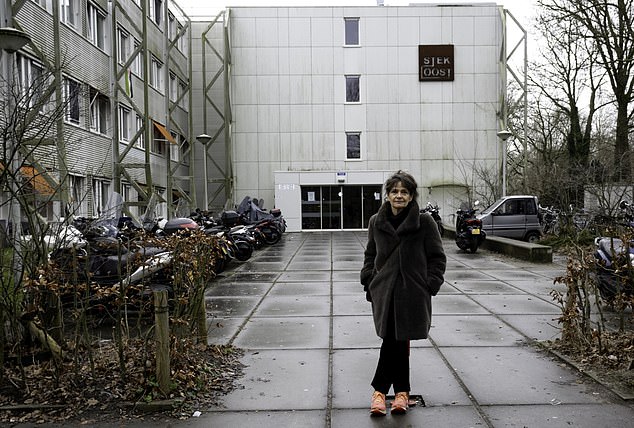
When it opened, Stek Oost – which describes itself as a ‘safe and comfortable environment where young people and refugee status holders are building a new life together’ – was hailed as one of the Netherlands’ most inclusive housing schemes, writes Jane Fryer (pictured)
But, perhaps unsurprisingly, it didn’t pan out like that and the poor Dutch students endured shouting, screaming and appalling aggression. Smashed glass doors. Punched walls. Brutal attacks.
One female student, ‘Amanda’ was raped by her Syrian ‘buddy’ in his room in 2019. She reported the incident to police shortly afterwards, but the case was dropped owing to a ‘lack of evidence’.
Six months later, another girl lodged a complaint against him. He only left the complex after being arrested in March 2022. In 2024, he was sentenced to just three years in prison for the two rapes.
A young man called Steijn was threatened with an eight-inch blade. Fights and drug dealing are commonplace, and there are swirling rumours of a gang rape in one of the rooms.
A documentary by Dutch production company Zembla has laid it all out. The violence. The sense of hopelessness. The lack of support for both students and refugees. The grinding fear.
And, perhaps most of all, the shocking fact that Stek Oost, run by Stadgenoot, along with other similar set-ups around the city are still operational. All of which is, of course, dreadful. But why are we so interested in this story in Britain? After all, we’ve plenty of our own grim stories of asylum seekers raping and sexually assaulting girls.
The reason alarm bells are ringing is because, as the Government’s daft ‘one-in, one out’ policy with France flounders, it is looking for more radical ways to take migrants out of expensive hotels.
Just last week, 27 asylum seekers were bussed in under cover of darkness to the former Army base at Crowborough, East Sussex, prompting furious protests from locals. If not former Army bases, then perhaps student accommodation is the answer?
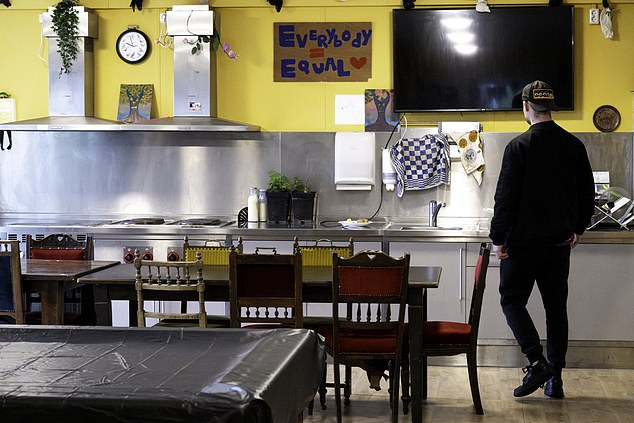
The deserted communal kitchen where a poster on the wall reads ‘Everybody Equal’, and where a young man called Steijn was threatened with an eight-inch knife
The Home Office has already tried it out in Aberdeen, where two former student halls near the city centre have housed migrants from Iran, Somalia and Eritrea.
Last September, it emerged that Mary Morris House, a 247-bedroom hall of residence in Leeds – currently home to fee-paying students – is earmarked to become accommodation for illegal immigrants.
And back in 2024, the Tory government leased luxury student blocks complete with gym and cinema in Huddersfield, West Yorkshire to put up 700 migrants, throwing out more than 150 students who had signed tenancy agreements a week before term began.
To be clear, they are not – so far – sharing with students as they are here in Amsterdam.
But let’s hope it stays that way, because no one I met at Stek Oost this week – whether Dutch or migrant – would recommend this once idealistic scheme.
In fact, they tell me there was so much wrong with it, it’s hard to know where to begin.
So let’s start by rewinding to 2015 when the municipality of Amsterdam came up with the scheme, having had success with a similar project that housed students with the elderly – helping out around the house in return for free or cheap accommodation.
However, back then, it wasn’t Dutch grannies driving the news agenda so much as the huge numbers of refugees who needed housing, having fled war-torn Syria – their journeys across Europe encouraged by Chancellor Angela Merkel’s opening of the German borders.
So the municipality decided to house them with students. It doesn’t help that, while there was clearly a lot of wishful thinking involved, no one seems to have thought through the nuts and bolts of this new shared living scheme.
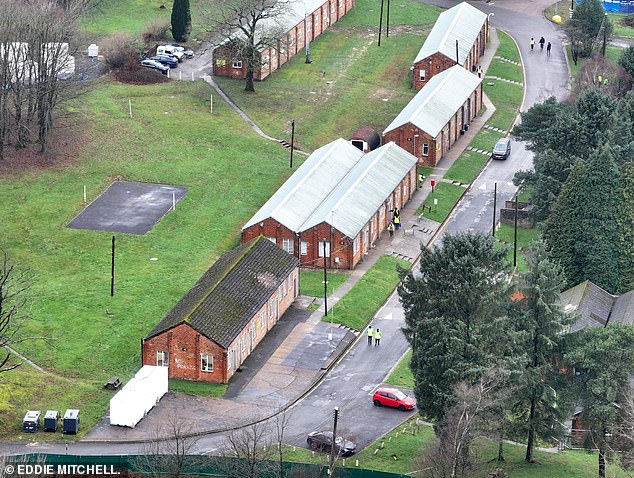
Last week, 27 asylum seekers were bussed in under cover of darkness to a former Army base at Crowborough, East Sussex, prompting furious protests from locals
The students and young workers were put through a rigorous selection process, had to study a 28-page manifesto and agree to volunteer for language classes and become buddies, or ‘community builders’, for their new neighbours. The refugees, however, were under no such obligations.
‘There was no screening process to come [to Stek Oost], other than you had to be under 28,’ says Kassem, now 28, a Syrian who arrived in the Netherlands in 2017, is studying to be a social worker and has lived at the housing scheme for two years. ‘No assessment to see if you should be sharing in this sort of community. Just dumped here with young Dutch people and left.’
Which, for many of them, arriving straight from asylum centres, was a disaster.
‘Most of the people like me have come from war zones, terrible times. A lot are from Eritrea where there are very bad stories,’ he says. ‘They need proper help from experts, clinics, psychiatrists. It is not OK to just put them here and say, ‘This is your room.’ It is dangerous. Very dangerous.’
Residents tell me that the 50:50 split was utterly unrealistic.
‘It’s too intense. Far too intense. All those refugees and a bunch of young Dutch,’ says Simona, 27, who works as a chef and has lived here for five years.
When she first moved in she made an effort to relate to her new neighbours, but admits that she just needed somewhere cheap to live that was a few minutes on the train to the city centre.
‘I joined language groups, but I soon lost interest. I’m not a social worker. I just wanted my own space,’ she says. ‘And no one’s checking. So if you’re not joining in, no one’s going to know.’

Protests in Netherlands in support of refugee migrants
So she opted out. Like lots of others. Particularly when it became clear that some of the refugees were deeply unsuited to sharing. ‘I know lots of people who’ve had problems with refugees – loads of them, particularly women. And most of them have left. They had to.’
Because they felt there was no support. No back-up from the landlord, Stadgenoot, or, more importantly, the municipality – even when more than 20 reports of sexual assault and violence have been made to the police.
In the documentary, we hear from Marielle Foppen of Stadgenoot, who says her team spent up to 36 hours a week on site, but could keep no one safe.
‘We were completely overwhelmed. We no longer wanted to be responsible for the safety of the complex. It was just too intense.’
This week, Stadgenoot declined to talk to the Daily Mail, but released the following statement: ‘We deeply regret the incidents that occurred at Stek Oost in the past. We have learned from this and taken action alongside the local council.’
They also confirmed that they have made changes – shifting the ratio at Stek Oost to 70-30 in favour of the Dutch and altering the social management, though no one I talk to has noticed any difference at all.
But, despite endless requests by Stadgenoot to shut it down, the municipality has refused to terminate the project or remove the migrants.
‘Where are people supposed to go [if that happens]?’ asked district chair, Carolien de Heer.
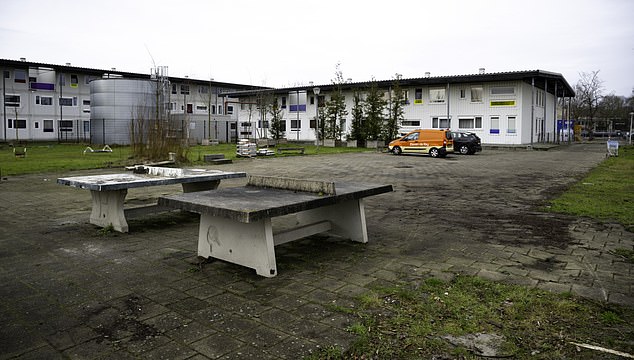
Startblok Riekerhaven is an astonishingly grim-looking container village that, over recent years, has been a hotspot for prostitution, drug-trafficking and violence
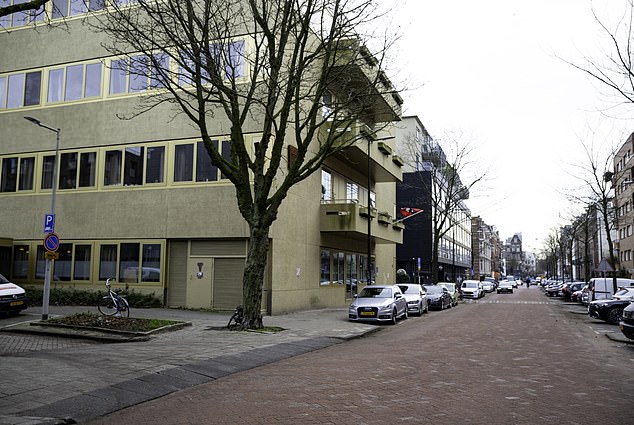
Also run by Stadgenoot is Stek West, a golden building right in the centre of Amsterdam. It is an amazing location with a ten-year waiting list for young Dutch people who again pay just €300 (£260) a month
Because, yes, there’s another problem they’d failed to consider. Thanks to Dutch law it is almost impossible to evict a refugee. So the students left instead.
The more you hear about this scheme, the more criminally irresponsible it sounds – all these young people holed up together with minimal support or supervision.
It doesn’t help that the inside of Stek Oost is just as depressing as the outside. Tattered old Christmas decorations. Shelves spewing with clothes. An abandoned pram.
Jude, 23, chats to me in the deserted communal kitchen where a poster on the wall reads ‘Everybody Equal’ and where Steijn was threatened with an eight-inch knife.
Jude has only been here for six months and was alarmed to watch the documentary – ‘I had no idea. Because I don’t know anyone here. I’ve not met anyone at all, though it is very noisy at night.’
To make things even more miserable, it seems that the building is not properly maintained. Several residents tell me that boilers are constantly breaking. That the sewers fail, gushing up human waste on to the first floor. And nothing is ever properly fixed.
While the very public failure of the scheme here has shocked the people of Amsterdam, some in this fantastically liberal and open-minded city still love the concept.
Ton is a retired anthropologist who lives near Stek Oost with his wife Anke, an educationalist. He says: ‘These people have had a terrible time and really need help and support and to feel welcome.
‘We need to do the right thing and the majority of people in Amsterdam are happy to receive them and give them a home.’
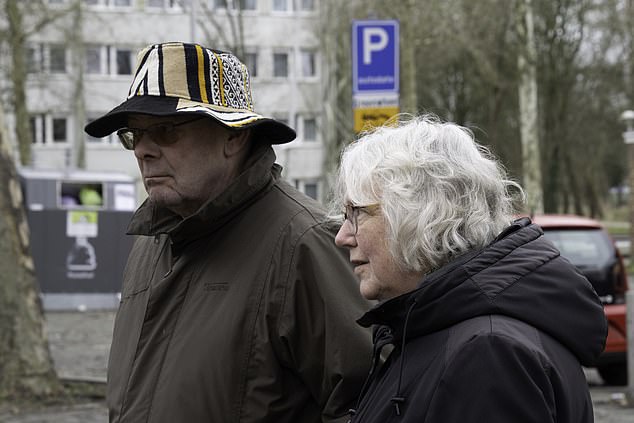
Ton is a retired anthropologist who lives near Stek Oost with his wife Anke, an educationalist. He says: ‘These people have had a terrible time and really need help and support and to feel welcome’
It has now been announced that Stek Oost will be closed in 2028, but it is just one of about 20 such complexes around the city and everyone agrees that, while the smaller ones with proper on-site managers and a bigger proportion of Dutch students and young workers to refugees are much better, the big ones are a disaster.
Startblok Elzenhagen, to the north of the city, for instance, has seen numerous reports of fights, drug use, assaults and vandalism.
And in the south-west, Startblok Riekerhaven is an astonishingly grim-looking container village that, over recent years, has been a hotspot for prostitution, drug-trafficking and violence. In November 2022, a large section of it burned down.
I visited last Wednesday and chatted to several male Dutch residents who also tell me that they have never made any effort to integrate, never felt the need to, that the complex operates as a magnet for homelessness and that they would not feel safe living there as women.
Before I leave Amsterdam, I visit one more site, also run by Stadgenoot, called Stek West. A golden building right in the city centre, it is an amazing location with a ten-year waiting list for young Dutch people who again pay just €300 (£260) a month.
Here, it’s a completely different story. The windows shine. The black, white and red Amsterdam flag flutters jauntily from the first floor. There are plants in pots, the cleaners are polishing the already spotless floor in the foyer and here, finally, all refugees have been carefully screened for suitability.
It feels as if all the resources have been diverted from the other sad sites to this gleaming golden goose. The building is beautifully managed, and Ange, who has lived here for two years, tells me that the student migrant ratio here is 70:30 and it all works brilliantly.
Which, of course, is great to hear. But not much comfort to Amanda and Steijn and all those other poor Stek Oost students still living in the grimmest, greyest and most dangerous accommodation I have ever seen – all in the pursuit of refugee integration.
This extraordinarily ambitious scheme started with such good intentions, but if it can’t work in Amsterdam – arguably the most liberal and forward-thinking city in the world – it’s hard to think where it could work.