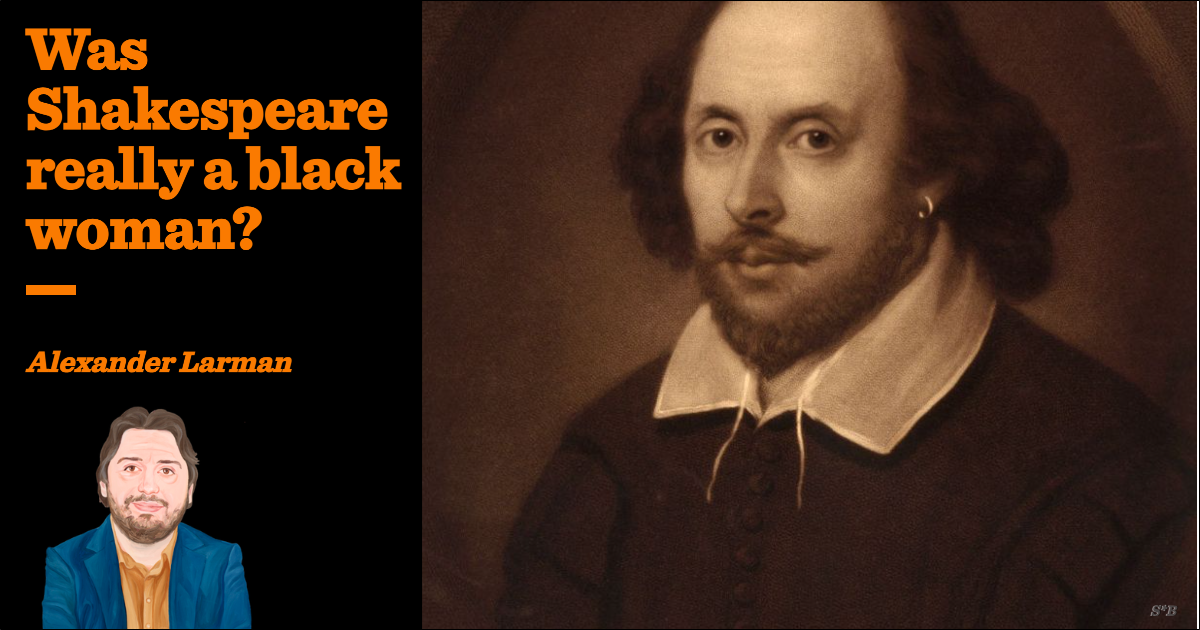
The Shakespeare authorship question — the belief that various academics, actors and writers hold that “William Shakespeare” was either a front for the real playwright, or that he was a pseudonym adopted by the true author for fear of their being publicly embarrassed — has existed in some form or another since the middle of the nineteenth century. The argument has some high-profile supporters, including the actors Sir Derek Jacobi and Sir Mark Rylance and, most recently, Elizabeth Winkler, who wrote a book in 2023 entitled Shakespeare Was a Woman and Other Heresies, which suggested that Shakespeare was not a glover-maker’s son from Stratford-on-Avon but that he was the poet Emilia Bassano.
Winkler’s argument was not convincing, but it was made with the brio and savvy of an author who knows that they are supported by a major publisher (in her case, Simon & Schuster) and that most literary critics will be afraid to review a revisionist book written by an avowedly feminist author negatively, for fear of being accused of sexism or ignorance. Still, Shakespeare Was a Woman should have been the last word on this particular subject, which is why it is both surprising and somewhat depressing that another writer, in the form of Irene Coslet, has stepped forward with her own thesis, namely that Shakespeare wasn’t just a woman, but a woman of colour into the bargain.
Coslet, who describes herself as a “feminist historian”, has written a book on the subject, entitled The Real Shakespeare: Emilia Bassano Willoughby. It is published at the end of the month by the prolific independent publisher Pen + Sword Books (other current books: Nazi Anatomy Lessons, 200 Years of British Train Development and Roman Emperors and their Illnesses, all of which sound like something Mark Corrigan might have written after self-publishing Business Secrets of the Pharoahs) and has attracted rather more publicity than a debut author bringing out her first book with a small press might expect. Coslet has written an article for the website of her alma mater, the LSE, in which she expounds on her central thesis, and argues that “A new piece of research evidence that I outline in my upcoming book shows that Shakespeare was not a man, but a woman: a black woman, Anglo-Venetian, of Moroccan descent, and covertly Jewish, named Emilia Bassano.”
Black, female and Jewish, eh? Of course, anyone who can write characters of different ethnicities and genders as brilliantly as Shakespeare did will, at some point in history, be accused of subterfuge of some kind. Yet while the authorship theory has been around for the best part of two centuries, the belief that Bassano, or Bassano Willoughby, was the true author of Shakespeare’s plays began in 2013 with the Shakespeare scholar John Hudson, who wrote a book Shakespeare’s Dark Lady: Amelia Bassano Lanier, The Woman Behind Shakespeare’s Plays?
Hudson took at his starting point the belief first espoused by AL Rowse that Bassano was the “Dark Lady” to whom several of the sonnets were addressed, and then raised the stakes by suggesting that she had written the plays herself. It was then brought into the mainstream by a 2019 Atlantic article by Winkler, which became a book, and now Coslet is the latest writer to argue that when Shakespeare wrote “presume not that I was the thing I was” in Henry IV Part Two, he — or rather she — was tipping the equivalent of a massive wink at the audience.
There will be those sympathetic to Coslet’s argument that “there is a scholarly consensus that Shakespeare was a feminist”, and discussions about the playwright’s interests in race, colonialism, gender and sexuality have been at the forefront of academia for decades now. Yet most scholars take it as read that Shakespeare is Shakespeare — namely, a white man from lower middle-class origins who was an actor as well as a playwright — and that attempts to claim that he was the Earl of Oxford, Christopher Marlowe, Francis Bacon or, now, Bassano are ultimately doomed.
One of Coslet’s claims is that Shakespeare’s name is an anagram of “A-She-Speaker”, and that if you fold the famous “Chandos portrait” of the playwright a certain way, it looks like the existing portrait of Bassano. For my money, this is no more sophisticated than the apocryphal Bacon fan who sat down with a copy of Hamlet and proved that his hero was clearly the author of Shakespeare’s plays because the letters “Francis Bacon wrote this” could be found in one of the soliloquies, albeit not consecutively. It brings to mind the phrase “clutching at straws”, itself a phrase invented by Thomas More in 1534. No doubt, any moment soon, there will be some bright spark claiming that the author of Utopia was Anne Boleyn.
I’ve always thought that the main reason why people want to believe that Shakespeare wasn’t Shakespeare — apart, of course, from it being an entertaining parlour game — is out of simple snobbery. There are those who are vexed by the knowledge that the greatest writer in the English language was not aristocratic or university educated, and that he had a keen appreciation of money and business matters, if the few surviving documents believed to relate to him are accepted as extant, which remove the idea of his being an ivory-tower dwelling genius. He wrote for money as well as art, and this has always been unacceptable to some.
There will be those who seize upon The Real Shakespeare with giddy joy … The rest of us, however, may be allowed a degree of scepticism
Coslet is not the first or the last to propose what would once have been a heretical idea, and as she is an academic of more than two decades’ standing, I am prepared to accept that her intentions are sincere, rather than an attempt to write a modish, potentially hugely popular book. Still, this does not make them gospel. She writes that “In the case of Emilia Bassano, the problem is not only historiographical misogyny, but also historiographical racism. Emilia Bassano was a Moor. She was a Jew. Modern historians failed to give credit to these identities for their role and contribution in Western history.” But if we concede that there might be a bias towards ignoring these “identities”, could there not also be a bias towards maximising their significance? And how better to maximise their significance than by projecting them onto the most revered writer of all time? The problem is that when such attempts to give belated credit are not grounded in reason, they rob someone else of the credit they deserve.
There will be those who seize upon The Real Shakespeare with giddy joy, delighted that Coslet has seen through centuries of obfuscation and conspiracy. The rest of us, however, may be allowed a degree of scepticism, and to continue in our — no doubt sexist, patriarchal, colonial — beliefs that “the man from Stratford” was just that, and should be celebrated as such, rather than his very identity impugned centuries after he was no longer able to answer for himself.