On Thursday, “One Battle After Another” received one Oscar nomination after another.
The strong contender for best picture is up for 13 Academy Awards. The movie features militarized police who venture into sanctuary cities to round up unauthorized immigrants. A band of resistance fighters pushes back. It might sound like something on CNN rather than IMAX.
The film’s impressive nomination tally includes nods in all four acting categories, including best actor for Leonardo DiCaprio. Paul Thomas Anderson, the 2025 film’s writer, director, and producer, was also nominated for best director. “One Battle After Another” will vie with “Sinners,” a vampire movie set in the Jim Crow era, which received a record 16 nominations. The 98th Academy Awards, hosted by Conan O’Brien, airs on ABC on Sunday, March 15.
Why We Wrote This
Best picture nominee “One Battle After Another” traces its origin to a 1990 novel, yet some elements feel uncomfortably relevant to the current news cycle. Where some culture critics see a left-wing storyline, others see a nuanced cautionary tale about the risks of political extremism.
The nominations for “One Battle After Another” land at a big political moment. As the Oscar race unfolds, acceptance speeches during other awards shows may reference news headlines from Minnesota. At the recent Golden Globes, some celebrities wore anti-ICE pins. “One Battle After Another” has already sparked contentious dinner-table arguments. Is it art mirroring real life? Or is it an instance of left-leaning Hollywood offering a distorted view of today’s America while excusing political violence?
Beyond debates over the movie’s blind spots and biases, some viewers will see an underlying message that transcends political tribalism. “One Battle After Another” critiques the appeal of extremism, on both the left and right, and illustrates how embracing polarizing views often comes at the cost of human relationships. At heart, it’s a story about a left-wing radical (Mr. DiCaprio) trying to reconnect with his adopted teen daughter, who struggles with her parents’ political choices.
“That was the most touching, and I think the strongest, part of the film,” says Michael Genovese, co-author of “American Politics Film Festival: Understanding US Politics Through Film.” “In the end, his politics were secondary. His love of his daughter came first, and that is a universal [quality].”
Siding with terrorists?
The almost three-hour “One Battle After Another” is loosely based on Thomas Pynchon’s often comedic and absurdist 1990 novel, “Vineland.” Here’s the basic plot. (Grab some popcorn – spoilers ahead.) It’s set in the near future. A young bomber (Mr. DiCaprio) is in a terrorist group named the French 75. His lover, Perfidia Beverly Hills (best supporting actress nominee Teyana Taylor), is its ferocious leader.
Early on, the two strike a government detention facility to free unauthorized migrants. But Perfidia secretly begins an affair with the facility’s commander, Steven Lockjaw (Sean Penn) and becomes pregnant. Not long after the baby is born, she begins leaving the child with Mr. DiCaprio’s character so that she can go out on raids. But Perfidia gets arrested. In exchange for freedom in a witness protection program, she betrays the identities of her fellow radicals, including her own family. The French 75 team scatters and assumes fake identities. And that’s just Act 1. Phew!

Some viewers have criticized the movie for siding with terrorist protagonists.
“Violent leftist radical activism – that is what the whole first act is about, and then it never really reckons with questions of morality about radical violence,” says Peter Suderman, who reviewed the movie for Reason magazine.
Mr. Suderman, a libertarian, describes himself as extremely pro-immigration and as appalled by recent videos of Immigration and Customs Enforcement (ICE) agents in Minnesota. So he’s sympathetic to the goals of the French 75 in “One Battle After Another.” Yet it’s a cop-out, he says, that the director never shows viewers whether Mr. DiCaprio’s bombs kill anyone. That makes it easier to feel sympathy toward the lead character.
One father’s struggle
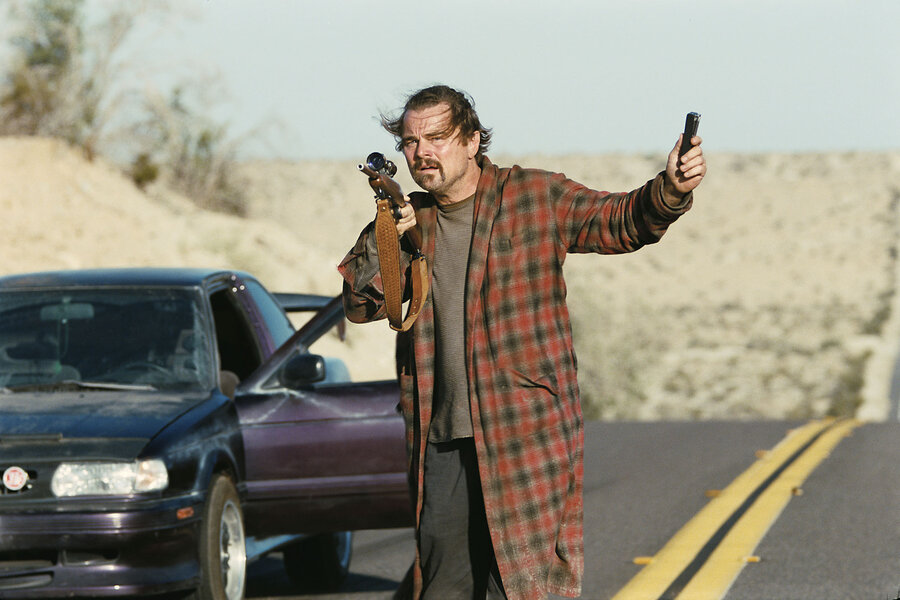
Act 2 begins 16 years later. Mr. DiCaprio’s bomber, now renamed Bob Ferguson, lives in Northern California. He’s a drug-addled, paranoid, conspiracy-theorist layabout, with all the fight gone out of him. Willa, Perfidia’s abandoned daughter, is embarrassed by her adoptive father. But when Lockjaw arrives in town to arrest his biological daughter, she flees. That stirs Bob to embark on a journey to find Willa before Lockjaw does. Yet Bob is bumbling and ineffectual, and spends the entire quest wearing a dressing gown. He’s like “The Dude” in “The Big Lebowski,” without the tenpin bowling skills.
In a video review of the movie, conservative commentator Ben Shapiro objects to Bob’s character – or lack of it. “It is better, in other words, to be a complete loser who wastes your life bombing things randomly in order to free illegal immigrants to run willy-nilly across the border, than to be a productive citizen of society,” he says.
Other readings of the film say that it hardly glorifies Bob and Perfidia. They’re not role models. In Act 1, the French 75 robs a bank to fund its terrorism. During the heist, in which the bank customers are lying on the floor, one member of the terrorist team proclaims, “I am what Black power looks like!” But there’s a disconnect between the revolutionaries’ rhetoric and their actions. Moments later, Perfidia shoots an older Black security guard who is lying on the floor. Some see echoes of a real-life tragedy in 1981, when members of the left-wing Weather Underground fatally shot two police officers, including Waverly Brown, the first Black law enforcement officer in Nyack, New York, following a heist.
“While some argue the film celebrates political violence, it doesn’t at all,” Richard Newby wrote in The Hollywood Reporter. “It depicts it as a temporary solution, one that, when drawing battle lines, only results in casualties on both sides and creates victims out of those who suffer under the same realities of America.”
The movie highlights a generational divide between older leftists and today’s progressives. When Bob meets one of Willa’s friends, who wants to be referred to as gender-neutral, he sarcastically asks, “Now is that a he, or a she, or a they?” Later, Bob has a hilarious argument with a young revolutionary phone operator who insists that he can’t help Bob unless he uses the correct password.
“The bureaucratic fussiness of the operator is clearly meant to be a satire of doctrinaire left-wing rigidity,” wrote Variety critic Owen Gleiberman in an essay titled “No, ‘One Battle After Another’ Is Not a ‘Left-Wing’ Movie.”
Yet, for all the satire about left-wing radicals, the movie’s villains are right-wing racists. Lockjaw becomes a member of an exclusive secret society of high-powered white nationalists. Its oligarchs insist upon racial purity even though some members utilize immigrant workers in their industries. Conservative influencer Mr. Shapiro slammed the movie’s portrayal of a United States run by white supremacist Christian nationalists.
It was a cheap shot, agrees Mr. Genovese, who nonetheless thought it worked comedically. If Mr. Genovese were to update his 2025 book on movies and politics with a chapter on “One Battle After Another,” he says, he’d point out how the film captures the confusion of today’s political landscape. For a couple of decades, the political ideology of American voters resembled a bell curve, Mr. Genovese says – a few on the far left and a few on the far right. Most people were in the middle. Now, we have a U-shaped curve, with more people on the far right and the extreme left. “One Battle After Another” depicts what political extremism looks like. Yet its choice of good guys versus villains doesn’t help bridge that gulf.
“We don’t have movies that have discussions,” says Mr. Genovese, who is president of the Global Policy Institute at Loyola Marymount University in Los Angeles. “We have movies that make points and take positions.”
The question of extremism – and how we respond
It’s telling that the two most extreme characters, Perfidia and Lockjaw, are attracted to each other despite being on opposing sides of the political spectrum. Lockjaw, a racist, is terrified that the others will find out that he has a biracial biological daughter. So he sets out to kill her. Lockjaw is as cartoonish as his name suggests. He walks with the gait of a saddle-burned cowboy. His military haircut – half mop, half buzz cut – looks like an accident from using a Flowbee. Yet there’s a scene in which he knocks on Perfidia’s door with a bouquet. When there’s no response, he returns with a battering ram and smashes the door open.
It’s a heartbreaking scene, Dane Rich, who reviewed the movie for Christianity Today, says in an interview. The deeply insecure and needy soldier was initially willing to reveal his vulnerability, but once he felt rejected, he resorted to violence in a display of masculine bravado. Later, Lockjaw’s search for acceptance leads him to join the racist club.
Mr. Rich sees a real-world lesson there about how viewers could respond to those who are lured into extremism. If we shun extremists, believing that they are only deserving of scorn and contempt, then there’s no hope for peace.
“Are we giving them off-ramps of love, or are we withholding it?” asks Mr. Rich.
In “One Battle After Another,” one character represents a moral center: karate teacher Sensei Sergio St. Thomas. (He’s played by Benicio Del Toro, who, alongside Mr. Penn, is nominated for best supporting actor.) In a sanctuary city, the sensei runs a “Latino Harriet Tubman” underground railroad. In a messy world that tries to entice people to embrace extremes, the sensei hasn’t succumbed to that pull, says Mr. Rich. Instead, he embodies composure and peace. He seems to treat his entire community as family. It’s a stark contrast with Lockjaw and Perfidia, who’ve each sacrificed their parental relationship with Willa for their fanaticism.
In the end, Bob works to regain Willa’s trust and rebuild a broken familial relationship.
“That’s an apolitical message,” says Mr. Rich, who also writes on Substack. “[It’s] looking at the ability to be present where you are, to see the humanity around you, and then to act and love – whatever that means in that moment – for the sake of those around you.”