In the years to come, we might all be driving electric cars – at least if the government gets its way.
But the move towards electric vehicles and a fume-free future is under threat by a distinctly old school kind of crime – as criminal gangs strip copper cables from two charging sites a day, the Daily Mail can reveal.
The cables have a scrap value of between £15 and £25 but costs at least £1,000 to replace at public charge points.
Businesses are now calling on the government to formally classify EV charging sites as critical national infrastructure, allowing police to dedicate more resources to protecting them after one firm reported incidents had more than doubled to 900.
And they are warning that the rate of cable theft is escalating so rapidly that, without intervention, it could even derail the UK’s 2050 Net Zero targets.
An exclusive survey by the Daily Mail has found theft and vandalism at charging sites across the country has surged by 80 per cent since 2023.
A Freedom of Information request to police forces found almost 400 incidents of theft and vandalism since 2023, with more than 170 this year alone. One force saw an eight-fold increase in incidents at EV charging points.
But only a quarter of police forces provided a response to the request meaning the scale of the problem is likely to be much higher.
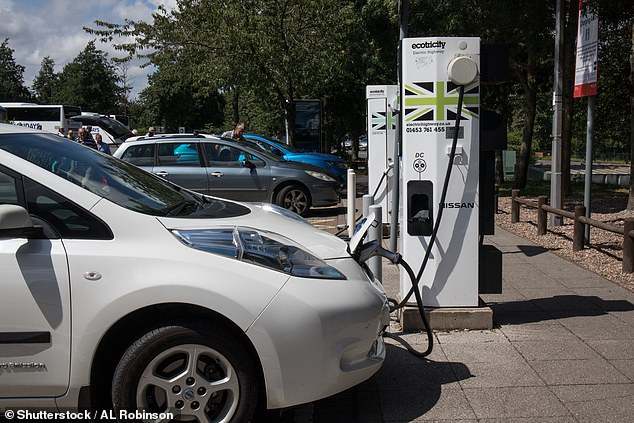
The cables have a scrap value of between £15 and £25 but costs at least £1,000 to replace at public charge points
The new crimewave comes after thefts of catalytic converters plummeted, leaving some to deduce gangs have switched their focus from the devices on petrol and diesel cars to the copper wiring at EV charging points.
On top of tens of thousands of home charge points, there are currently around 86,000 public chargers in the UK, with a new charge point now added to the network every 33 minutes, according to Government figures.
But in a blow to the Government’s drive to ban the sale of new petrol and diesel cars by 2030, latest statistics show the introduction of public chargers for electric vehicles has slowed for the first time.
By the end of November, the number of new public charger installations stood at 13,469, according to charger location app Zap Map – which provides data to the Office for National Statistics – a drop of 30 per cent on 19,834, the figure for the whole of 2024.
Last month, Tory leader Kemi Badenoch said the party would scrap the Zero Emission Vehicle (ZEV) mandate – under which manufacturers must meet increasing quotas for EV sales – if it won power, and slash subsidies for the sector.
Experts say what started as opportunistic one-off thefts are now the preserve of organised criminal gangs as the price of copper continues to soar.
They are going on to sell the cables as scrap to illegal scrap dealers, or on places like Facebook Marketplace and eBay.
Andy Rogerson, who runs the Electric Vehicle Man YouTube channel, said: ‘People will go after anything they can make money from.
‘There are more chargers than ever before, and the number of thefts are increasing in tandem.
‘We now have to adapt to the thieves in the same way they have adapted to these new opportunities (to steal)’.
And there are fears that as the EV network continues to expand at pace – with a £381 million grant of public money – the problem will grow if left unchecked.
Damage caused by crime can leave chargers out of service, frustrating drivers and eroding confidence in the network which industry bosses fear could slow the transition to electric vehicles.
In November, four EV chargers installed by the council in Mackworth, Derby, with £186,000 from the government were rendered ‘useless’ after they were stripped bare by thieves.
And in March a brazen thief was caught on camera cutting through cables at an electric vehicle charging station at a retail park in Wednesbury in the West Midlands – risking electrocution.
Despite clear CCTV and national electric vehicle charging network Be.EV putting up ‘wanted’ posters, the thief has never been caught.
Charging network InstaVolt said dealing with the cable theft epidemic forces engineers to divert from essential maintenance and new installations, delaying network expansion.
The privately funded firm estimates that the crime has cost it close to £2m when all factors, including new security measures to protect the cables, are taken on board.
InstaVolt said that since November 2023, more than 900 EV charging cables have been cut from InstaVolt sites, with the West Midlands being one of the worst-hit areas.
The number of thefts has nearly doubled year-on-year, with 510 cables stolen by October 2025 compared to 310 in all of 2024.
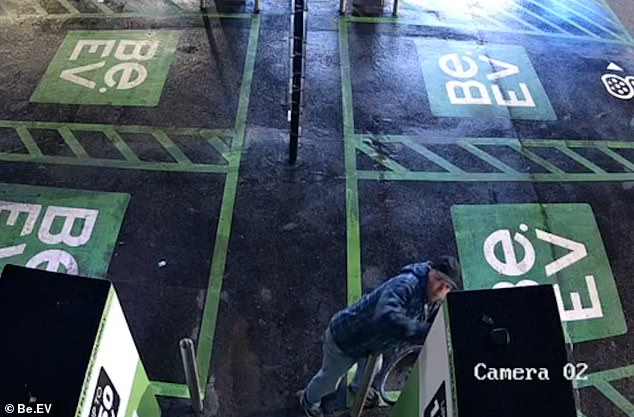
A man (pictured) stole charging cables at the EV charging hub at Decathlon Gallagher Retail Park, Wednesbury, just after 8.30pm on March 12
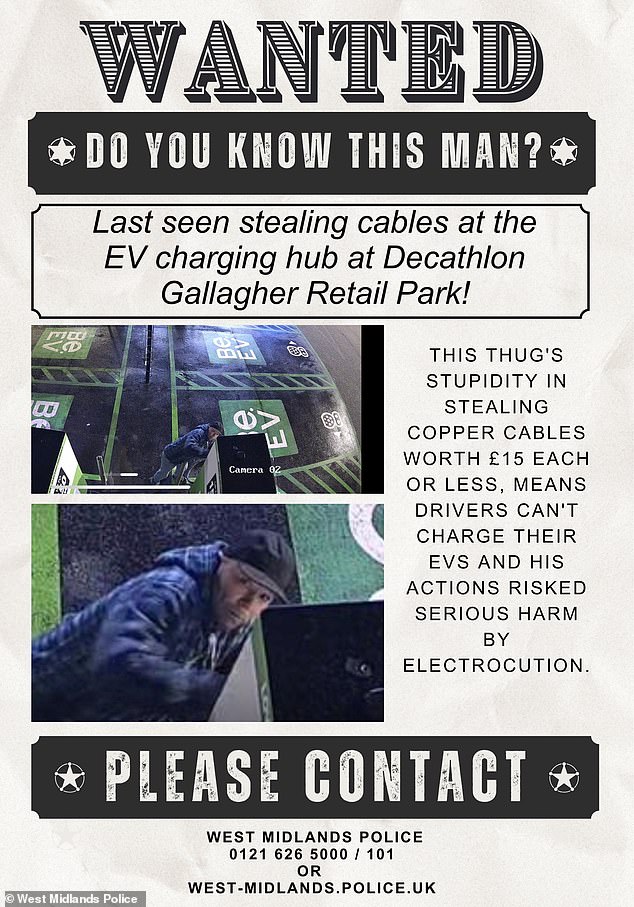
National electric vehicle charging network Be.EV put up 40-50 ‘Wanted’ posters in the area in a bid to catch the thief
InstaVolt is urging government and local authorities to classify cable theft as criminal damage to national infrastructure, calling for stricter sentencing and more policing in hotspots like the West Midlands, South Yorkshire, North East, Thames Valley, and more recently Hampshire.
The Public Order Act 2023 introduced a new offence of interference with key national infrastructure, which covers any behaviour which prevents or significantly delays the operation of major infrastructure, including railways or printing presses.
The offence carries a maximum penalty of 12 months’ imprisonment, an unlimited fine, or both.
‘This is not a low-level crime’ said InstaVolt CEO Delvin Lane. ‘It is a direct attack on the UK’s national infrastructure. The cost is approaching £2 million, but the damage to public confidence in electric vehicles is even greater.
‘Without serious intervention, cable theft threatens to derail the UK’s 2030 net zero targets. We must act now to protect our EV infrastructure and support the transition to cleaner, greener transport.’
InstaVolt, like some rival networks, has introduced a range of counter mearsures including the rollout of protective sheathing, GPS technology to trace stolen equipment, CCTV monitoring, and increased security patrols.
Operator Evyve claims an estimated 100 chargers had been targeted in the last 12 months – a third of its entire UK network of devices – while the Osprey charging network told the Mail that over the last two years, it has seen over 100 separate incidents affecting over 250 individual charge points at its sites.
A spokesman said: ‘Tracking the increasing price of copper and other industries’ theft trends, incidents involving cables cut at Osprey charge points have accelerated in 2025, reaching a peak over the summer.’
Asif Ghafoor, CEO of Be.EV, said cable theft was quickly becoming the number one issue for the EV charging sector.
He said: ‘It’s easy to focus on the business cost of the damage but the real impact falls on drivers who rely on access to this infrastructure to keep moving.’
Labour is under mounting pressure to delay its 2030 ban on new petrol and diesel cars, after the EU last month watered down its plans to ban the sale of new petrol and diesel vehicles by 2035.
Under the European Commission’s new plan, on the back of intense lobbying by manufacturers, 90 per cent of new cars sold from 2035 would have to be zero-emission, rather than 100 per cent.
The government has set a target for Britain to be net zero by 2050 and said it remains committed to its net zero policies, despite an official report last month revealing that slowing the pace of net zero could save the British economy £350bn.
While it plans to ban new petrol and diesel cars from 2030, hybrid cars have an extra five years’ grace.
Greg Smith, the Shadow Parliamentary Under Secretary for Net Zero and Transport, said: ‘We announced before Christmas that if we form a government before 2029 we will get rid of the ZEV mandate and let people choose what they want to drive.
‘For many people the charging infrastructure is not there – they do not have their own driveways, or range anxiety is an issue, and now there is this (cable theft problem).
‘It’s just going to be an added misery.’
He added: ‘We’re trying to drive something through which people were probably not fully on board with but felt pressured to comply with.’
The charging industry is a vital component in the country’s push towards EV uptake, clean transport and Net Zero. There are currently around 1.7 million electric vehicles on the roads.
Vicky Read, chief executive, ChargeUK: ‘The EV charging industry is putting huge effort and investment into giving drivers the certainty that when they arrive at a charge point, they’re going to be able to put power in their vehicle.
‘So, it is infuriating when that is not the case because a criminal has cut the cable — for drivers and for the charge point operators who are spending thousands on this problem which could be better spent building more charge points.
‘We need to work together as an industry with the police and the Home Office to cut down on this crime and continue to give EV drivers confidence.’