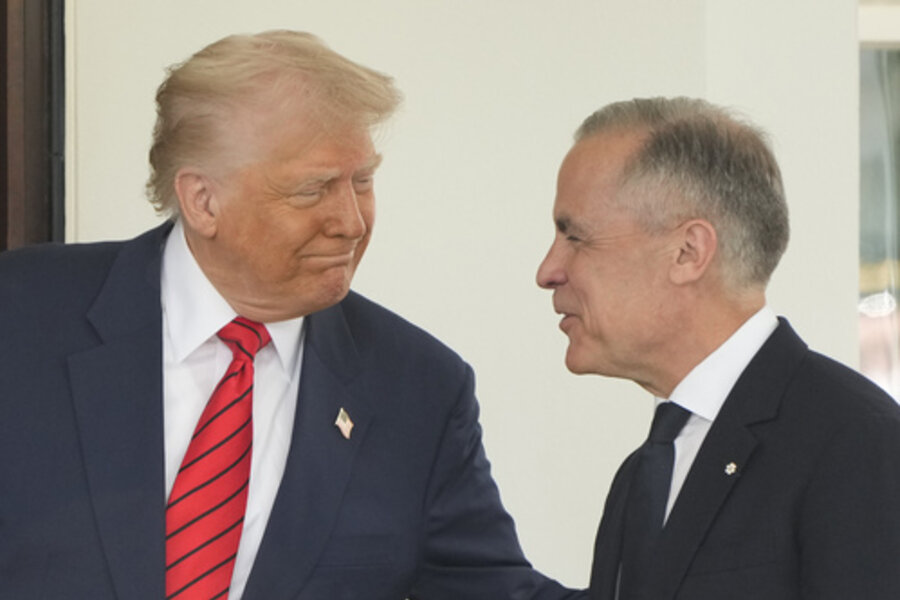
Donald Trump was elected twice as president, in part because many Americans believe the United States has done enough for the world over more than a century – in defending freedom and opening its markets and borders – with little gratitude or assistance in return. That grievance over a perceived lack of gratitude was in full throttle Wednesday during Mr. Trump’s speech to world leaders in Davos, Switzerland.
The president criticized Denmark for being “ungrateful” after the U.S. saved its territory of Greenland during World War II and then “gave it back.”
“We fought for Denmark,” he said. “We weren’t fighting for anyone else.”
He also went after America’s northern neighbor. “Canada gets a lot of freebies from us, by the way. They should be grateful … but they’re not.”
And he said this about America’s role in many wars: “What does the United States get out of all of this work, all of this money – other than death, destruction, and massive amounts of cash going to people who don’t appreciate what we do?”
His demand for gratitude, from either countries or companies, is not new. Last year, Mr. Trump accused Ukraine of showing “zero gratitude” for U.S. support in the war with Russia. Yet many leaders have grown tired of this type of guilt-tripping that seems aimed at dealmaking, that sees genuine gifts only as veiled bribery.
In Davos, for example, Canadian Prime Minister Mark Carney indicated a new distance from the U.S. for the sake of Canada’s prosperity and security. He is seeking ties with smaller nations like his that see power in “legitimacy, integrity, and rules.”
One of Canada’s top intellectuals, Michael Ignatieff, explained on Substack last year that gratitude is “one of those feelings which ceases to be itself, when it is forced. It is like love in that respect. It is in the very meaning of gratitude that it should be free.”
“There used to be Presidents who understood what freedom was, and why it was unnecessary to demand gratitude when the United States defended it. Not anymore.”
For his 2017 book, “The Ordinary Virtues: Moral Order in a Divided World,” Dr. Ignatieff traveled the world to vulnerable communities under stress to find out how they developed their own “moral practice,” including appreciation for one another, in order to live together. He found that “ordinary” virtues are not an abstraction or seen as universal but are something individuals discover in each other from community encounters. They are both local and “the point and purpose of a human life.”
That may be why Prime Minister Carney’s speech in Davos drew high praise. In it, he called on countries under stress like his to help “build a new order” that encompasses “common” values in “genuine cooperation.”
Any gratitude for the success of that project will probably be freely given.