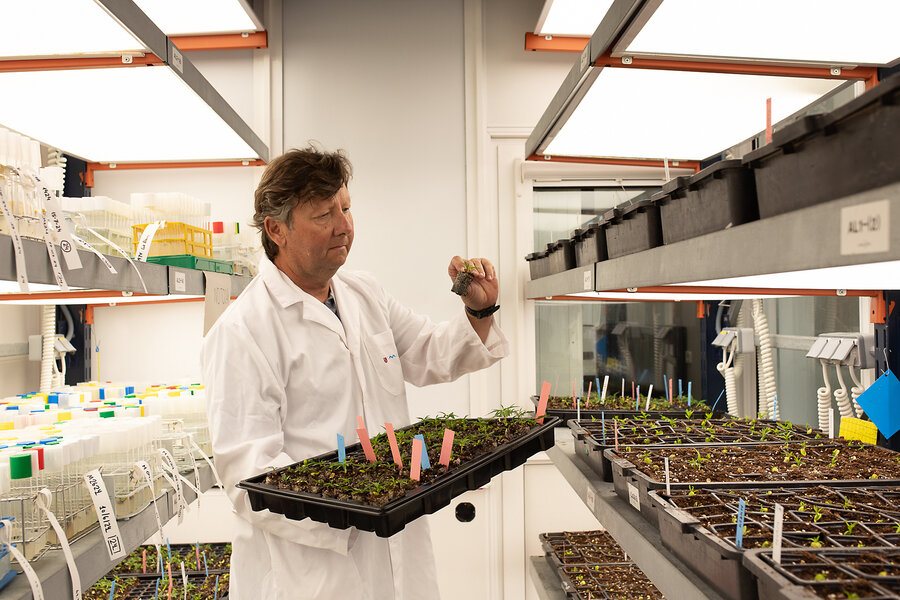
When I arrive at his office at the Murcian Institute for Agricultural and Environmental Research and Development, José Cos-Terrer has already been working for hours. “Every morning, as I start the day, my first thought is how lucky I am,” he says with a smile, almost like a confession.
Dr. Cos-Terrer and his team are dedicated to developing fruit tree and vegetable varieties that can withstand drought, poor soil, and blight. In southeastern Spain, which has a desert climate and severe water scarcity, the task of finding sustainable solutions is urgent. So far, the answer has been to combine public infrastructure, scientific innovation, and sophisticated sensor technology.
Alongside the Murcian Institute’s genetic advances, sensors play a key role in ensuring that crops receive exactly what they need, particularly under extreme environmental conditions. And I am surprised at how small these sensors are.
Why We Wrote This
In a region with an arid climate and severe water scarcity, finding sustainable solutions to grow crops is urgent. So far, the answer has been to combine public infrastructure, scientific innovation, and sophisticated sensor technology.
I had imagined towers of cables and bulky equipment, but when I visit the Widhoc agricultural tech company’s workshop – an area no bigger than my living room – I discover that a sensor fits into the palm of a hand. Hundreds of the devices are produced in the workshop each month, explains Juan Jiménez, a Widhoc manager, as he points to a table full of prototypes ready to go to the fields.
To understand how the sensors work, he shows me the company’s new software platform. The screen displays real-time data on soil moisture, temperature, and nutrient levels from various crop plots. With a click, irrigation charts pop up, along with data comparisons with previous seasons and high-resolution satellite images of crops.
“A client can see their entire farm from here,” Mr. Jiménez says proudly. “In the end, there’s more science in a tomato than in an iPhone.”


For more visual storytelling that captures communities, traditions, and cultures around the globe, visit The World in Pictures.