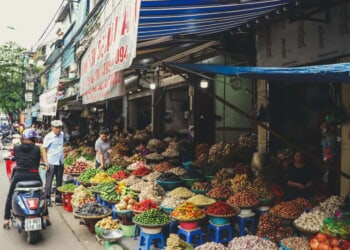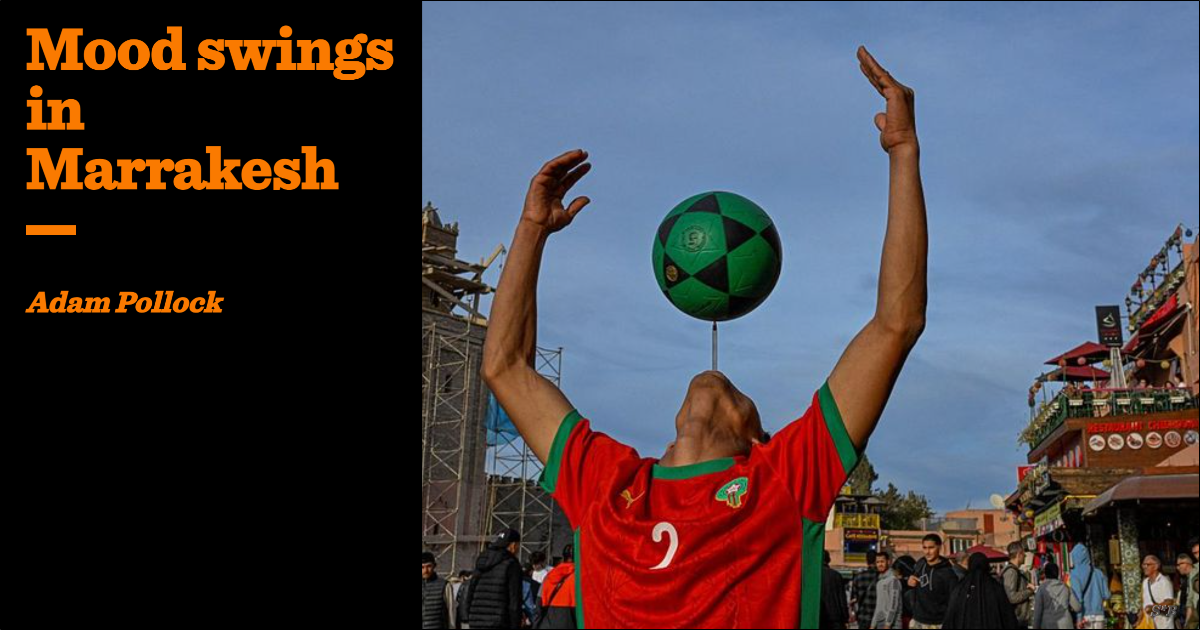
It was dusk in Jemaa el-Fnaa, the main public square in the medina of Marrakesh. The overbearing scent of incense from market stalls mingled with horse manure carried over from the stationary traps parked up on an adjacent street. The constant calls from pomegranate juice sellers were punctuated by the revving of motorcycle engines and the piercing din of vuvuzelas. In the distance, the moonlit minaret of Koutoubia Mosque loomed over a large LCD screen.
We had gathered in the “Fan Zone” to watch Morocco’s semi-final match against Nigeria in the Africa Cup of Nations — an international football tournament which the country was also hosting. Unlike crowds of football supporters in the UK or Europe, this was a sober affair — in terms of alcohol rather than mood.
The several thousand-strong crowd of attendees consisted largely of local men and children, many astride motorcycles and mopeds, which they plunged deep into the horde in search of a vantage point. Tourists in the throng held largely back from the screen, likely wary of densely packed areas after days treading cautiously through densely packed souks. Most tourists, unsurprisingly, were French; few appeared to be football fans, while two or three sported out-of-place keffiyehs, doubtful to protect them from the sun in the dismal late-evening drizzle of midwinter Marrakesh.
The match remained goalless while tea-sellers teetered through the tense crowd. At half-time, I retreated to get some chips from a shawarma shack, weaving through the busy square towards a side street as counterfeit football shirt merchants gave way to counterfeit handbag vendors. A snake charmer’s song couldn’t have had less of an impact on the sedentary serpent, whose attention was very much elsewhere.
The match itself passed most uneventfully, until the Moroccan team found itself victorious in a late-night penalty shoot-out. The crowd surged, and soon the square was abuzz with noise and commotion. Fans flocked in every direction as we made our way back towards our riad.
The roads surrounding Jemaa el-Fnaa — hectic at normal hours — were frenzied, full of vehicles performing a triumphant victory lap of the old town centre. Cars and motorcycles alike sped through the streets in procession, with drivers tooting horns and shouting — a jubilant din carried across miles by the city’s resonant low-rise walls. In the newer part of Marrakesh, fireworks illuminated the night sky as supporters took to the main roads with flares and frenetic triumph.
One resident of the city remarked to me that they celebrate like this for everything; there was a United Nations resolution that went their way at the end of October, backing its plan for the contested Western Sahara region, which saw the last day of the month be declared a national holiday as residents took to the streets in celebration.
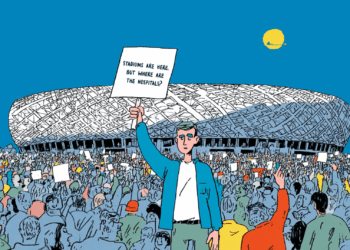
Extreme mass emotion is the norm in Morocco, whether positive or negative. One wonders if this is a remnant of the cultural legacy of its stint as a French protectorate. Earlier last year, violence erupted from young people in cities across the country as they criticised mass spending by the Government ahead of its hosting of the Africa Cup of Nations, as well as matches in the 2030 World Cup. Protestors argued that health and social services were not being prioritised, with funding diverted in favour of what are viewed as largely narcissistic displays of wealth through the building of sports stadiums and accommodation. Over 400 people were taken into police custody at the protests, while over 250 members of law enforcement services were injured.
Children sell packaged tissues while sitting on the ground outside boutique shops
The protestors certainly have a point. Inequality is rife within Morocco, as even the briefest of visitors to the country would be able to tell. While the vast majority of residents travel by foot or moped, those who can afford cars can generally be seen driving models from many years ago; even the taxis are inexpensive Dacia models. Despite this, it is not uncommon to see a Range Rover or Porsche weaving through the narrow streets. A sprawling complex named Golf City has been created on the outskirts of the city, mainly for tourists and the Moroccan ultra-wealthy; on the same road a barefoot man burns rubble for warmth on an abandoned building site. Children sell packaged tissues while sitting on the ground outside boutique shops.
The youth unemployment rate sits at over one in three. In a nation where over half the population are under 35, this presents a worrying problem for the Government, which argues, as all governments do, that the problems facing the country were inherited from previous governments.
While the concerns of the Moroccan youth may have been partially addressed — the Government’s draft budget for 2026 introduced an increase in funding for health and education of 16 per cent — it is unlikely that such measures will do much to alleviate the drastic social inequality that permeates Moroccan society.
Morocco lost the final of the Africa Cup of Nations on Sunday, and the public mood turned from jubilant to sour once again. From Belgium to the Netherlands, Moroccan immigrants took to the streets to riot, echoing the mood that once again took hold of the youth of their country. If Morocco was to spend so much money on football stadiums rather than schools, the very least they could do, it seemed, would be to win the competition.