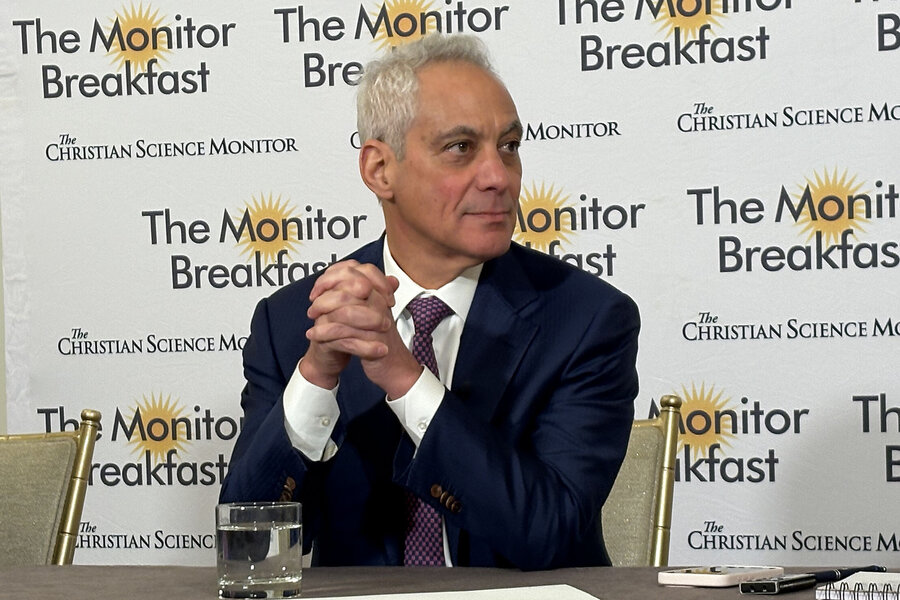
To Rahm Emanuel, a man who has had many roles in the Democratic Party – most recently, U.S. ambassador to Japan – the answer to winning the midterm elections sounds simple: “Restore access to the American dream.”
At a conversation with reporters on Wednesday hosted by The Christian Science Monitor, Mr. Emanuel didn’t dwell much on threats to democracy, the topic that drove much of Democratic messaging in 2024. Instead, he circled the rising cost of groceries, health care, and housing.
“The moment the American dream becomes unaffordable and inaccessible is the same moment American democracy becomes unstable,” Mr. Emanuel said.
Why We Wrote This
With an eye on his own possible presidential run, former Chicago Mayor Rahm Emanuel tells a Monitor Breakfast that fellow Democrats need to show voters a viable path for addressing economic issues including affordable health care, education, and housing.
“You want to stabilize democracy? Make sure that more Americans than just the few and select get access to it,” Mr. Emanuel says, adding that, today, he sees the rich getting richer and the middle class struggling – and the government making no attempts to rebalance.
As November’s midterms draw nearer, independents are the fastest-growing group of voters, making up a near-majority. The discomfort those voters feel is one of three emotions regarding President Donald Trump that Mr. Emanuel sees in the electorate. The others are anger, among Democrats, and a sense of betrayal, felt by Republicans, including former Rep. Marjorie Taylor Greene of Georgia.
President Trump promised to be “America first,” yet lately has been focused on expanding U.S. territory and securing a Nobel Peace Prize, says Mr. Emanuel. “What Democrats shouldn’t do is walk around saying, ‘I told you so.’”
Instead, Democrats need to show a path for change, he says, and admit what they got wrong during their time in power. Democrats need to also earn the support of the unaffiliated voters who make up some 45 percent of the electorate – something they can work to solidify between this year’s midterms and the 2028 presidential election.
“Yes, they have turned against Trump and the Republicans, but they haven’t turned towards you,” Mr. Emanuel says to his party.
The elections this fall will follow a pattern, he says. “There’s a law of physics when one party controls the microphone and the gavel,” Mr. Emanuel says, insisting the midterms will be a referendum election and that Democrats, as the party out of power, will likely see heavy turnout.
To win, Democrats should be wherever Mr. Trump isn’t, he says. “He can talk about Greenland; we’re going to talk about groceries. You want to talk about Venezuela? We want to talk about the families that are struggling in Virginia.”
Mr. Emanuel is no stranger to running for office. After serving as a senior adviser to President Bill Clinton, he was a member of Congress before returning to the White House as President Barack Obama’s chief of staff. Next, during eight years as mayor of Chicago, he pushed through education reforms – raising graduation rates, but also drawing ire from the teachers’ union. Under President Joe Biden, Mr. Emanuel served as ambassador to Japan.
Lately, Mr. Emanuel spends his time crisscrossing the country and making stops in small communities – recently in Mississippi and soon in Michigan. He speaks mainly about education and affordability as he appears to be exploring a 2028 presidential run.
At Wednesday’s event, part of the long-running Monitor Breakfast gatherings of newsmakers with reporters, he outlined a series of reforms he proposes for Washington, which he says needs to be “cleaned up.” Those include a crackdown on corruption in all branches of government, from receiving gifts to stock trading to family members’ profiting. And he called for mandatory retirement at 75 for people serving in the executive, judicial, and legislative branches, saying he would do so by enacting legislation.
Mr. Emanuel, who is 66, says he would not exempt himself from the age limit should he run for president and be elected. If so, he would be a one-term president. Currently, he says, Washington “looks like a bad version of the Politburo, how old everyone is.”
Globally, Mr. Emanuel says America’s influence is waning, weakened by the leadership of Mr. Trump, who he says “punches down and kisses up.” While he agrees with Mr. Trump that the United States has long neglected its own backyard in favor of Europe and the Indo-Pacific, he opposes the president’s aggressive foreign policy in Latin America and warns of the consequences of pushing Canada and U.S. allies in the Pacific toward China.
As the ambassador to Japan, Mr. Emanuel participated in a 2023 trilateral summit at Camp David between the U.S., South Korea, and Japan, something he says was “the worst day in China’s life.” Just recently, South Korea and Japan held a bilateral meeting without the U.S. “That was a good day for China,” says Mr. Emanuel.
Convincing Japan and the Philippines that they can feel secure about partnership with the U.S. is the first step to making sure America is a permanent power and presence in the Pacific, but that standing is “under attack” by the Trump administration, he says.
Still, “nothing about China today scares me. What we are not doing at home scares me,” says Mr. Emanuel. “We’re in a race for the future. We’re not going to do it [with] the worst reading and math skills ever.”
The solution? Education, which he describes as a pathway to achieving the American dream and making the nation competitive internationally.
“Education is core to the Democratic Party,” Mr. Emanuel says. “The party’s lost its edge. We’re known more for opening bathroom doors and closing school doors than anything else.” His quip was a nod to the party’s political difficulties on transgender policies and pandemic school closures.
All in all, Mr. Emanuel is optimistic for Democrats’ chances going forward. “I’d rather have our hand than their hand.”