Keir Starmer faced fury last night after spy chiefs warned of the risks posed by China‘s new mega-embassy in London.
The Prime Minister was accused of giving up national security in return for a better trading relationship with Beijing, after Labour granted planning permission for the alleged spy base just days before he is expected to fly out to meet president Xi Jinping.
In a sign of the espionage danger posed by what will be the biggest diplomatic mission in Europe, ministers admitted for the first time that action had been taken to ‘increase the resilience’ of nearby telecoms cables, which carry millions of pieces of sensitive data and sit just yards from the site at the old Royal Mint, near Tower Bridge.
And in a rare intervention, the heads of Britain’s domestic intelligence agencies publicly warned they cannot eliminate the risk attached to the embassy, while Parliament’s security committee said it had struggled to get answers about the controversial case.
Meanwhile, local residents are preparing a legal challenge to the long-awaited decision, which could see it tied up in the courts for years, and opponents of the Chinese Communist Party said they would live in fear of the building they believe could become their prison.
Last night Reform MP Robert Jenrick, a former Home Office minister, said: ‘Kow-tow Keir’s decision to approve the Chinese embassy is a spineless decision that will compromise our security for decades.

Keir Starmer faced backlash last night after spy chiefs warned of the risks posed by China’s new mega-embassy in London (Pictured: Concept plans for the embassy)
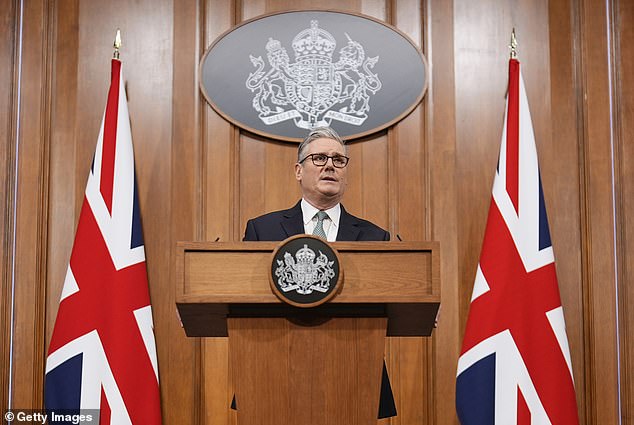
The Prime Minister (pictured on January 19) was accused of giving up national security in return for a better trading relationship with Beijing
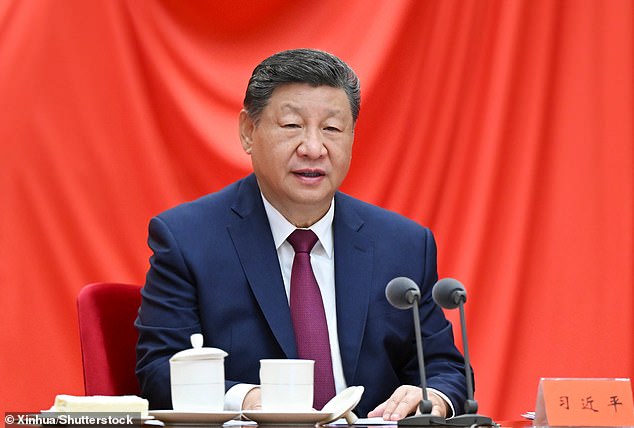
China’s President Xi at the 20th CPC Central Commission for Discipline Inspection earlier this month
‘For years the security agencies have warned about Beijing’s espionage, yet Starmer still gave the green light to a spy hub that sits over some of the most sensitive data cables in London. It’s a giant, metaphorical fortune cookie for president Xi and his band of fifth columnists.’
China announced plans for its new embassy in 2018 after buying the former Royal Mint building for £250million.
Its first application was rejected by Tower Hamlets Council but it resubmitted its plan in July 2024, just weeks after Labour won the election, and soon afterwards president Xi raised the matter in a phone call with Sir Keir.
Just months later, Sir Keir told the president that his new Government would make the final decision after taking control of the planning process. He told him at the G20 summit: ‘You raised the Chinese embassy building in London when we spoke on the telephone. And we have since taken action by calling in that application.’
Since then ministers have been urged to reject the application, by Labour MPs as well as international allies including the White House, campaigners and dissidents including Hong Kongers who have fled Chinese oppression.
In recent weeks there has been particular alarm over the prospect of a hidden chamber, revealed in previously secret blueprints, that will be built alongside fibre-optic cables that transmit sensitive financial data to businesses in the City of London.
But yesterday Housing Secretary Steve Reed approved the application in what was described as a ‘quasi-judicial’ decision.
Join the debate
Do YOU trust the Government’s judgment on national security after MI5 raised concerns?
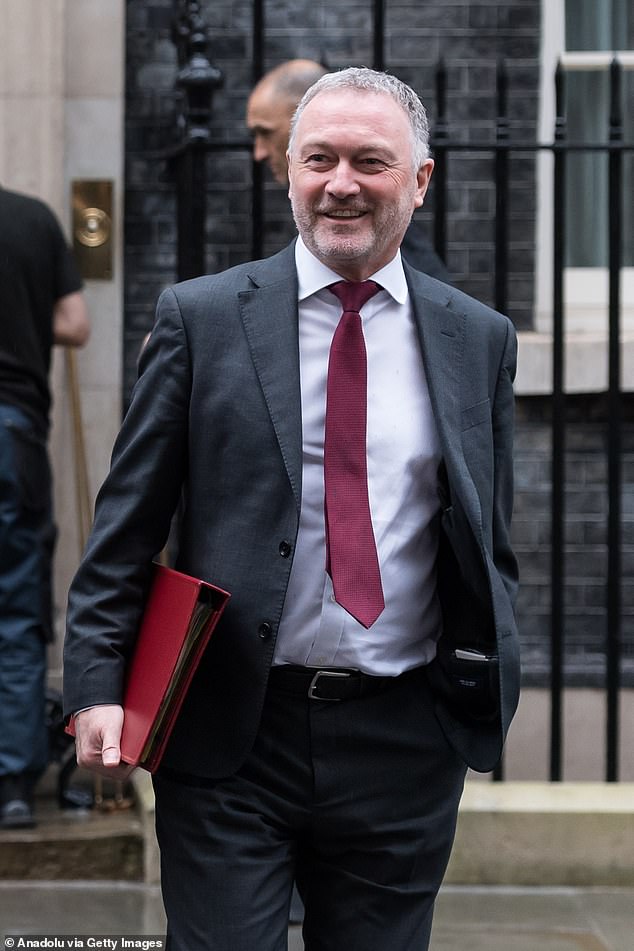
Housing Secretary Steve Reed (Pictured on January 12, 2026) approved the application in what was described as a ‘quasi-judicial’ decision
A government spokesman insisted: ‘National security is our first duty. Intelligence agencies have been involved throughout the process and an extensive range of measures have been developed to manage any risks.’
The Government also published a letter to the Home Secretary and Foreign Secretary written by MI5 director general Sir Ken McCallum and GCHQ director Anne Keast-Butler.
They admitted: ‘For the Royal Mint Court site, as with any foreign embassy on UK soil, it is not realistic to expect to be able wholly to eliminate each and every potential risk.’
But they added that MI5 had ‘over 100 years of experience managing national security risks associated with foreign diplomatic premises in London’, and that ‘the package of mitigations deals acceptably with a wide range of sensitive national security issues, including cabling’.
In addition, they claimed there were ‘clear security advantages’ in China consolidating into one building the ‘seven different diplomatically accredited sites’ it currently operates across the capital.
Parliament’s intelligence and security committee, which considered evidence from senior Whitehall officials as well as spy chiefs, also raised concerns about the planning process.
Its chairman, Labour peer and former minister Lord Beamish, said: ‘It has proved more difficult than it should have been to get straightforward answers to our basic questions.’
He went on: ‘We were surprised both at the lack of clarity as to the role that national security considerations play in planning decisions, and that advice was prepared without some of the key facts at hand.’
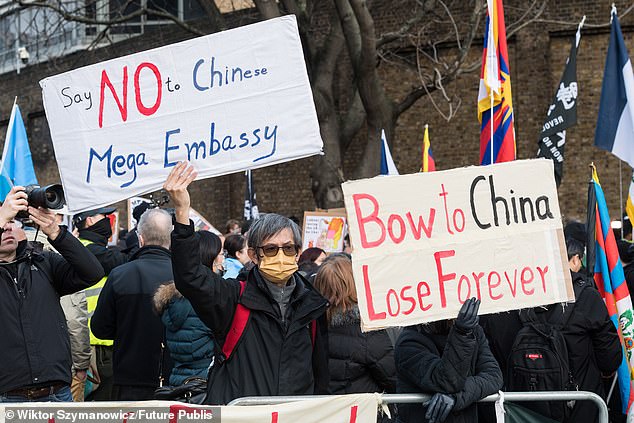
Pictured: Protesters, including Tibetans, Uyghurs and Hongkongers, outside the Royal Mint Court last week, demonstrating against plans for the mega Chinese embassy
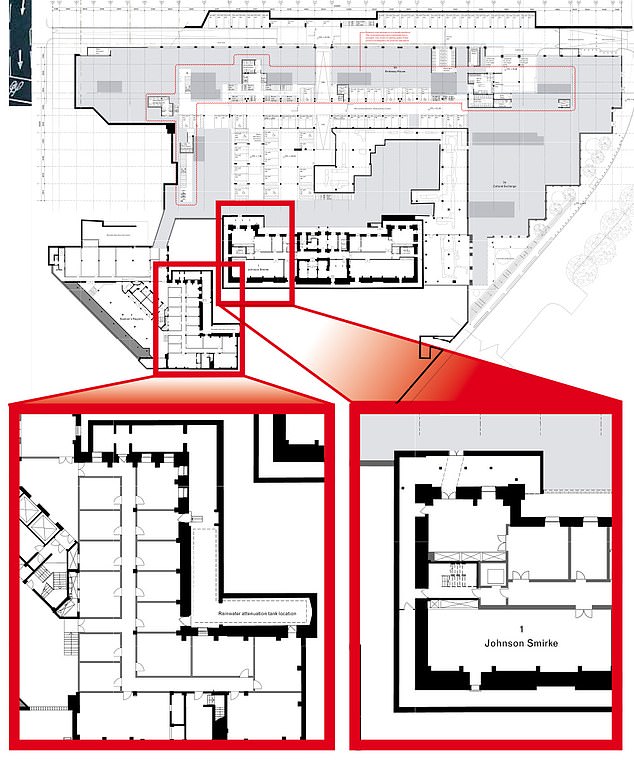
The Mail on Sunday revealed that planning documents for the embassy included ‘spy dungeons’ (highlighted in red above) – two suites of basement rooms and a tunnel, with their purpose redacted for security reasons
In the Commons, security minister Dan Jarvis revealed that ‘an extensive range of measures have been developed to protect national security’.
He told MPs: ‘We have acted to increase the resilience of cables in the area through an extensive series of measures to protect sensitive data.
‘And I can confirm that, contrary to reporting, the Government had seen the unredacted plans for the embassy and the Government have agreed with China that the publicly accessible forecourt on the embassy grounds will not have diplomatic immunity, managing the risk to the public.’
Mr Jarvis acknowledged that China posed threats to UK security, ranging from cyber-attacks and espionage as well as transnational repression, but the minister insisted: ‘It is only through engagement that we can directly challenge China on its malicious activity.’
Shadow Home Secretary Chris Philp said: ‘From its timing and from president Xi’s clear demands, this planning consent appears to be linked to the Prime Minister’s imminent visit and to the economic deal.
‘It seems clear to me that the Government are trading national security for economic links, and that this is a shameless capitulation to China’s demands.’
Fellow Tory MP Mark Francois agreed, saying: ‘Let’s call this what it is: this is appeasement of communist China for economic gain.’
Leading China critic Sir Iain Duncan Smith questioned the Government’s claim that ‘lawful embassy use’ would not lead to interference with the cables, adding: ‘Nothing about the Chinese is lawful here in the United Kingdom.’
And Labour’s Alex Sobel warned: ‘It will send a chilling effect through Tibetans, through Hong Kongers, through Uyghurs and other Chinese who just dissent with the regime in Beijing.’
Christopher Mung, who fled to Britain from Hong Kong, told a press conference in Westminster: ‘This decision has struck fear into our hearts and make many regret taking up the UK’s promise of our safety.’
Opponents of the scheme are already raising funds to launch a judicial review, which could lead to the disclosure of private discussions between the Government and the Chinese.
Luke de Pulford, of the Inter-Parliamentary Alliance on China, said: ‘If it emerges that the UK Government gave assurances to the Chinese that they would get their embassy, then those assurances would have been unlawful.’