The Conservative leader fundamentally misunderstands the problems with the social order
Between Keir Starmer’s mock-heroic posturing over “censoring” Grok — talked about in faintly anthropomorphic terms, as though it were a badly behaved individual — and Kemi Badenoch sacking Robert Jenrick, either as an act of decisive leadership or a discourteous disposal of someone who had at least tried to steady HMS Conservative (depending on your loyalties), it was a noisy week. Jenrick may have been pushed, may have jumped, or may simply have been flirting too openly with Reform — it’s hard to tell. Lost amid all this turbulence, however, was a quieter announcement: the Conservatives’ proposal to ban under-16s from social media.
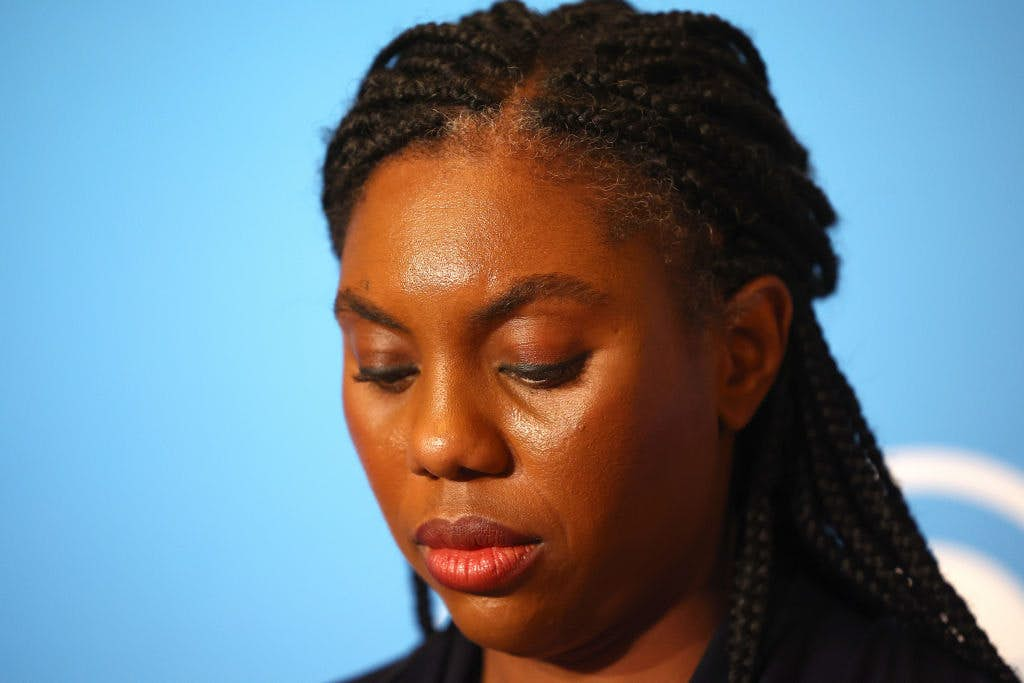
It is, in a way, a shame, because the episode ends up revealing far more about Kemi Badenoch than about Robert Jenrick himself. Officially, the Conservative Party is now talking a harder right-wing game than it has for years: half-committed to a serious review of the ILR system and officially committed to withdrawal from the ECHR. That alone marks a shift when set against the Sunak government, which would not even countenance legislation to override the Human Rights Act, let alone leaving the Convention altogether. And yet almost no one inside the party appears to believe this Damascene conversion is sincere. The sight of familiar wets openly whooping and cheering as Jenrick was expelled rather gives the game away.
Badenoch’s background is genuinely interesting, not least because it is so often misunderstood. Although she was born in the UK in 1980, a birth that conferred British citizenship under the rules then in force, she did not settle permanently in Britain until the mid-2000s. This helps explain the political instincts she brings with her: a striver’s belief in the British state as something to be joined, navigated, and ultimately mastered.
She appears more comfortable casting herself as leader of the Conservatives than as a prime minister-in-waiting with a fully articulated governing programme. In that sense, leadership is not so much a means to an end but as the end itself.
Regardless of any structural advantages her background may have afforded her, standing for the Conservative Party and performing at the despatch box week after week requires genuine political competence, and her PMQs performances, in particular, have visibly improved. While she is clearly ambitious — no one stumbles into a party leadership — what seems to motivate her is nonetheless broadly sincere rather than merely performative. Whatever one thinks about her politics, Kemi Badenoch’s ideology is far more closely aligned with the instincts of the modern Conservative Party than many of her critics admit.
She is a capital-C Conservative, deeply invested in the party’s myths and self-conception — particularly a striverist idea of the British dream, in which an individual can arrive from abroad, internalise the country’s norms, and rise by force of effort rather than grievance. Even at the height of the “woke” moment, she did not default to a racial grievance narrative, nor was she swept up in calls for reparations or in the more hysterical denunciations of Britain’s imperial past, its figures, or its statues. She famously has said Britain is the best country in the world to be black. Unlike some non-white conservatives this is something she genuinely believes and I don’t doubt her.
Given that she has been in the job for less than eighteen months, it is probably too early for anyone to speak with much confidence about Badenochism as a settled doctrine. What can be identified, however, are certain instincts — and her support for banning under-16s from social media fits neatly into a pre-existing Conservative worldview rather than standing as an ad-hoc intervention. That worldview might best be described as Birbalsinghism, after Katharine Birbalsingh, frequently billed as Britain’s strictest headmistress.
Birbalsingh’s educational philosophy — colour-blind, disciplinarian, unapologetically focused on hard work, silence, and personal responsibility — was one of the more successful attempts by Conservatives, particularly under Michael Gove’s education reforms of the 2010s, to articulate a form of colour-blind conservative society. The appeal was deliberate and double-edged: on the one hand, it tapped into small-c conservative instincts among many ethnic-minority parents who value order, discipline, and particularly academic attainment; on the other, it gestured towards a Thatcherite meritocratic ideal in which outcomes are earned rather than explained away.
At Michaela School, the rules are famously strict. Children are placed in detention for forgetting equipment, corridors are silent, and behavioural expectations are enforced without apology. As a triangulation exercise within the media and political ecology of the 2010s, this was remarkably effective. The disciplinarian ethos appealed to older, socially conservative voters nostalgic for grammar schools and inclined towards the “the cane never did me any harm” school of thought, while remaining conspicuously open to pupils of all backgrounds.
Unsurprisingly, Birbalsingh has been bitterly opposed by left-leaning teaching unions and education activists, and has become something of a cause célèbre on the right. To her credit, she has also been unusually forthright in challenging what she regards as the excesses of the modern “race industry”, including resisting demands for cultural or religious exemptions, for example, from Muslim parents seeking distinctive dress codes. The point was not provocation for its own sake, but the assertion of a single, uniform standard applied to everyone.
The deeper problem with this worldview is that it is a Cameronite parlour trick dressed up as something more cogent. The school held up as its proof of concept is brutally self-selecting, drawing in the most compliant families and the most academically able children, and then triumphantly pointing to outcomes that were largely preordained (and of course not scalable).
It is colour-blind in the bureaucratic sense, but also strangely colourless: a laboratory environment in which culture is stripped down to a thin gruel of rules, routines, and hymns. Everyone is invited to pretend that reading Shakespeare produces the same shiver of recognition in everyone, as if a refugee from Sudan is supposed to feel his hair on his neck upon hearing Henry V’s St Crispin’s Day speech.
This carries with it a revealing utopianism. It assumes a blank-slate sociology in which anyone, from anywhere, can be dropped into the same behavioural mould and emerge not merely well-disciplined but genuinely attached, as if belonging were an administrative outcome rather than a historically and culturally accumulated one. The harder questions of ethnicity, nation, and inheritance lie beyond the scope of this piece, but it is difficult not to see the project as a form of failed socially conservative multiculturalism: strict, rule-bound, loudly “anti-woke”, and yet oddly deracinated.
The proposed ban on under-16s using social media is the logical extension of this confusion — Disciplinearianism in service of utopian outcome. But social media is not an optional vice for young people; it is the default communications layer. To propose banning it is not to regulate a platform but to amputate an infrastructure. It is the digital equivalent of announcing a ban on the telephone, email, or group chats — a policy that sounds firm only if you have no idea how social life now actually functions.
Once a technology becomes infrastructure, prohibition is not just heavy-handed but downright incoherent. You are not removing harmful content or setting boundaries around behaviour but severing the channels through which people talk, organise, socialise, and belong. This is conceptual illiteracy in the guise of moral seriousness.
It mistakes discipline for legitimacy, rules for belonging, and prohibition for authority
An idea like this could only have been dreamt up by people whose political instincts were formed before the internet ceased to be a novelty and became the nervous system of everyday life. It is the politics of the landline applied to the smartphone age: reassuringly authoritarian, rhetorically muscular, and completely detached from reality.
What the social media ban exposes, then, is a fatal category error at the heart of Badenoch’s Conservatism. It mistakes discipline for legitimacy, rules for belonging, and prohibition for authority. The Birbalsingh model works only inside tightly bounded, self-selecting institutions that can opt out of the wider world, but politics cannot. You cannot run a nation as a headmistress runs a school, nor conjure social cohesion by removing the communications layer through which it now forms. Conservatism, at its best, is meant to be a theory of reality — of limits, habits, inheritance, and what cannot simply be redesigned by fiat. A party that once understood this now is confusing firmness with seriousness and nostalgia with insight. Banning under-16s from social media is less of a defence of the social order than an admission that the order has changed, and that its would-be stewards no longer quite understand how.