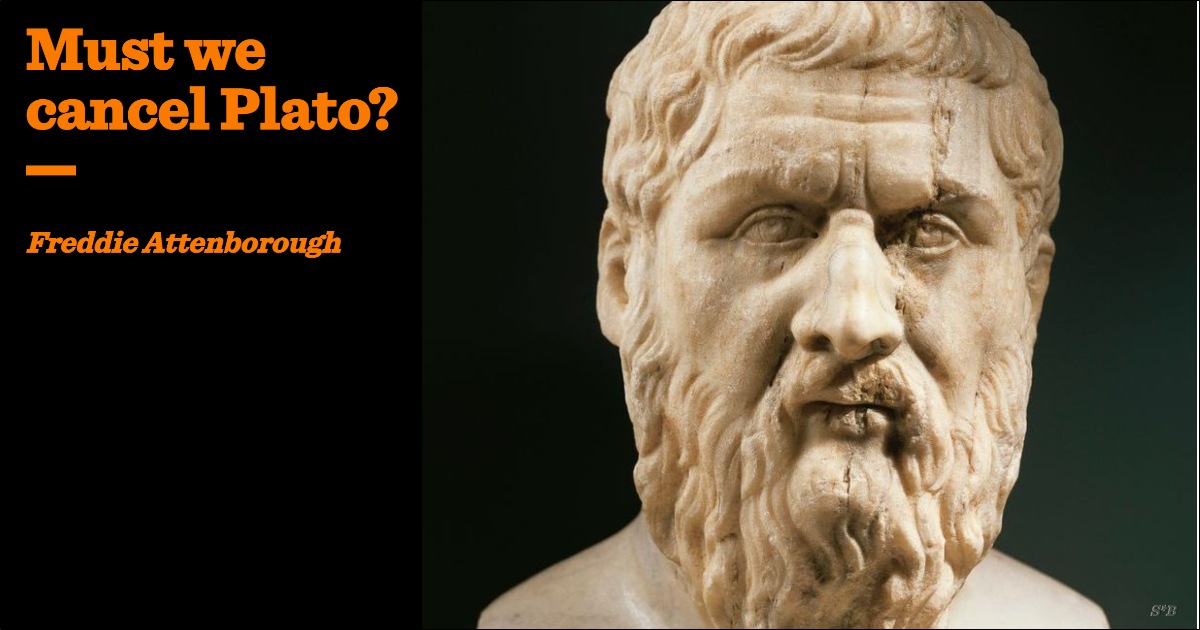
Plato has been excised from a syllabus at a US public university after a lecturer was warned he could lose his course. Why? Because the 2,400-year-old Greek philosopher’s musings on same-sex love and androgyny were deemed “inconsistent with the approved syllabus” under a new Trump-style policy requiring sign-off from the university president for any course said to “advocate” gender ideology.
Days before the Spring semester began at Texas A&M, Martin Peterson, a philosophy lecturer, found his syllabus for Contemporary Moral Issues coming under scrutiny. “Philosophy challenges students to understand, articulate, and evaluate arguments from multiple points of view,” reads the course description. Students, it adds, will examine how ideas and values shape experience and institutions, while practising “respectful and thoughtful engagement on contentious matters”.
So far, so pluralist. And yet, in an email sent on 6 January, Peterson’s department head, Professor Kristi Sweet, delivered an ultimatum: drop the modules on race and gender ideology, including the Plato readings, or be reassigned to a different course.
Sweet’s rationale? A new rule, unanimously approved by the university system’s Board of Regents in November 2025, which echoes the conceptual frame of President Trump’s Executive Order, “Defending Women from Gender Ideology Extremism and Restoring Biological Truth to the Federal Government”. Under it, no academic course “will advocate race or gender ideology, sexual orientation, or gender identity unless the course is approved by the [campus president]”. A parallel revision to the university’s “Academic Freedom, Responsibility and Tenure” policy now states that while “each faculty member is entitled to full freedom in the classroom”, they will not “teach material that is inconsistent with the approved syllabus for the course”.
It might be argued, of course, that it takes a peculiarly masochistic mind to come away from the collected works of Plato thinking “proto-Judith Butler”, but apparently at Texas A&M they now regard the poor chap as a sort of gateway drug to cross-sex hormones and gender reassignment surgery.
In The Myth of the Androgyne, a passage from the Symposium Peterson was told to drop, Plato, via the comic playwright Aristophanes, sketches a mythical origin of three human sexes: male, female, and androgynous, suggesting a time when human nature was not strictly binary. “In the first place,” Aristophanes lectures Eryximachus, “There were three kinds of human being and not two as nowadays, male and female. No, there was also a third kind, a combination of both genders, but that has disappeared and only its name remains.”
Quite how Sweet, or anyone on the Board of Regents for that matter, could possibly know that Peterson was about to “advocate” a particular ideology on the basis of this material remains unclear. Whatever it was, it must have been peculiarly compelling, since, reading carefully between the lines, one can’t help feeling there’s a concession — guarded, of course, and heavily veiled — that this form of activity wasn’t top of mind for Peterson in his reply to Sweet: “Please note that my course does not ‘advocate’ any ideology,” he wrote. “I teach students how to structure and evaluate arguments commonly raised in discussions of contemporary moral issues.”
Peterson protested that the decision “to bar a philosophy professor from teaching Plato is unprecedented” and then, unusually for a philosopher, summed up the whole affair in a single additional sentence: “You are making Texas A&M famous – but not for the right reasons.” Nonetheless, facing the clear threat that his class would be taken away, he complied, stripping out the Plato unit and some material on race issues.
Was President Trump’s Executive Order the main culprit? Signed on 20 January 2025, it undoubtedly set the tone. Among other things, the Order declares a federal policy of recognising only two sexes, male and female, and directs federal agencies to purge “gender ideology” from guidance, forms and, crucially, funding priorities.
Texas politics had been moving in the same direction for some time. Senate Bill 17 (2023) curbed EDI programmes at public universities (although did explicitly carve out space for academic instruction and research), while Senate Bill 37 (2025) subsequently strengthened regents’ oversight of curriculum and degree programmes.
What supplied the trigger was the conservative backlash that followed a summer-semester classroom incident at Texas A&M. During a children’s literature course, an undergraduate secretly recorded Professor Melissa McCoul as she discussed a novel featuring a 12-year-old nonbinary protagonist and displayed a “gender unicorn” graphic used to distinguish gender identity, expression and sexuality. In the clip, the student accused McCoul of violating Trump’s Executive Order. McCoul was fired soon afterwards, and the university later refused to reinstate her, even after a faculty appeals panel unanimously concluded the dismissal was not justified.
And so it came to pass that a conservative-driven policy … ended up decolonising the academy of a white, male, foundational Western-canon author
Happily ignoring the fact that an executive order binds the federal government, not the reading list for a university seminar, Republican figures promoted the covert recording online, with Governor Greg Abbott weighing in publicly to suggest the teaching was “contrary to Texas law”. This pressure helped foment the climate in which Texas A&M adopted a rule defining “gender ideology” in terms that strongly echo the executive order’s conceptual frame, then triggered the syllabus reviews that swept up Peterson’s class.
And so it came to pass that a conservative-driven policy, ostensibly aimed at eliminating EDI-influenced identity politics from campus life, ended up decolonising the academy of a white, male, foundational Western-canon author.
None of this is to deny that indoctrination happens, that some activist lecturers treat the classroom as a political catechism, and that maybe, just maybe, some of the courses now under review had aims in mind other than critical and reflexive discussion. In that light, it’s easy to see the appeal of a rule that purports to separate teaching from advocacy. After years of drift away from open discussion, years of appeasing the most radical factions, years of encouraging divisive identity politics that treats dissent as evidence of heresy, it would be surprising if a quick fix didn’t seem tempting.
The trouble is that words take their meaning from use, and use is irreducibly contextual. Sure, “advocacy” can encompass activism, cheerleading, propaganda and various other vernacular descriptive categories. But it can just as easily be stretched to encompass analysis, provocation, or devil’s advocacy. In practice, everything depends on the ideological filters and institutional incentives in play, and on the political milieu that supplies the criteria. You don’t have to be Ludwig Wittgenstein to grasp these points – very literally so, in fact, since diehard Republicans have long since accepted the same argument when it comes to elastic categories like “hate speech”, “disinformation” and “misinformation” as applied to conservative views under the Biden administration.
The solution is not to reimagine the lecture hall as a Foucauldian Panopticon, but to get the academic ethos right before anyone enters it: lecturers willing to promote debate, disagreement and intellectual conflict, and students willing to read, study and gain the confidence to push back — not with covert recording but intellectual perspicacity. In a culture of that kind, the problem to be policed has already dissolved: anything that looks or feels like “advocacy” simply doesn’t survive contact with its interlocutors.
Instead, Texas A&M has produced straight-up coercive interference with academic curricula: coercive, because academics like Peterson have no real choice if they want to keep teaching their courses; and interference, because the order is imposed by regents and political appointees from outside the faculty’s collective academic judgement.
Indeed, as one venerable sage once put it, in words that, though uttered in a different context, could scarcely be improved on here: “to many of us on the other side of the Atlantic, it looks more and more like old, entrenched interests hiding behind ugly Soviet era words… who simply don’t like the idea that somebody with an alternative viewpoint might express a different opinion”.
Not Plato, no — but US Vice-President JD Vance in 2025, castigating European leaders for the erosion of free speech within their societies.