- Have you seen the northern lights tonight? Email in pictures to jake.holden@dailymail.co.uk and tell us where you are
Brits were mesmerised by another round of Northern Lights sightings for a second night in a row, but cloudy weather spoiled the beautiful sight for millions.
The night sky was illuminated on Monday from the Scottish Highlands all the way to Penzance in Cornwall after a G5 geomagnetic storm hit Earth – the highest level.
On Tuesday, the Met Office predicted a G3 storm, meaning it was likely that yet more aurora borealis would be visible from the UK.
However, cloud maps show that much of the country will be blanketed with clouds, ruining the view of the ethereal dancing illuminations.
There were holes in the cloud cover above parts of Cornwall, Devon, and northern Scotland as well as Northern Ireland – all places that were able to see the lights on Monday night.
There have been sightings reported on Northern Lights detection app Aurora around Edinburgh and Glasgow, as well as in Lincolnshire, around Birmingham and even in London despite the clouds.
Continental stargazers seem to have had more luck, with many sightings reported across the Netherlands, Belgium and Germany.
At the G3 storm level, there may be problems of surface charging on satellites, disrupting services like sat navs and low-frequency radio on the ground.
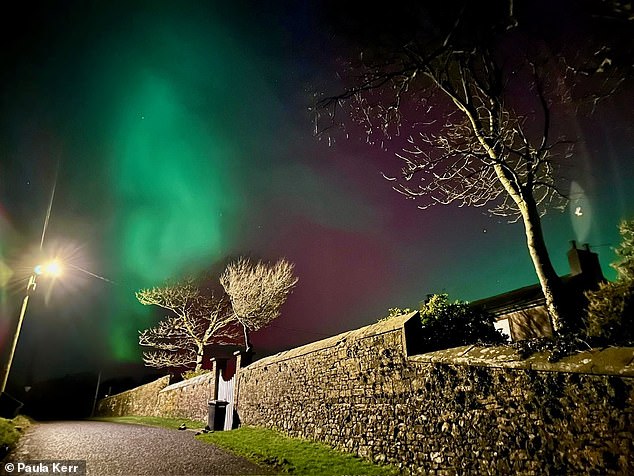
Incredible colours seen in Moresby, Whitehaven, Cumbria on Monday
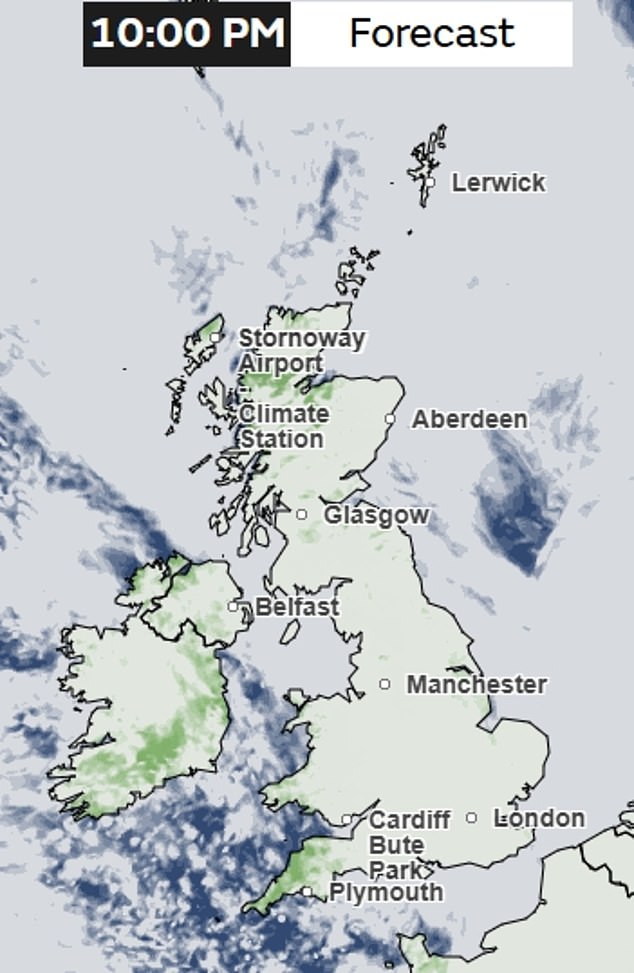
The Met Office cloud cover forecast was not looking great for stargazers in most of the UK on Tuesday
The best place to see the aurora was in Scotland and Northern Ireland but it can also be visible from the Midlands and mid Wales. Forecaster AuroraWatchUK said that it was likely the lights would be visible across the UK.
In some cases, the lights are not visible to the naked eye and stargazers have to watch the show using long exposure photographs, a feature that is on many smartphone cameras.
The Met Office has said geomagnetic activity is due to ‘return to background levels’ after Tuesday night, so it was the last chance to see the spectacular show for a while.
Auroras are caused by solar flares – coronal mass ejections (CME) – from the sun which slam into the Earth but are deflected by the planet’s magnetic field.
These deflections are made visible in lights that we call aurora.
The storm was the remainder of Monday night’s geomagnetic disturbance and was caused by a large CME that fired out from the sun on Sunday, only reaching us a day later on Monday.
Despite it being a leftover part of the storm, it was still classified as a strong disturbance.
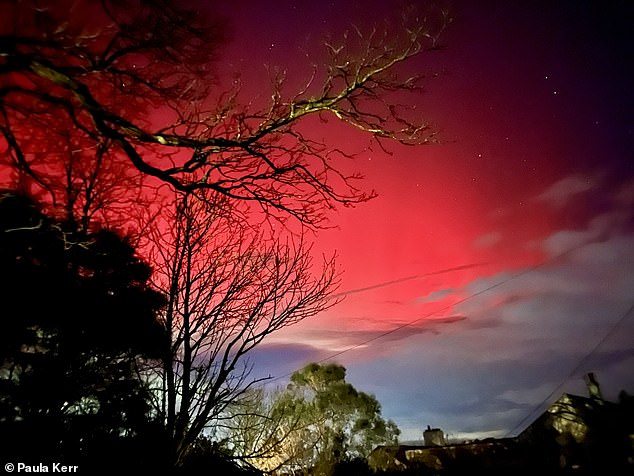
Moresby, Whitehaven, Cumbria skies turned bright red on Monday night
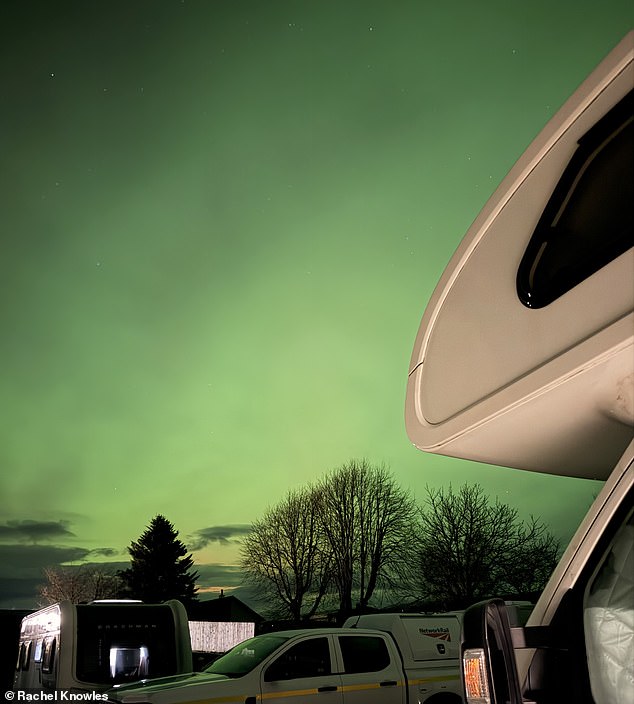
Fort William, Scotland, was lit up green on Monday
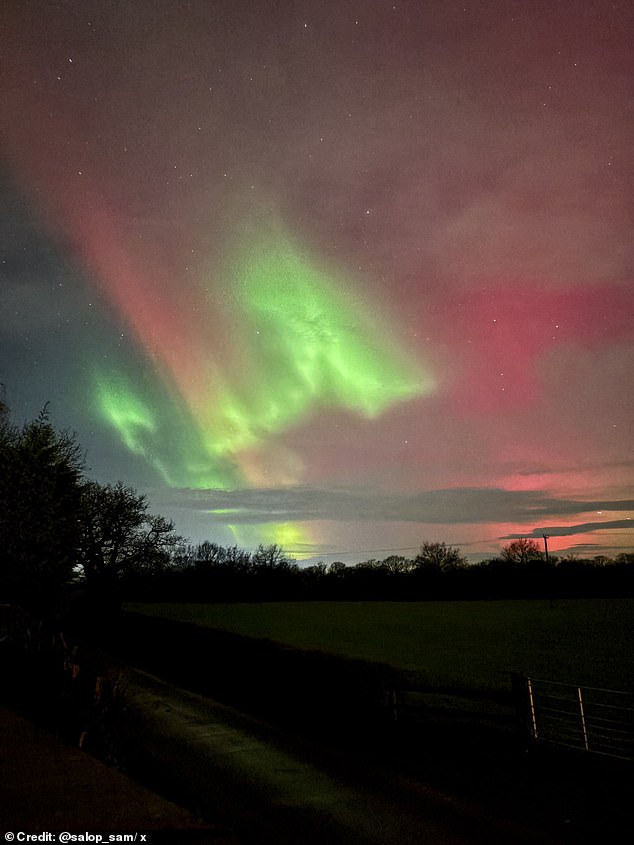
Shropshire was also hit with a stunning light show on Monday
AuroraWatchUK said that on Tuesday, there were large peaks of 634.6nT (nanoteslas) in electromagnetism on Earth.
Tuesday’s storm had a Kp index of seven out of nine, a very high level. Kp index is derived from the German Planetarische Kennziffer, meaning Planetary Index and is used to measure geomagnetic storms.