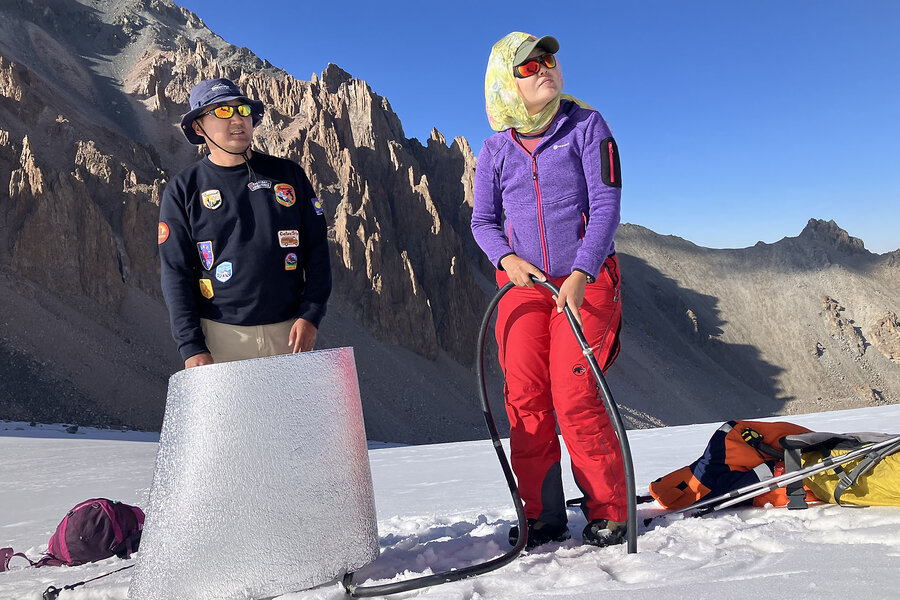
You can hear and feel the Adygene Glacier melting under the cloudless August sky.
Every step through the inch-and-a-half layer of snow reveals trickles running over the ice’s surface. Turquoise water roars as it plunges through deep, jagged channels down the slope.
Bakyt Ermenbaev crouches down and holds a measuring tape to the small PVC pipe sticking up from Adygene’s ice.
Why We Wrote This
Five Central Asian nations all rely on water from regional glaciers, but in conflicting ways. With climate change threatening their shared resource, they appear set to move past bickering and instead share a negotiated usage.
“Thirty-six centimeters,” Mr. Ermenbaev reads out as his colleague Gulbara Omorova notes it down. The pair of glaciologists affiliated with the Kyrgyz Institute of Water Problems and Hydropower had drilled the pipe about 15 feet into the glacier at the beginning of the month, and, in just 20 days, those 36 centimeters – or 14 inches – have melted.
It means the surface of the glacier has dropped 13 1/2 feet since last year, Ms. Omorova calculates. Which is fast. If the Adygene glacier were healthy, you would expect about 3 to 6 feet of melt each year, she says.
Fifty years since the Soviets diverted the water of Central Asia’s great rivers to water cotton fields and doomed the Aral Sea, Central Asian states face a new and perhaps greater ecological threat. As climate change warms the region at double the global rate, the mountains’ snow and glaciers’ ice that feed those rivers are disappearing.
For two decades, management of the region’s mighty rivers, 30,000 miles of canals, and 80 major reservoirs, which zig-zag across Central Asia’s scramble of borders, was a source of tension and distrust. Yet in the last few years, Central Asian leaders have turned the page on two decades of bickering over their shared water resources as the climate threat looms.
The region’s five states have signed historic border treaties, agreed to the joint control of major water projects, and brought a more level-headed approach to negotiations over who gets water, how much, and when.
“This is now the turning point to something much better,” says Volker Frobarth, ambassador to Kyrgyzstan for the Organization for Security and Cooperation in Europe. “There’s one thing clear: They have understood that they need to cooperate.”
A contested resource
The reason why water cooperation is so difficult in Central Asia comes down to geography.
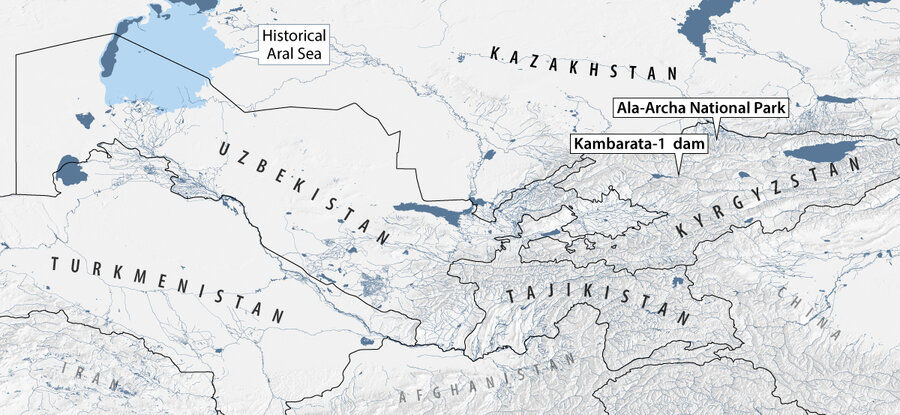
Rain, snowmelt, and glaciers in mountainous Kyrgyzstan and Tajikistan contribute about 75% of all the water in the Aral Sea basin, which covers much of Central Asia. But, about 90% of that water from upstream is used in the arid, downstream countries of Uzbekistan, Turkmenistan, and Kazakhstan, according to the Interstate Commission for Water Coordination, a regional international body.

Much of that water used to flow to the Aral Sea, once the world’s third-largest lake, through a pair of river systems. But the Soviets constructed massive dams and reservoirs in the upstream countries to control the rivers, and built a sprawling canal system in downstream states to expand cotton cultivation. The Aral Sea dried up over the course of several decades as a result.
After a period following the Soviet Union’s collapse that saw water treaties signed and regional organizations created, a divergence “took center stage,” says Filippo Menga, a geographer at the University of Bergamo in Italy who studies Central Asian water politics.
Downstream countries want the upstream countries to release water from their mountain reservoirs in the summer growing season, but upstream countries want to release it in the winter, when demand for hydroelectricity is highest, Dr. Menga says.
“Quickly, it became evident that there would be a recurring problem each winter and each summer,” he adds.
The Soviets had solved this problem by compelling oil- and gas-rich Uzbekistan, Turkmenistan, and Kazakhstan to ship Tajikistan and Kyrgyzstan free energy in the winter.
That deal fell apart in the early 2000s when Uzbek dictator Islam Karimov began cutting the discounted winter energy supply.
The domino effect was almost immediate. As energy crises hit, Kyrgyzstan and Tajikistan began releasing more water in winter and resurrected Soviet plans for massive new dams.
Uzbekistan, Kazakhstan, and Turkmenistan constructed largely ineffective downstream reservoirs to save parched fields. Mr. Karimov ratcheted up his rhetoric against his neighbors and occasionally closed borders and deployed troops, fearful the planned upstream reservoirs would hold water hostage.
“When you have these water-energy autarky policies, in principle, nobody benefits from that,” Ambassador Frobarth says. “They have shortages on all the sides.”
Water coordination
Change began in 2016 when a new president, Shavkat Mirziyoyev, came to power in Uzbekistan, and he immediately took a more constructive tone on water, starting to work with Kyrgyzstan and Tajikistan on their hydropower projects rather than oppose them.
A breakthrough came in the summer of 2024, Ambassador Frobarth says.
Upstream Kyrgyzstan and downstream Uzbekistan and Kazakhstan agreed to equally share financing and planning of the massive Kambarata-1 hydroelectric project, even though it was located entirely in Kyrgyzstan.

Since then, border agreements between Uzbekistan, Kyrgyzstan, and Tajikistan have settled long-standing disputes over water, and the five countries’ leaders now regularly meet with water at the top of the agenda.
But 2025 proved to be a test of the new spirit of collaboration.
Last year was the driest in decades as there was little rain for eight months, says Dinara Ziganshina, director of the Interstate Commission for Water Coordination’s scientific information service.
In tough negotiations this past summer, Uzbekistan agreed to release more water to save the harvest downstream in Kazakhstan, she says. In winter, with little water left in mountain reservoirs, Kazakhstan promised additional electricity exports to Kyrgyzstan to keep the lights on.
“Thanks to cooperation, the countries were able to get through this year,” Ms. Ziganshina says. “The challenges will come in the future.”
Staving off catastrophe
And 2025 demonstrates what that future could look like.
Research shows that a warming climate will significantly reduce water supply in some parts of Central Asia by 2050 while increasing the volatility of precipitation across the region, meaning more drought years and flood years.
Before, Central Asia could count on a steady supply of water from its glaciers in the summer to keep the fields green and reservoirs full. But as that warm day on the Adygene Glacier showed, they’re disappearing.
Back down at the scientists’ little mountain hut, Mr. Ermenbaev, the glaciologist, explains the risks.
If Adygene’s core melts in the next decade, he says, “to put it mildly, it’ll be a water deficit. But to put it bluntly, it’ll be a catastrophe.”
The region’s governments will have to use their reservoirs to regulate the volatility, as the glaciers once did, and that will require more trust and difficult choices.
“There are some things that have developed very well, and things that I would not have thought possible even five years ago or 10 years ago,” says Jenniver Sehring, a political scientist at the IHE Delft Institute of Water Education in the Netherlands, who has studied Central Asian water cooperation for a quarter-century.
But some of the biggest challenges remain unresolved, including strengthening water treaties and regional organizations and significantly reducing water waste in irrigation that can run around 40%, she says.
The focus on infrastructure megaprojects raises serious environmental concerns too, Dr. Sehring adds.
Ms. Ziganshina, from the interstate commission, says much work remains for the region’s governments.
“They’re ready to be ready. They’re taking actions to reduce risks,” she says. “And they’re not denying that, yes, climate change will significantly influence everything that happens in the region.”