
In 2018, at the height of #MeToo, Lili Loofbourow’s article “The Female Price of Male Pleasure” went viral. In it, Loofbourow argued that definitions of bad sex varied depending on whether the complainant was male or female, with men often meaning “a passive partner or a boring experience” whereas women could mean “coercion, or emotional discomfort, or even more commonly, physical pain”.
This, Loofbourow suggested, reflected broader assumptions about male and female roles:
The old implied social bargain between women and men […] is that one side will endure a great deal of discomfort and pain for the other’s pleasure and delight. And we’ve all agreed to act like that’s normal, and just how the world works.
The article was written in response to a piece by Andrew Sullivan, in which the latter had claimed #MeToo had gone too far in denying “natural differences between men and women”. It came at a time when feminists were already under attack for decrying as “toxic” behaviour which might not meet the threshold of sexual assault but which made women uncomfortable nonetheless.
Did this discomfort merit attention, or were expressions thereof an example of “overreach”? “Countless women”, Sullivan surmised, were perfectly fine with “the core aggression of the human male”. Yet as Loofbourow pointed out, how could Sullivan be so sure of this? “Women,” she wrote, “have spent decades politely ignoring their own discomfort and pain to give men maximal pleasure”. Some were raising their voices now, only to be told they were “hypersensitive and overreacting”.
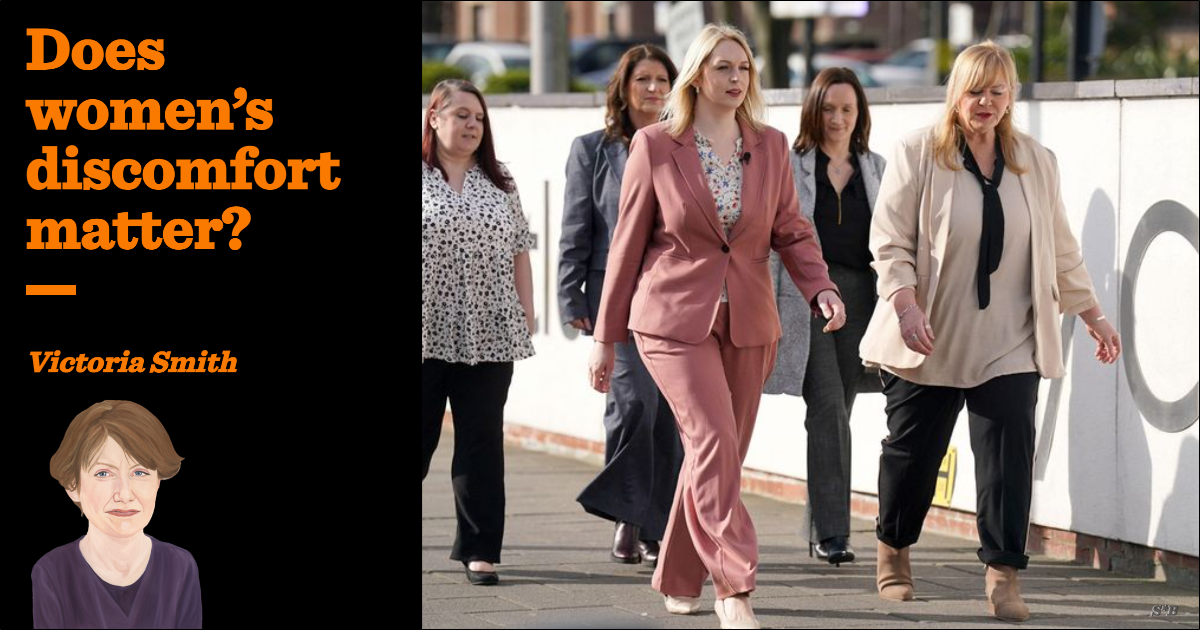
I thought of Loofbourow’s articles this week, following the employment tribunal victory of eight female nurses who complained about having to share changing facilities with a male colleague at Darlington Memorial hospital. Like nurse Sandie Peggie, who is appealing a similar case against NHS Fife, the nurses were made uncomfortable by being expected to strip in front of a man who claimed to be a woman. In both of these cases, the employer, not to mention the men involved, were perfectly aware of this discomfort. The question was, did it really matter? As far as the hospital HR departments were concerned, no, it didn’t. Female discomfort was trivial in the face of male desire.
I imagine most of those defending allowing male doctors into female-only changing rooms do not see themselves as being anti-#MeToo. On the contrary, some claim to be feminists, and many might have shared Loofbourow’s article, objecting to Sullivan’s gender essentialism. Yet to me the NHS Fife and Darlington cases offer perfect examples of the dynamic Loofbourow identifies: “At every turn, women are taught that how someone reacts to them does more to establish their goodness and worth than anything they themselves might feel.” Sandie Peggie and the Darlington nurses were treated as bad women because their own discomfort — such a little thing — stood in the way of male self-realisation. In order to prove that their distress mattered, they were forced to refer to more serious experiences, including past sexual abuse, rather than rely on “this made me feel bad in the here and now”. Because who cares if you feel bad as long as he feels good?
Trans activism has enabled males to encroach on female-only spaces by relying on the very stereotypes Sullivan drew on in his piece. Some women are fusspots; most don’t care really; distress at some minor transgression — a man entering a female-only space, staring, asking you when you’re going to undress — well, it’s hardly a big deal is it? Especially not if he claims to think he’s a woman, and any challenge to this belief would make him feel sad.
All this is contrary to the way in which #MeToo, for all its flaws, sought to stress that female inner lives matter as much as male ones, and that women do not exist to fit themselves around male desires — for sex, for spaces, for words — no matter how much it hurts them. In the Darlington case, HR managers played off the risk of “upsetting Rose [Henderson, the trans-identified male]” against that of the nurses “feeling uncomfortable”, before recommending “going back to the people that have complained and explaining that as an organisation we understand they may feel uncomfortable, however we respect Rose’s right to identify as female and her choice to use the facilities that match her gender”. Come on, ladies! With you it’s just sadfeelz, whereas for Rose, there’s an entire identity at risk!
The intangibility of discomfort — at least as it is experienced by women — has always made it vulnerable to being recast as evidence of paranoia, hysteria, bigotry or prudishness. Rather than a man take responsibility for making a woman feel uncomfortable, a woman will be offered advice on how to manage her feelings while he carries on as before. This is the case in traditional feminine conduct guides, and it’s the case in their more recent equivalents, such as the Oxfam Inclusive Language Guide, which tells us “as you read this guide you may experience discomfort […] There is a distinction between being uncomfortable and being unsafe”. It is as if discomfort itself doesn’t matter. As if, when it stops the male of the species doing whatever he wants, it’s actually a mark of privilege.
We should not want a world that sees female discomfort as natural, simply the way women accommodate male desires
The Darlington verdict, while welcome, leaves questions unanswered. It does not consider Rose Henderson to have personally harassed the claimants. Very well — but what should we call someone using female-only facilities while knowing of the impact on others? It is as though Henderson’s belief in his own entitlement (or his “sense of inner worth”, as the judgment puts it) overrides any moral responsibility. The judgment also states that the overall decision in favour of the nurses “may make for difficult reading for Rose” (perhaps, for once, discomfort may get to change sides).
In future cases of this nature — of which there may be many — I would like to see an end to women having to call on other issues (safety, past trauma) to fortify their case. We should not want a world that sees female discomfort as natural, simply the way women accommodate male desires. The role of an HR manager should not be to decide how much women exist to take.