
Is it me, or has Mozart’s great opera — this “opera of operas”, this mysterious and deep piece that for over 200 years has been idolised above all others, has seemed to distil the crisis of the Enlightenment and the birth of a turbid, liberating but terrifying Romanticism — been demoted from its lofty place in the firmament?
In Britain, lately, it has certainly seemed so — with everyone terrified of its failure to provide answers acceptable to sensibilities blunted by years of infantile, strident public discourse, where the ignorant armies of Andrew Tate and Andrea Dworkin clash by night. Mozart, it seems, wrote an opera about a rapist: what use could that possibly be?
You don’t often find a director who takes this as a starting point, rather than the now standard case closed. But though Tom Goossens’s production is smart, serious and properly investigative, the most important thing about this show (performances end on 20th January, but it will appear free to stream on Operavision from February) was its musical strength. Including just about every last one of Mozart’s variant notes, including the knockabout Act 2 scene between Zerlina and Leporello (added for Vienna performances a few months after the 1787 Prague premiere) that is nearly always cut, it made the strongest possible case that as a piece of musical drama there is not — as is generally supposed — anything parenthetical or irrelevant anywhere in it; a remarkable achievement, given that Mozart never envisaged it being performed like this.
And yet it worked, with a freshness and spontaneity that left you breathlessly wondering what would happen next — kind of a miracle with a piece so familiar. It started with the work of conductor Francesco Corti, a harpsichordist by training who put his flying fingers to astonishing use in the most virtuosic accompaniment (on a fortepiano) to the recitatives: the kind of thing I’ve heard only once before, done by the wizard Maxim Emelyanychev when he was the keyboardist with Teodor Currentzis in Russia years ago. That was a lot of fun but basically wasted effort, going for nothing as the vandal Currentzis dismantled Mozart, but this was a whole different deal, the kind of rhapsodising you could imagine someone like Franz Liszt coming up with, but entirely in the Mozart idiom, and emphasising the point that the recits in this opera are not just linking dialogue between numbers, but really the meat of the piece.
In between these furious bouts of virtuosity, Corti got the most gorgeous performance out of the orchestra, as sparklingly new as if it had been written yesterday. This sense of spontaneity, of making the thing up as you go, is like hen’s teeth in opera, where singers so often appear to be reading the lines off each other’s foreheads. Nor was there anything over-studied or attention-seeking about the performance, just a proper, detailed framing of Mozart’s amazing score that let it speak for itself: the way an essentially comedic idiom suddenly but subtly clouds over, how a few bars of an extended woodwind cadence suddenly open up a deep gulf of mystery, how the multiple dramatic shocks of the plot can be rendered via the purest classicism with far greater impact than any massive orchestral explosion could achieve.
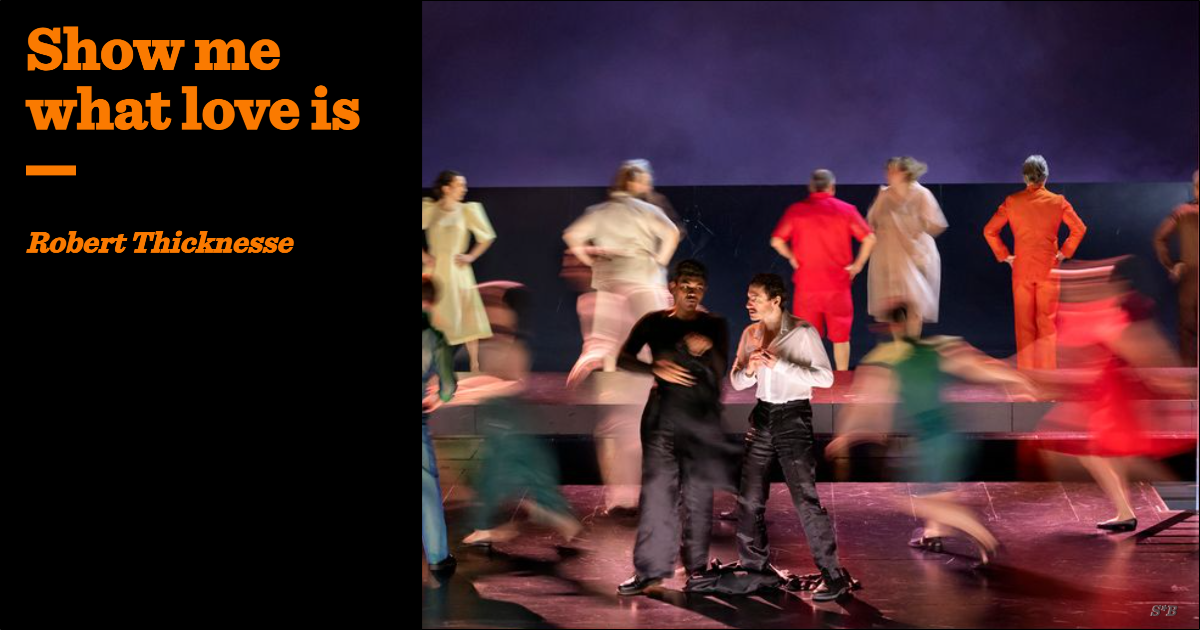
This was in service of a staging that, while thoroughly original and a bit tricksy, actually stayed pretty close to the drama Mozart and Lorenzo da Ponte wrote. It took its cue from a little rejig of the last line: “dei perfidi la morte alla vita è sempre ugual” rendered as “the death of villains is always a reflection of their life” — usually taken as an oddly jokey moral stuck on the end of a drama of much greater import; but Goossens took it literally, turning the stage action into a literal mirror-image of itself, Act 2 unwinding ingeniously backwards in a way that was only occasionally annoying, usually quite funny, and really not stupid at all.
This sense of repetition and circularity set up an interesting contrast with the music, so free and unpredictable. Everyone was stuck in fixed behaviours; someone would charge off stage left and reappear a little later running in from stage right — much to their own amazement. This was a neat metaphor for the general human imprisonment in ourselves, I guess, and added a nice encrypted layer to the action.
But that’s just a gloss on Mozart, however engrossing. This stage action, taking place in the emptiest space, on a raised catwalk or causeway across the stage, with a black or midnight blue background, occasional rather magical wisps and billows of smoke passing through the night (designs by Sammy Van den Heuvel), zeroed everything in on the characters and their very plausible, closely observed interactions — and went a good way to seeking what it is that Mozart (this moral philosopher working in musical notes) is actually driving at.
To which end, it turns out the most important characters are the usually derided Anna (Marie Lys) and Ottavio: a study in human love under pressure, the notion (first aired in Figaro) that empathy is born from sexual love, and can redeem the world. The moment Reinoud Van Mechelen launched the crystalline “Dalla sua pace” over its transparent cradle of strings, everything became clear: this is no milksop, but the absolute moral centre of a universe, identifying the precise thing that Giovanni, despite all the shagging and seductions, has no conception of, and suddenly casting him as the object of pity.
Mozart’s human insights, expressed through a medium of incredible strength and beauty, leave you staggered and choked
That was the key: all the people whose lives are fouled up, disrupted or (briefly) brightened by Giovanni (very engagingly sung by Michael Arivony) actually possess, in different ways, the secret he isn’t even aware he lacks: Zerlina and Masetto share the show’s only sexy moment as she gently seduces him, Elvira’s tormented passion finds some core of value in the frivolous, contingently likeable but basically worthless Giovanni, and Anna and Ottavio share a rather beautiful bond of mutual respect, even worship. Even Michael Mofidian’s yes-man Leporello (another very strong performance) seems to be learning something about life as he watches Anna and Ottavio. Arianna Venditelli’s sad, conflicted Elvira sings the discursive, questing “Mi tradì”, basically working out and nailing exactly what’s wrong with Giovanni (and longing to save him, of course), another of those long moments where Mozart’s human insights, expressed through a medium of incredible strength and beauty, leave you staggered and choked.
There was a great deal more: a really terrific impetus to the long finale of Act 1, a genuine frisson of terror at the end, a strong and growing understanding that the great lover is in truth the one thing opera cannot forgive: the great sinner against love. That, and something I’ve never seen before, though opera does love its animals on stage: a show-stealing turn by a gaggle of handsome chickens ― possibly Brahmas, with extravagantly feathered undercarriage. They wound up in a pot, of course, but the time-reversing magic of the production brought them back to life again, and only Giovanni’s goose was cooked.