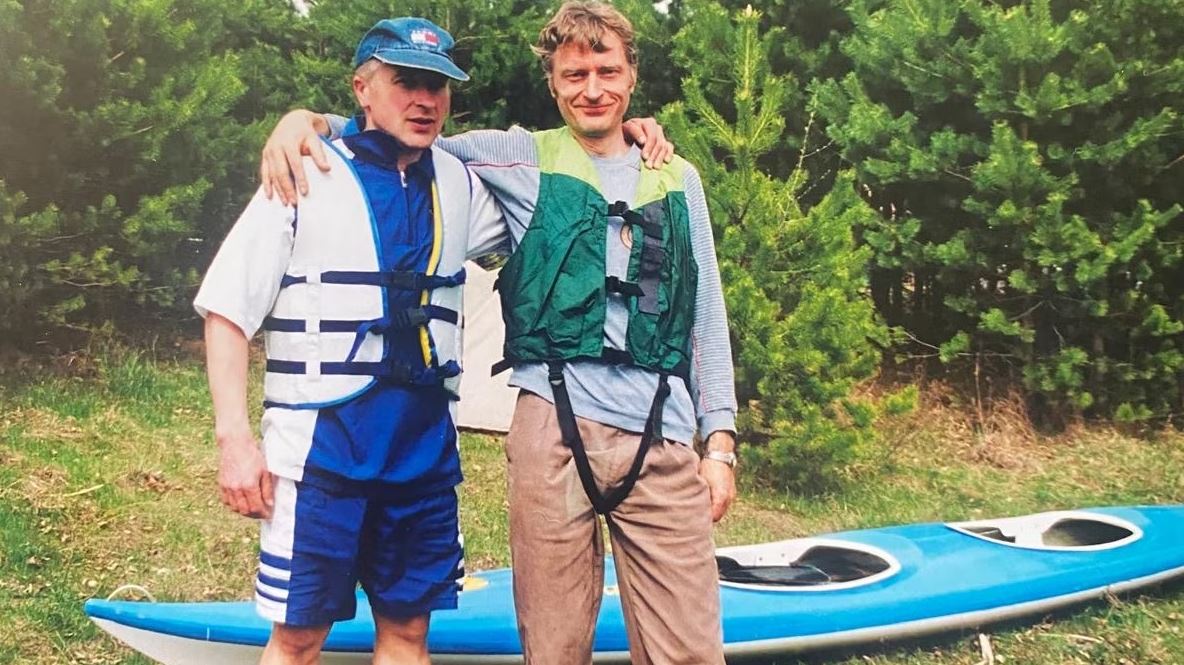
AFTER 20 hours trapped in a cold river in a remote ravine with his leg wedged between two boulders, Valdas Bieliauskas was barely alive.
Attempting the unthinkable to save Valdas’ life, a team of top medics were forced to make a decision to amputate the stricken hiker’s leg beneath powerful white water rapids – with no room for error.
In November 2024, a group of 11 veteran adventurers were five days into an expedition near the Franklin River in Tasmania, southern Australia.
It was the kind of trip they had completed plenty of times before.
Reaching the Great Ravine – a gorge between walls of rock over 1,000ft high – Valdas and his friends moved slowly down the river.
Jumping between two rocks, Valdas lost his footing and ended up in a gulley – with his leg wedged.
Dr Jo Kippax, who was choppered to the scene to amputate his leg, told The Sun: “There was a perfect knee-shaped cavity, and somehow his leg slipped straight into it.
“Valdas would have been in agony, but we’re dealing with a person here who is incredibly tough. He didn’t complain. He didn’t panic.”
Alone in the remote area, his friends wrestled to free the leg for almost an hour using their hands and ropes, but it wasn’t budging. That’s when they put in an SOS call.
Over the next few hours, teams of paramedics, rescuers and police arrived at the scene – all of them winched down on a rope from a helicopter.
They tried every method in their inventory, from pneumatic spreaders to a 6-to-1 pulley system, but everything failed.
As night fell, Valdas didn’t lose hope.
Dr Kippax says: “The efforts continue throughout the night, and Valdas is completely determined. He works with the rescuers all night.”
But with freezing water gushing past his body, Valdas’s body temperature was falling fast.
Dr Kippax said: “Amputation was the only option left. But it had been agreed pretty early on that the procedure was only going to be possible in daylight, so they had to wait.”
At around 7am, Dr Kippax receives the call as he’s loading up the car for a kayaking day trip with his wife and two children.
He was called upon because he’s highly experienced in retrieval medicine – and crucially, because he has training for white water conditions, meaning he can work in the river.
As Jo was making his way to the scene, the medics at the scene suffered another setback.
The leading doctor fell backwards and broke his arm – but kept treating Valdas even with a lopsided wrist.
Dr Kippax says: “I suddenly find myself heading off to remote Southwest Taz in a helicopter, dressed in a dry suit.
“It was a pretty incredible scene when I winched in. The team was operating from a boulder slanting down to a gnarly-looking rapid. There was a constant roar from the river going past us.
“But it was reassuring for me to see a team of people that I’ve worked with for many years, and who I trust implicitly.”
At this point, Valdas was “barely conscious”, and his head was being held up by one of the rescuers to stop him slumping into the water.
After a short scramble, Dr Kippax positioned himself on hand and foot holds.
He said: “Right at the extreme reach of my arm, I could just feel where his knee was trapped.”
Usually, Valdas would be unconscious with general anaesthetic for the amputation – but that wasn’t an option, so the team administered him ketamine.
Amputations are normally carried out with a surgical scalpel – but the positioning is “too awkward” for that to work, Dr Kippax said.
Instead, he pulled out a 10cm serrated bushcraft knife.
Managing to cut away layers of flesh and muscle with the small knife, he then reached for a Gigli saw – a piece of serrated wire specially designed for the job – for the next part of the op.
Then, the wire on the saw broke, Dr Kippax said.
“There was an awful moment when I looked at the intensive care paramedic who was assisting me,” the doctor said.
“He looked back into my eyes and we were both thinking, ‘oh crap, what now? We didn’t have a second one of these things.”
At this point, they had to improvise – Dr Kippax plunged his arm into the water and snapped off the rest of the bone.
“It was a bit brutal, but there were really no other options at this stage,” he said.
The team was forced to improvise when it came to applying a tourniquet – a tight strap that goes around a limb to stem blood flow.
Velcro straps wouldn’t bind in the water, so they bound Valdas’s leg with a cam buckle used for loading rafts.
But it’s the next hour-and-a-half that were the most perilous for Valdas.
As Valdas was hauled up the three-metre cliff, his breathing slowed and eventually, as the team feared, he went into cardiac arrest and his heart momentarily stopped, Dr Kippax said.
“The chance of surviving a cardiac arrest in the middle of town is very low,” the medic said.
“The chance of surviving one in the middle of remote Tasmania is about as bad as it can get.
“When he was completely unresponsive and not breathing, we knew there was only a slight chance of survival. It did look pretty grim, it looked pretty hopeless.”
It was now a race against time to transport him to hospital to give him any chance of survival – and the fact Valdas is severely hypothermic made the situation better, Dr Kippax said.
Strapped into a stretcher and winched up into the helicopter – all while on a ventilator, a mechanical CPR device and various infusions – he was taken to Hobart hospital.
Dr Kippax says: “This was an incredibly technical phase. It’s something that as a service we’d never attempted before, winching a ventilated patient up like that.”
The chopper ride was around 45 minutes and, as his body temperature increased, Valdas started to regain consciousness.
Dr Kippax visited Valdas multiple times during his recovery in hospital – and they shared a unique bond that can only be forged under the pressure of a near-death experience – even if they were on opposite sides of it.
Valdas’s reaction to his new reality with one less leg was the affirmation that “life is beautiful”, Dr Kippax revealed.
“He’s an amazingly resilient person, he’s just unfailingly optimistic,” he said.
Valdas spent two months in hospital in Hobart before becoming well enough to fly back to Lithuania – where Dr Kippax later visited him.
“It was pretty wonderful to see him,” he said.
Now, more than a year after his incredible rescue, Valdas told The Sun that his strength is “returning very slowly”.
He tells The Sun: “Only now after a year I feel that my body is recovering near to its condition before the accident.
“I have a prosthetic leg with latest model of hydraulic knee joint from Ottobock.
“On YouTube, I found a Ukrainian man with a short limb after an above-knee amputation similar to mine and the same knee joint model, who learned to walk in three months.
“I have walked every day for one-and-a-half months with elbow crutches, and believe that one day I will no longer need them. So far, I can only take a few steps without crutches.”
For his part in the job, Dr Kippax was awarded Australian of the Year for Tasmania 2026, and could go on to win the national competition.
But he is absolutely clear that his role was just one small part in a much larger huge team effort – for which dozens of people deserve credit.
He says: “This was definitely the most complicated job I’ve ever been a part of. It’s amazing when a job like this goes well.
“It requires everyone’s skill, amazing teamwork, and very fluid leadership.
“You’ve got someone who’s trapped by the leg, facing cardiac arrest, and they’re four days walk from anywhere.
“It’s pretty unfeasible that someone would survive. It is thanks to a pretty incredible bunch of colleagues and agencies that worked together so well on the day.”
Giving a sense of just how difficult the rescue was, Dr Kippax explained that a complicated job will “often require two, three or four winch cycles”.
The incredible Franklin River rescue needed 57.